

Bad Bets
Our sad, sudden surrender to sports betting was a long time in the making.

Few social changes have come with the swiftness and lack of opposition that mass gambling liberalization has. As recently as 2017, most forms of wagering were forbidden or heavily regulated at the state level. But the moral force behind such regulation had long since collapsed; the Supreme Court in 2018 gave the rotten edifice of anti-gambling law a final and apparently decisive kick by overturning the 1992 Professional and Amateur Sports Protection Act (PASPA), which had frozen the spread of state-level sports gambling legalization. A 2022 Pew Research study found most Americans indifferent in the face of broadly legalized sports betting, with almost one in five adults saying they had actually placed bets in the past year.
This apathy is of fairly recent vintage. A lively 1998 collection titled Legalized Gambling gathered nearly two dozen essays from social scientists, lobbyists, and right-of-center pundits. Some hailed liberalization as a blow against the meddling nanny state, but others expressed concern about the unintended social and economic consequences of allowing what is conventionally regarded as a vice industry to operate without regulation. Between then and now, something happened to American moral sensibilities, and these unresolved questions stopped being of much interest.
But in recent years people have noticed that there’s an awful lot of gambling, specifically sports gambling, going on. In the Saturday Night Live sketch “Rock Bottom Kings,” the leering degenerate played by Shane Gillis touts a new betting app in which people can wager on when their gambling friends will hit financial and personal embarrassment: “With Rock Bottom Kings, you feel like you’re in the game. The game of your friend versus his horrible demons.”
Some social revolutions are propelled by state power: metricization in Britain, gay marriage in America. Some are wholly private: the normalization of tattoos. Most are somewhere in between—an existing trend receives sanction from the state and feeds off it. The fortunes of vice industries usually fall into this last category: Cannabis legalization followed years of growth in cannabis use. Sports gambling has followed this mixed push-pull path, whereby a complex of existing interests—illegal and quasi-legal bookmakers, media and entertainment concerns, friendly politicians, and most notably professional sports leagues themselves—pushed forward one of the past decade’s most distinctive innovations in American living.
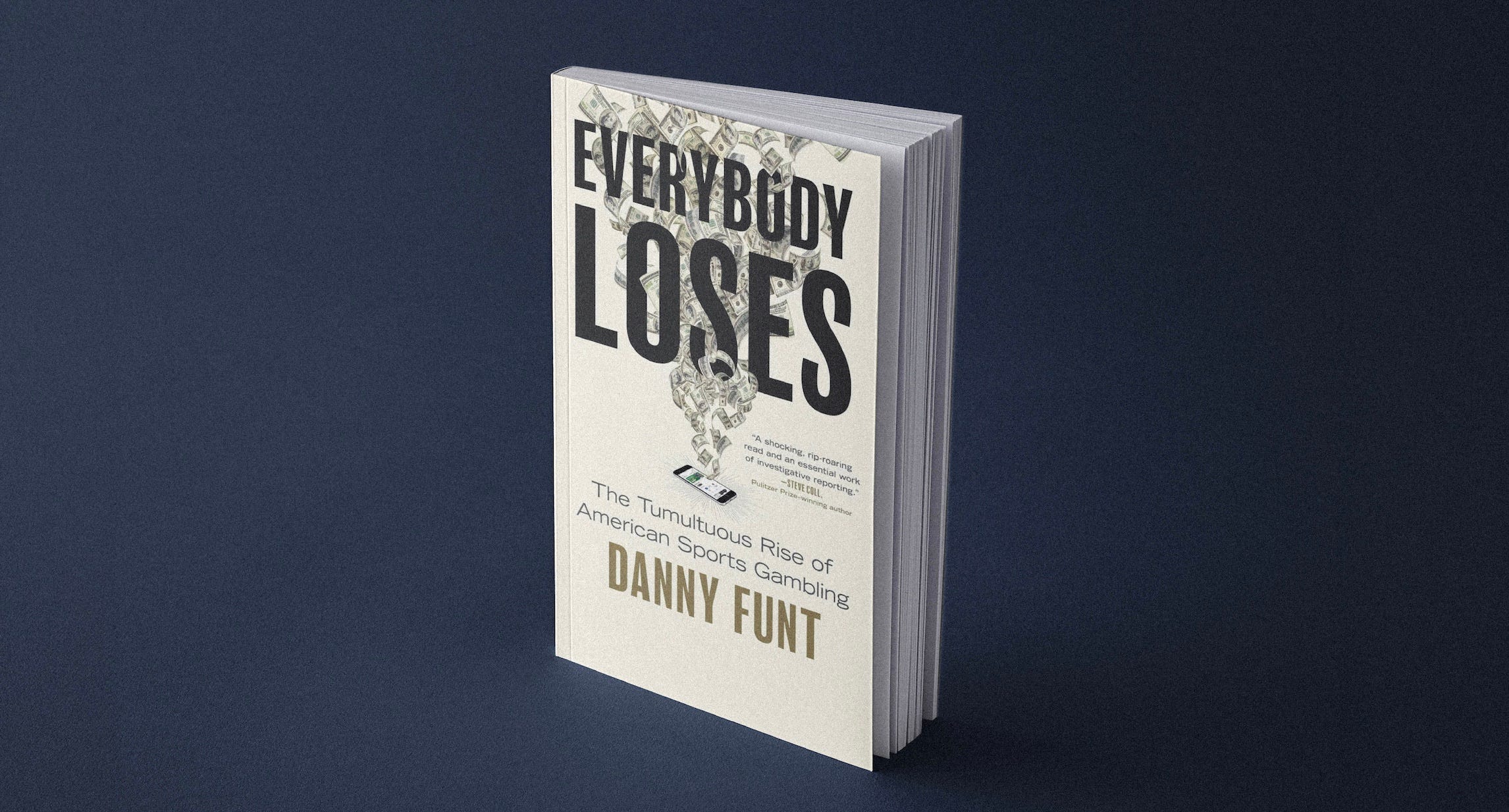
The sportswriter Danny Funt has taken an admirable crack at unraveling the tangled skein. Everybody Loses: The Tumultuous Rise of American Sports Gambling is one of the first efforts to track the explosion in sports betting since the overturn of PASPA. (The other is Jonathan Cohen’s Losing Big: America’s Reckless Bet on Sports Gambling.) Funt, a contributor to the Washington Post, has taken great pains to try to get the whole story as it stands, and the result is thorough and engaging. In his reporting, he lands remarkable interviews with sports officials, lawmakers, and (most valuable of all) industry insiders and lobbyists. Everybody Loses is the closest thing to a full picture of the recent history of sports betting.
Following some background on the traditional enmity between organized sports and organized gambling in the United States, Funt’s real story begins with the birth of illegal offshore sportsbooks in the early internet era, followed by the gray-market expansion of daily fantasy sports (DFS) into the American market. DFS, which allowed users to make predictions about daily outcomes rather than putting together a season-long campaign as in traditional fantasy sports, were seen as kissing cousins to traditional sportsbooks—and, sure enough, after PASPA was overturned, the DFS giants FanDuel and DraftKings immediately became the leaders in the American sports betting market.
While aspects of the push against PASPA have already been treated at length, Funt finds fresh material and brings a critical (if not quite hostile) eye to the pro-gambling campaign. One of the most persistent arguments presented by the gambling liberalization side is the idea that broad legalization will bring the money out of a huge, sinister black market and into the open where it can be regulated and taxed. (This is, of course, very similar to every argument for social deregulation ever forwarded—drug decriminalization, the relaxation of laws against abortion, the ongoing push to legalize prostitution. Somehow, though, the people who push these lines don’t like it very much when you actually get around to regulating or taxing these activities.)
The American Gaming Association, the country’s largest gambling industry group, claims $150 billion of betting in the shade. In an influential 2014 New York Times op-ed pushing for legal sports betting, NBA commissioner Adam Silver alleged that up to $400 billion was being bet on black market sportsbooks. If it’s happening anyway, it may as well happen legally and with protections for gamblers, right? (And if it helps state treasuries and struggling sports leagues a little, that doesn’t hurt either.)
But it turns out numbers that look like educated guesses are more guess and less education. A New York Times report found that Silver’s number was based on a 1999 study that cited an Associated Press article’s quotation of one of the study’s own panelists saying that there was between $80 billion and $380 billion wagered on sports illegally each year. The commish took the top of the range and added a little to make a round number. This thin gruel also backs the AGA’s number of choice, Funt finds: “So, how did the AGA reach $150 billion? I asked a spokesperson, who replied, ‘We took the most conservative end of that estimate ($80B) and applied GDP growth to it to come up with a reasonable estimate for 2018.”
Koleman Strumpf, an economist at Wake Forest University who researches illegal sports gambling, is blunt: This estimate is “no more accurate than our guess as to the weather a hundred days from now,” he tells Funt.
“What is done instead is to take an old estimate that is literally based on a flippant guess from a quarter century ago, then update it to the present assuming it grew at the same rate as the rest of the economy,” Strumpf adds. “In short, garbage in, garbage out.” This kind of sleight of hand is characteristic of pro-gambling rhetoric, which has as its foundation the theory that massively expanding access to an activity will reduce the social harms from it.
Everybody Loses is remarkably dynamic, which is no mean feat—descriptions of the technical side of gambling tend to be roughly as interesting as instructions on how to maximize your income tax exemptions. Policy researchers and fellow journos might wish that Funt had used a fuller citation format and included a bibliography, but for the general reader this concession to readability is well worth the price. Funt is an engaging writer; his account is sprinkled with enjoyable table talk in the footnotes. (On a meeting of DFS executives and their New York lobbyist: “During dinner, none other than Pete Rose came by their table. There they were, desperately working to convince the country that they weren’t offering sports betting, and one of the most notorious gamblers introduced himself and said, ‘Hey, if anyone knows sports betting, it’s me.’”) At the same time, he addresses angles that are obvious but largely neglected in American reporting on gambling—for example, the extensive research on negative social externalities following the United Kingdom’s legalization of online sports betting in 2007.
Rarely does Funt fall into trivia recitation, the classic stumbling block of sportswriters; this makes the lapses more noticeable. While talking about gambling interests’ capture of the sports press and media, Funt spends ten pages on the recent career of Bill Simmons, the sports media personality and gambling enthusiast, including a partial transcript of one of Simmons’s podcast episodes. Appended to this is some editorializing about how Simmons has fallen off as a writer and commentator since he became primarily a gambling-sponsored podcaster. This could have been a page; as written, it feels otiose and strangely vindictive in a book that is generally fair-toned in its treatment of the pro-gambling side.
But these lapses are rare. Nor are there many places where the general reader feels short of information; Everyone Loses covers all the angles, from addiction to sports corruption to economics to the prospects of regulation or legislation. It is, in itself, a complete picture.
However, the picture fits into a larger gallery of changing American mores and morals. Funt notes that opposition from religious groups to sportsbook liberalization was muted, a fact that he attributes to relatively permissive modern social mores and the fact that many churches have bingo fundraisers. The expectation that organized religion is the bulwark against gambling, for good or ill, still runs pretty deep in America.
Once, after a miserable evening in which I debated in favor of the proposition that all sports gambling should be banned outright, a hypothetical policy on which I am unpersuaded, an audience member came up to me and asked whether I was “really Christian or something.” It was unimaginable to him that someone would want to tamp down on all this without some sort of deep pre-rational conviction.
Funt’s offhand speculation is perhaps a touch simplistic, though; it is simply more difficult to articulate why gambling is pernicious than it is for other vices. It won’t fry your brain the way PCP will, it doesn’t encourage human trafficking, it won’t give you cancer, it won’t make you fat. Unlike abortion or the sex trade, it doesn’t directly touch anything discussed in the Ten Commandments. Prohibitions on intoxication flow easily from scripture or scholastic theology, depending on your tastes. I’m ambivalent about gambling’s inherent nature myself.
Yet it is difficult to shake the sense that there is something to do with morality at play here. There is a clear sort of coarsening that accompanies gambling, something akin to the dysfunctions David Foster Wallace attributed to the tyranny of television—a commoditization of sporting entertainment, the transformation of something basically about a kind of human excellence into something basically about money, and an effort to bang the dopamine receptors a few more times per hour.
Funt interviews Nik Bonaddio, FanDuel’s former chief product officer, who has a curious comment about young people’s betting habits, particularly their affinity for long-shot parlays:
When I look at the eighteen-to-twenty-five audience, there is a remarkable level of what I would call financial nihilism,” he told me. “If you sort of pull that string a little bit, it has tentacles into income inequality, into the rise of housing prices and sort of the non-affordability of the American dream right now, into existential concerns about climate change, and a whole host of other things. And so when you talk to that cohort, there’s this real level of nihilism, which is like, ‘What does it matter? If I lose $5, who cares?’ And it translates into them disproportionately betting these 100-to-1 or 1,000-to-1 parlays—disproportionately searching for very high upside outcomes because, in their mind, that’s the only way for them to escape.
By this telling, gambling falls in the same category as financial speculation and the pursuit of social media virality—an eschewal of the normal modes of American prosperity in favor of trying to get hit by a golden bullet.
This looks like a bad symptom, if social stability is something you care about. When Gertrude Himmelfarb wrote about the “de-moralization” of society in the mid-1990s, she was playing with this very idea—that vice and discouragement go hand in hand. Hemmelfarb analyzed it as both a symptom and a cause of the further empowerment of the state and its encroachment of American daily life. In an editorial for my own magazine some years ago, Helen Andrews put the matter somewhat more bluntly. “The health of the whole society rests on the ability of ordinary parents to instill in their children the self-control necessary to resist modern life’s little temptations,” she wrote. “Otherwise, free citizens will degenerate into subjects and clients. Vices and republican virtue cannot both thrive.”
With this in mind, perhaps the most striking episode occurs early in the book. Kamala Harris, then California’s attorney general, in 2015 was considering a cease-and-desist letter to DraftKings and FanDuel for violating anti-gambling laws in the Golden State, which was then the largest DFS market. The companies feared that such an order would set off a cascade of actions in other states. But Harris’s chief of staff at the time, Nathan Barankin, was married to a lawyer whose firm was representing those companies; some behind-the-scenes persuasion seems to have occurred, and the cease-and-desist was never issued. Harris became senator and then vice president, and the sportsbooks became legal. A rising tide lifts all boats.
 | A guest post by
|
Interesting examination of that grey area that is immoral but not illegal.
For a long time I’ve thought that we have too many laws and not enough morals, but I think legalization of sports betting was a big mistake.
The real problem is, of course, the insatiable desire of most governments / politicians for more and more money to spend / control / launder. Taxation is not something that should be decided by our representatives without direct citizen concurrence.
Ok, a book review. As a worker oriented progressive I am virulently opposed to on-line betting. In person betting has inherent social controls, whereas on line betting does not. I'm personally against gambling in general, but I recognize some forms are less harmful than others. I don't believe outright bans of gambling are reasonable morally or practically. But a simple analysis of who benefits and how, should result in the clear perception that the online platforms win and the public writ large loses. The overall winning has to be less than overall losing plus profit to the platforms. It's not an even trade. And what is the utility of gambling on sports, or now, nearly any event? Entertainment? Like meth use is entertainment? There are far better entertainments available, many that actually improve ones life rather than degrade it.
The whole mentality of getting something for nothing as an activity or enterprise is based in avarice and sloth. Work and productivity are honorable and have value. Gambling is the opposite of that. On the other hand, the author notes a nihilist explanation which has a nice narrative ring to it. If that is true for a substantial set of dupes, should exploiting despair be something we allow and promote? What about all the hand-wringing over the fecklessness and lack of direction of young men? Gambling helps that problem? Prostitution is largely an occupation born of despair and hopelessness. We don't promote that. Why would we allow gambling if it is driven by nihilism?
I sound like a religious prohibitionist. I'm far from that. But I am very much in favor of policy that promotes the well-being of the working class. The main supporters of legalized online gambling are big money interests, not workers' interests. I oppose both Trump and Harris because they are both tainted by big money corruption. I resent the last section of the book review in its indictment of Harris as somehow the cause of the online gambling scourge. As I just said I actively oppose Harris. But to imply online gambling is a democrat sponsored vice is unproductive and dishonest. Legalized gambling is most closely associated with Libertarian ideology. That has completely usurped actual conservative ideology in the Republican party. It is exercised behind the scenes by the elite in the Democratic party. Of course that is the very reason the Democratic party is so reviled. But big money and greed has been the literal Republican Brand forever. Trump put a new style spin on it but practically speaking it's big business as usual. Thus, legalized online gambling gone wild.
People need to recognize, explicitly and clearly, that Wealth is Power. Extreme wealth is extreme power to impose what ever it wants on the hoi poloi. Voters don't set the rules voters live by. Big Money does because it has corrupted the parties, politicians and the courts. Online betting, like so much else, was imposed on citizens by the power of extreme wealth. Trump's so-called populist movement is a sham. It is more accurately described as a manipulative Big Money driven cult of personality headed by a profoundly multi-dimensionally defective man. A genuine populist movement devoted to the betterment and security of the working class and the fairness of our economy and politics could be a great thing. It would of course be genuinely disruptive in a good way, as that is the opposite of what we currently live in. Since I don't see that kind of popular groundswell yet, I'm not betting it.