


Editor’s note: This is the first piece in a series about restoring faith in elections ahead of the 2026 midterms.
“Defending our democracy” is one of those political catchphrases that voices on the Left, from the Washington Post to nonprofits like the Southern Poverty Law Center, banter about regularly. But amid the unending suggestions that “modern-day populism” or whatever President Trump is doing today threaten the American project, a more serious problem lurks: Americans of all political stripes are losing faith in the elections that give form to our democratic republic.
Liberal Americans point to supposedly unfair redistricting and the prospect that immigration officers or other Trump-related threats will undercut turnout. Conservatives cite fraud and nefarious counting tactics, particularly in blue cities. Overall, fully one-third of Americans believe that voter fraud is “the single biggest threat to keeping elections safe and accurate,” according to a PBS/Marist poll released in March. The takeaway is clear: Americans no longer believe that, as Abraham Lincoln put it, “elections belong to the people.”
Regardless of how much fraud or abuse can be proven, the truth is that the mere appearance of foul play constitutes a national crisis, one that could prove disastrous if not remedied. Luckily, there’s a simple—and historically grounded—answer to this problem: restoring Election Day to its original understanding.
History Repeats
Falling trust in elections isn’t a new problem. Until the mid-1800s, individual states set their own election timelines and were required only to schedule their votes within a 34-day window set by Congress. The loose rules created chaos, chief amongst them concerns around voter fraud, which eventually came to a head in the 1840s. As members of the House of Representatives argued in 1844, reform was needed “to guard against frauds in the elections of President and Vice President.” Sound familiar?
There were also concerns about early voting and how those returns could undermine turnout and even shift voters’ decisions in states with later elections. The advent of the electric telegraph also meant that earlier voters would be deprived of new information about events and candidates in an increasingly connected country.
To allay these concerns, Congress in 1845 passed what has come to be known as the Presidential Election Day Act to “establish a uniform time for holding elections for members of the House of Representatives, and for electors of President and Vice President, in all the States of the Union.”
The spirit of that law governed U.S. elections thereafter. “For nearly two centuries, Americans understood elections to be events conducted on a single, defined Election Day,” Trey Trainor, a former commissioner of the Federal Elections Commission, explained to me. “While absentee voting existed in limited circumstances, widespread post-Election Day ballot collection and counting was not the norm. That expectation gave voters confidence that everyone was participating under the same rules and within the same timeframe.”
As news headlines and polling suggest, that trusted practice has largely collapsed. So too has confidence in elections.
A University of California San Diego poll conducted earlier this year found that only 60% of respondents “are confident votes will be counted accurately nationwide in the 2026 midterms,” a drop of 17 points from 2024. That pattern holds across age, demographics, and political party. Confidence was down 17% among Republicans, 13% for Democrats, and 16% across independents.
The findings reflect a broader theme. The aforementioned PBS/Marist poll from March found that only two-thirds of respondents were “confident their state or local government will run a fair and accurate election,” representing “a drop of 10 percentage points from the month before the 2024 presidential election.” That this decline occurred in the past two years makes clear that what’s concerning voters isn’t about hanging chads or January 6th. Younger voters are even more disenchanted: April’s 2026 Harvard Youth Poll found that “only 33% of Americans ages 18 to 29 believe that the 2026 midterm elections for Congress will be conducted fairly and accurately.”
The recent shift away from in-person voting feels dramatic to the electorate because it is. As late as 1996, about 90% of voters cast their ballots in-person on Election Day. Since then, individual states have slowly chipped away at electoral safeguards, undermining both the institution and public faith therein: making it easier for voters to get an absentee ballot; loosening rules about how those ballots are submitted; extending timelines for when ballots could be accepted; and more.
The COVID-19 pandemic broke voting open. Nearly a year after “15 Days to Slow the Spread,” nine states and the District of Columbia mailed absentee ballots to all registered voters regardless of whether or not they requested one; 11 states eliminated the need for an excuse to vote absentee; and 18 states (plus D.C.) allowed votes to be counted even if they were received after Election Day. Those legal changes shifted the way Americans cast their ballots, making mail-in voting the most popular method in 2020.
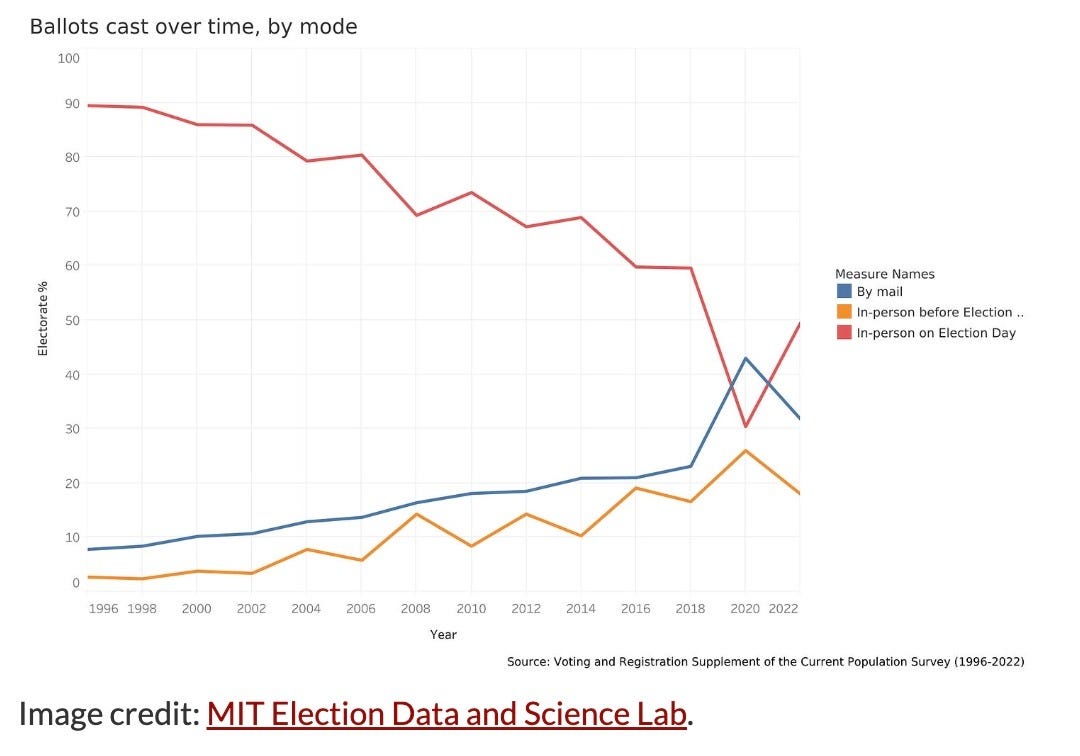
In most cases, these “temporary,” lockdown-induced fixes—meant to allow voters to safely get to the polls during a pandemic—have remained on the books in the years since it ended.
In the wake of COVID, the continuation of these efforts were promoted as “voter rights,” and efforts to sunset them derided as “voter suppression,” as if the ability to choose the nation’s leaders without putting on your shoes was God-given. Opposing an ever-easier path to voting was branded “Jim Crow 2.0” by Democrats and the legacy media, allegedly meant only to stop black voters.
But the erosion of Election Day voting has created an untenable system.
Take, for example, this year’s California primaries. It took a full week to determine the outcome in the governor’s race; in fact, as of early July, numerous counties still haven’t reported their official results. California now provides mail-in ballots for all residents—which can be accepted up to a week after Election Day—and rather than backing off following the pandemic the state has layered on additional levels of bureaucracy.
For some perspective, many less-developed countries are able to count votes far faster. Colombia held its presidential election on Sunday, June 21; 99% of the vote had been counted by the next morning.
That California, a state with the GDP of Japan, takes multiple weeks to count votes will naturally give rise to the same types of concerns that motivated Congress in 1845. No amount of finger-wagging about the low rate of voter fraud convictions will cause ordinary Americans to look the other way when a country like Colombia counts votes in a matter of hours while California takes a month.
Rediscovering the Wisdom of 1845
Given the Supreme Court’s ruling that Mississippi and other states can count ballots received after Election Day so long as they are postmarked by that date, Congress will need to act, using powers vested in the legislature under the Constitution’s Article 1, Section 4 and Article II, Section 1, Clause 4. The former clause reads that (emphasis mine), “The Times, Places and Manner of holding Elections for Senators and Representatives, shall be prescribed in each State by the Legislature thereof; but the Congress may at any time by Law make or alter such Regulations, except as to the Places of chusing Senators.”
Amid the stalemate over the SAVE Act, Congress could address voter concerns by requiring that all states hold their elections on a unified date, clarifying the Presidential Election Day Act of 1845 by codifying a uniform timeline for voting. While states are often seen as the masters of their own elections, federal law sets national standards that states must obey.
Restoring Election Day to its rightful place as a day of national obligation would also address other voter concerns.
Along with erasing concerns over late votes, it would also eliminate concerns over illegal ballot harvesting and election drop boxes. Other commonsense and broadly supported measures that could be tacked on include requiring that voters provide ID, a rule that 84% of Americans across party lines support, and something that in-person voting makes easy to put into practice.
Targeted exceptions for those who truly can’t get to the polls—the homebound, soldiers serving overseas, etc.—can be provided in a limited fashion and for legitimate reasons, as the term absentee implies.
If this suggestion feels radical, it’s worth asking why so many of these alternatives to regular voting exist in the first place. With COVID over, why do states still mail out ballots to everyone? Why don’t you need an ID of some kind to vote, when you do need one to enter a bar or buy cough syrup? Why do we allow early voting to begin with, given everything a voter can learn about a candidate in the months before Election Day?
American democracy already asks so little of its citizens. Asking voters to get out of bed one day a year and head to a polling place is a small price to pay for restoring faith in the legitimacy of elections.
At the moment, more than one-third of Americans are skeptical of how our elections are conducted, and these same voters, from across the political spectrum, desperately want someone to offer a better path forward. Rather than tilt at political windmills, elected leaders would be wise to grab an opportunity clearly spelled out in the letter of the law, and put muscle behind a solution to election concerns nearly as old as the nation itself.
Why not make it a federal holiday? Aside from all essential workers, no business can open on election day until after 3pm. You are guaranteed that 95%+ of the voting population can make it to the polls then, which will eliminate the necessity for early voting and/or mail in voting aside from those essential workers and anybody stuck overseas. I think it's a bit conceited to think that people are using these other mechanisms because they are lazy or part of some fraudulent scheme. You point to 1996 as some grand achievement, meanwhile, only 51.7%* of the VEP (voting eligible population) turned out and only 51.7% of eligible voters made it. Let's make it easy for everybody to vote on one day and then we can eliminate most of the other mechanisms that have been used to increase voter turnout.
*https://www.presidency.ucsb.edu/statistics/data/voter-turnout-in-presidential-elections
I think the issue I have with the argument is that it conflates the right and left objections to electoral foul play. The right tends to point to assertions of fraud and the left points to voter suppression. Moving to Election Day-only voting could allay the concerns on the right — maybe — but will smack of further suppression on the left. Making voting less convenient is not a way to increase voter participation or inspire voter confidence. It would do the opposite.