


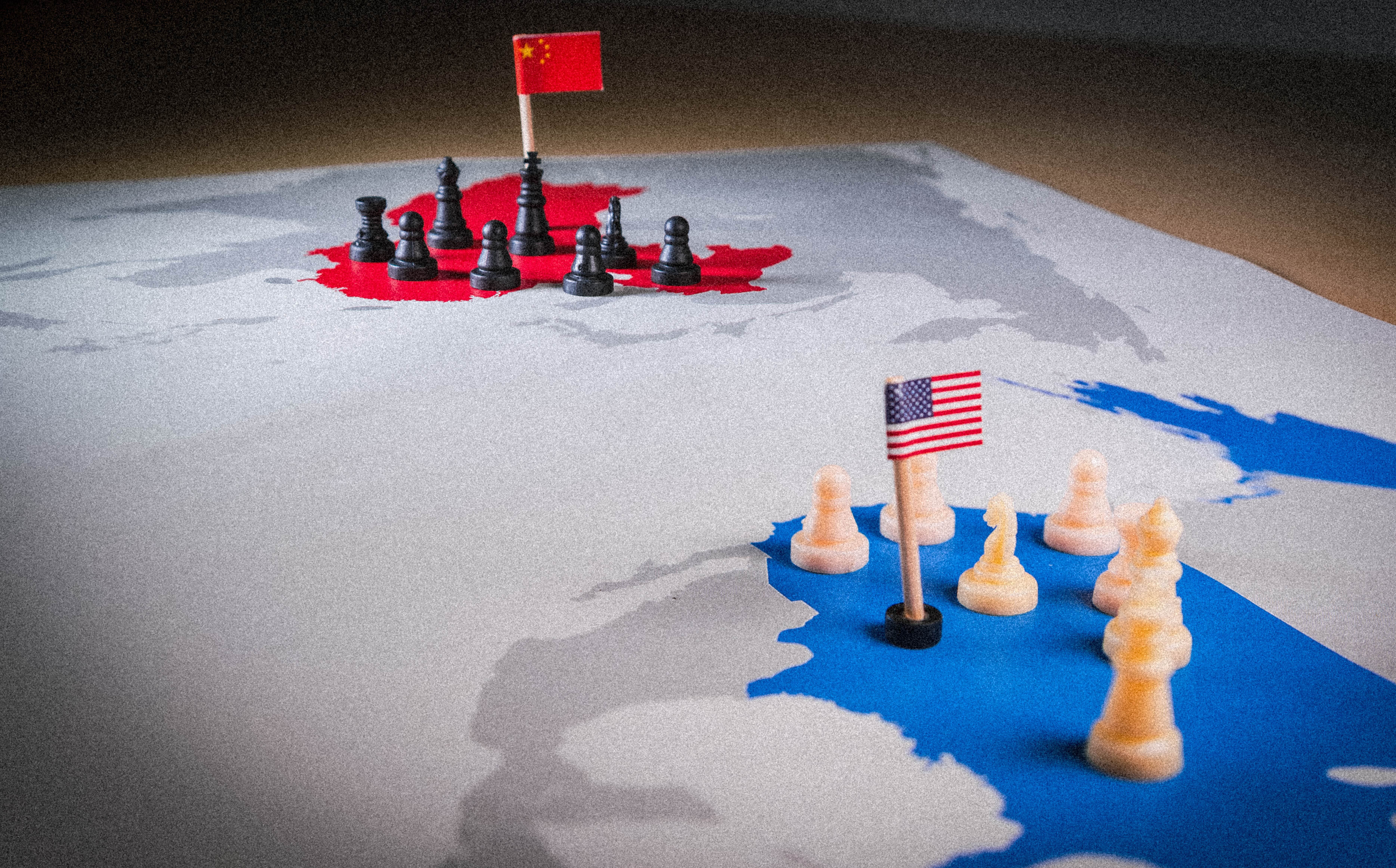
There is a vulnerability at the heart of the U.S. economy so profound that it imperils our national sovereignty, and most Americans have no idea that it exists.
The public is well aware of China’s manufacturing dominance, which exceeds that of the United States, Europe, and Japan combined. The scale is alarming, yet it is not the real danger. The deeper, more insidious vulnerability is that China has secured control over a narrow set of manufacturing chokepoints that the entire U.S. industrial base relies on to function.
Economies are complex systems, and complex systems fail at their bottlenecks. This is what systems theorists call a reverse salient—a critical, rate-limiting node that constrains what the larger system can produce. A system can often absorb the loss of non-critical parts, but the loss of essential hubs creates cascading failure across the entire network.
Critical minerals are the most consequential reverse salient in the American economy today, underpinning nearly every essential industrial process. China does not merely dominate these sectors; in many instances, it maintains near-total control.
For years, Washington viewed the decline of domestic industrial capacity as an unfortunate but acceptable byproduct of globalization. The prevailing logic was rooted in the principle of comparative advantage: If another nation could produce an input more cheaply, the United States was better served by importing it and focusing capital on higher-value activities. But this framework implicitly assumed that all market participants were optimizing for economic return. Beijing was optimizing for control.
America looked at industries and asked how profitable they were. China asked how important they were. Where Washington saw dirty, low-margin, old-economy businesses, Beijing saw strategic chokepoints that would grant leverage over vast downstream sectors. It secured that control with subsidies, preferential treatment, lax environmental rules, and a willingness to accept returns no private Western investor would tolerate.
China’s dominance may not have begun as a grand design. Some of it grew out of ordinary industrial development and Western indifference. But it did not remain accidental. Beijing’s own industrial plans identify rare earths, tungsten, lithium, graphite, and other special resources as strategic materials that need to be controlled for strategic benefit, such that any disruption constrains the entire economy.
Beijing is already using its supply chain dominance as a lever for economic coercion. Targeted export controls on rare earth products, such as those that forced the temporary closure of Ford’s Chicago plant, demonstrate the cost that Beijing can impose.
In peacetime, this dependence creates friction. In the event of a full-scale conflict, it could dictate the outcome of the fight.
The Reverse Salient in Action
The popular lesson of twentieth-century great-power conflict is that military power is downstream of industrial capacity. The side that produces more ships, planes, tanks, and munitions will sustain a long war. That lesson is true, but it is incomplete. The more precise lesson is that industrial might only matters if you control the inputs that allow it to operate.
The Axis powers did not lose World War II simply because they lacked overall industrial capacity. They lost, in part, because their military rested on inputs they could not secure. As Daniel Yergin details in The Prize, the outcome of the conflict was fundamentally shaped by supply chain reverse salients that forced nations into catastrophic strategic decisions.
China learned this lesson, and decided to be the one controlling the chokepoints.
The United States thinks about industrial power in terms of aggregate capacity. China thinks more like a systems engineer. What are the upstream dependencies? Which inputs are hardest to replace? Which nodes, if controlled, can slow everything else down?
The U.S. now risks falling into the same trap that constrained the Axis powers. After decades of offshoring, the modern American economy is exposed, limiting how hard Washington can push on trade, sanctions, technology controls, and military deterrence.
For decades this was a competition China knew it was fighting and the U.S. largely ignored. That has changed. The Trump administration, governed by the conviction that economic security is national security, is working to rectify these reverse salients.
Once you see the world through reverse salients, many seemingly separate policies start to look connected: securing mineral supply chains, rebuilding defense production, expanding allied industrial capacity, increasing energy leverage, and denying rivals control over strategic chokepoints. They are all part of the same race to restore America’s leverage and build pressure points of its own.
From Diagnosis to Action
When President Trump entered office for his first term, the United States did not even have a clear map of its vulnerabilities. The initial task was diagnosis. In 2017, Trump signed Executive Order 13817, which formally defined critical minerals, declared supply chain vulnerability a federal priority, and directed agencies to identify America’s most critical exposure points. This was a necessary first step, because dependencies must be identified before they can be addressed.
Mapping those vulnerabilities cleared the way for the second Trump administration to move to action. Over the past year, it has pursued the most aggressive critical minerals policy effort in modern American history.
In the United States, it takes an average of nearly 29 years to bring a new mine from discovery to production, the second longest timeline in the world. To tackle this issue, the administration has taken a series of executive actions to speed up permitting and simplify approvals.
The One Big Beautiful Bill Act carved out dedicated, mandatory funding specifically for critical mineral extraction, processing, refining, and infrastructure. It set aside $5 billion for direct investment, $3.3 billion for purchase commitments, contracts, and grants, and $2 billion for the National Defense Stockpile. The administration has organized this effort across the federal government, assigning each stage of the bottleneck to the specific agency best equipped to handle it.
According to data compiled by BMO Capital Markets, the government has announced roughly $18.6 billion of committed and conditional financing across approximately 60 critical minerals projects. Most of that support has come through loans and loan guarantees, with a smaller amount coming through grants and equity investments.
And that’s just the tip of the iceberg. BMO estimates that the total available funding capacity for critical minerals reshoring runs into the hundreds of billions, most of which has yet to be used. Nearly $4.5 billion remains in the OBBBA’s direct investment pool, only $850 million of the loan capacity backed by its credit subsidy has been drawn, and the purchase commitment authority remains largely untouched.
From Architecture to Deployment
With the financing architecture in place, the next step is deployment.
The first wave of projects reveals a clear administration priority to target minerals and processing with defense-related chokepoints. Rare earths lead at $6.3 billion, followed by zinc ($4 billion), graphite ($3.5 billion), and tungsten ($1.9 billion).
The rare earth supply chain is the clearest case of the problems the administration must solve. Rare earths move through several stages before becoming finished components. The process begins with mining ore, which is then crushed and upgraded into a more valuable intermediate material called concentrate. That concentrate then has to be chemically separated into individual rare earth elements, refined into oxides or metals, and finally manufactured into usable components. The crucial end product is the neodymium-iron-boron permanent magnet, a high-strength magnet used in electric motors and other advanced equipment.
The United States isn’t simply trying to increase mining, which in many ways is the easiest step to solve. The harder part, and the part China dominates, is the ability to refine the ore, process it, and turn it into permanent magnets. China accounted for 60% of rare earth mining in 2025, but more than 90% of separation and refining, and 94% of magnet manufacturing. In heavy rare earth separation (the dysprosium and terbium that high-temperature magnets require) Beijing’s share approaches 99%.
A mine won’t reduce dependence if the material still has to be shipped to China for processing into the components that a missile, fighter jet, electric motor, or data center actually uses. Thus, the Trump administration’s task is to reshore the missing links.
MP Materials remains the definitive case study for the new U.S. industrial playbook. Historically, 60-70% of the rare earth concentrate MP mines was shipped to China for processing. But after Beijing implemented export restrictions in 2025, MP was forced to run in-house separation at its Mountain Pass mine.
The Department of War’s July 2025 agreement with MP included a $400 million equity stake, a ten-year price floor of $110 per kilogram for the company’s neodymium-praseodymium oxide, and a ten-year agreement for the government to buy the entire output of MP’s planned 10X magnet facility. The Office of Strategic Capital also issued a $150 million loan to add heavy rare earth separation, a move clearly designed to attack China’s 99% chokepoint. Those commitments helped pull in $1 billion in additional private financing to back the project.
A separate deal with a company called USA Rare Earth showcases the same strategy. USA Rare Earth has commissioned magnet production in Stillwater, Oklahoma, and is developing the Round Top deposit in Texas to supply heavy rare earths and gallium—both of which Beijing uses as a reverse salient.
Taken together, these projects are a real start, yet they remain small relative to the global market. MP only began manufacturing permanent magnets in December 2025. Its Independence facility is designed for roughly 1,000 metric tons of annual magnet capacity, with production ramping up gradually. Under the DoW agreement, MP is expected to expand Independence to roughly 3,000 tons annually and build 10X, a second facility that would bring total U.S. magnet capacity to about 10,000 tons per year. That would be a major step, but still small compared with China’s existing dominance over the global magnet supply chain.
Beyond rare earths, the strategy extends to downstream nodes like KoreaZinc’s planned Tennessee smelter, which received a $1.4 billion government-backed investment and $2.15 billion loan facility alongside a $210 million CHIPS Act grant. Along with zinc, the smelter is expected to produce or recover copper, antimony, gallium, germanium, indium, bismuth, gold, and silver. This is an ideal project that relieves several bottlenecks at once.
Despite this progress, significant gaps remain. The development of minerals including antimony, nickel, cobalt, tantalum, and tin remain underfunded. Once those are addressed, the U.S. will need to focus on magnesium, scandium, titanium, vanadium, and zirconium.
It took decades for U.S. supply chains to atrophy, and it may take decades to bring them back. But after years of ignoring our dependencies, Washington is finally taking concrete steps to reduce them.
From Funding Projects to Shaping Markets
Beijing, of course, will not sit passively while the United States decouples its supply chains. The Chinese government views the reshoring effort as a direct challenge to its geopolitical and economic leverage, and it is actively working to stop it.
Beijing has used two distinct tactics to maintain its stranglehold on critical mineral supply chains. The first is the use of predatory pricing to dismantle competitors, flooding markets with supply until prices collapse and rival projects shut down. As Vice President JD Vance explained at the Critical Minerals Ministerial, “A lithium mine or a gallium recovery center is announced, sometimes with years of planning and financing nearly in place. Then overnight, foreign supply floods the market, prices collapse, and investors pull out. The project stalls and eventually dies on the vine. The result is a global market where consistent investment is nearly impossible.” This is the exact strategy Beijing used in the 2010s to destroy Molycorp, the only U.S. rare earth producer at the time.
The second weapon is input denial. China uses its control over midstream processing to restrict the export of the equipment, technology, and other inputs needed to build and operate processing facilities. For example, in October 2025, Beijing extended its export controls to include separation and refining equipment. The International Energy Agency warned that these measures “risk constraining the ability of emerging projects to refine raw materials and produce permanent magnets,” creating hurdles for “nascent industrial ecosystems.” On June 22, 2026, Beijing added ten U.S. entities to its export control list, including MP Materials and USA Rare Earth. Specifically targeting the two U.S.-backed companies furthest along in building a non-Chinese supply chain is a clear signal that Beijing’s bottleneck strategy is intentional.
Input denial works because reverse salients are recursive. Rare earths are a reverse salient in the U.S. economy, but the same structure reappears within the sector. While domestic mining and magnet manufacturing are being addressed, separation and heavy rare earth processing still require Chinese material. Through export restrictions, China has signaled that it will relocate pressure to whichever steps remain dependent. Any unresolved step becomes the new chokepoint. To succeed, the U.S. must close every one.
The solution to China’s attack on the nascent U.S. supply chain rests on a two-part defensive structure, using demand certainty to combat price suppression and vertical integration to neutralize input denial. MP Materials and USA Rare Earth are largely insulated from Beijing’s actions precisely because of this strategy. Offtake agreements and price floors gave them the demand certainty to raise private capital and build the full chain: MP now refines its own rare earths and is closing its last gap in heavy separation, while USA Rare Earth is building the entire chain from mine to magnet.
That self-sufficiency is what defeats input denial, and demand certainty is what made it possible. Going forward, the administration will lean more heavily on these guarantees, using public funds to stabilize project economics and unlock private capital for the buildout. These measures must now be extended to the rest of the rare earth pipeline and to other critical mineral sectors.
These guarantees require consistent funding from Congress. The equity stake and the loan rely on OBBBA funding, which is secure because it does not depend on annual appropriations. But the price floor and offtake are recurring obligations. The government has agreed to cover the difference between the $110 floor and the market price, and those payments draw partly on the Defense Production Act Fund, which will require fresh appropriations once the initial funding is spent.
That demand certainty is what gives companies the confidence to invest, and what pulls in the private capital needed to fund the buildout. Congress must treat these commitments as a long-term strategic necessity rather than a one-time outlay. Failing to sustain this funding would strip the U.S. of its most potent tool to rebuild its industrial base and protect projects from Chinese predation.
The tools the Trump administration has assembled can successfully build domestic capacity. But the scale of the problem means that domestic production alone cannot close every chokepoint. Reaching that scale requires extending the same model to trusted allies such as Japan, Australia, and Argentina.
In February, Vice President Vance proposed a preferential trade zone for critical minerals built around reference pricing and enforceable price floors maintained through adjustable tariffs. Such a zone would extend the domestic model outward, pooling purchasing power across an allied network to create a demand base large enough to help non-Chinese suppliers survive. The goal should be to create a market capable of sustaining itself independently. Not every project needs the full MP treatment, but every project aimed at a Chinese chokepoint needs a credible plan for surviving retaliation.
Only the Beginning
Critical minerals are not the only reverse salient in the American economy; they are simply the first to be addressed. Pharmaceuticals, industrial machinery, drones, shipbuilding, aircraft components, and semiconductors all depend on upstream capacity that the United States has allowed to migrate offshore.
The same playbook the Trump administration is applying to critical minerals will likely be replicated across these other sectors: identify the bottleneck, accelerate permitting, use federal financing to catalyze private capital, coordinate demand, and work with trusted allies to create durable, non-Chinese supply chains.
For now, the United States remains closer to the starting line than the finish line. But the strategic shift is real. Washington has begun to understand that the strength of an economy is not determined only by its most advanced industries, but also by its weakest links.

Hope indeed! But is it too little, too late? Shame, shame on the globalists in both of our major political parties that encouraged this situation to develop.
Among China’s advantages are unity, continuity, and consistency.
You can bet that if the DSA comes to power, they will completely abandon and probably reverse the policies and programs of the current administration, and surrender to our adversaries or perhaps even join them in their efforts to dismantle what the DSA calls the American empire.