


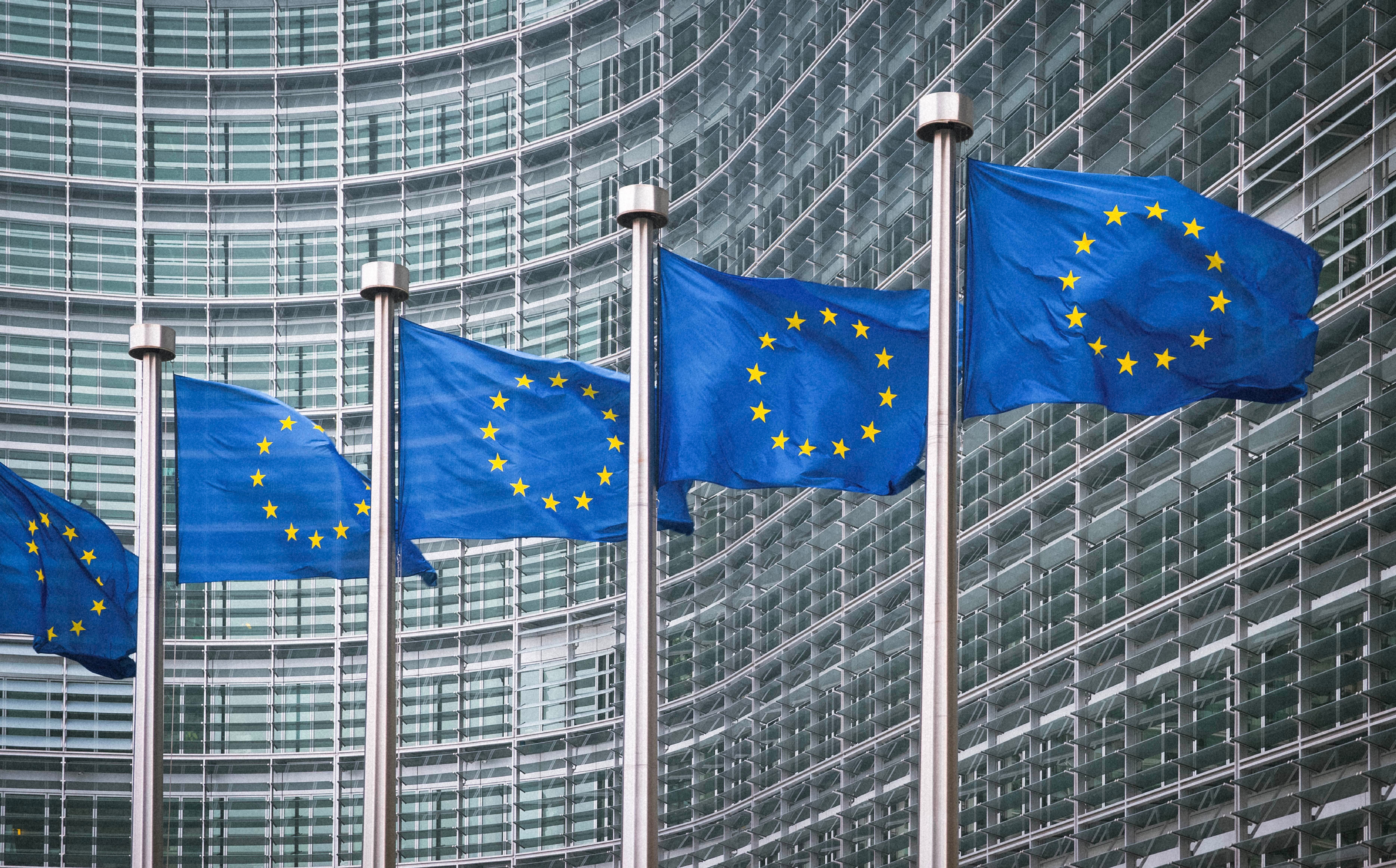
What is the most expensive European import? Some might guess it’s German sports cars, French champagne or perfume, or Italian designer fashion.
But the most expensive European import is neither a good nor a service. It is European regulation, perhaps more aptly labeled a “bad” or a “disservice,” and it’s about to become even pricier for America’s largest and most successful corporations.
By my estimates, hundreds or even thousands of U.S. businesses are set to fall under a tangled web of new obligations from the European Union. These regulations will severely affect how those businesses operate—and cost billions or even trillions of dollars—even though not a single American voter was consulted about them.
The Expanding ‘Brussels Effect’
The inescapable consequences of European regulations in the U.S. and around the world have been labeled the Brussels Effect by Columbia University professor Anu Bradford. The EU passes regulations regarding privacy, food safety, and perhaps most importantly the environment, and the rest of the globe must comply.
Two newly announced EU regulations, the Corporate Sustainability Reporting Directive (CSRD) and the Corporate Sustainability Due Diligence Directive (CS3D), stand to supercharge the Brussels Effect, embedding it deep into the operations of America’s biggest companies, and eventually in the countless small businesses that supply them and distribute their products.
In December, the EU Council and EU Parliament adopted revised versions of these twin initiatives, saying they would “boost EU competitiveness.” The accompanying press release hailed the agreement’s virtues, saying it “simplifies the directives on corporate sustainability reporting and corporate sustainability due diligence by reducing the reporting burden and limiting the trickle-down effect of obligations on smaller companies.”
A casual reader might assume the EU had embraced deregulation. If only that were the case.
CSRD and CS3D are vehicles for environmentalism, not economic growth or competitiveness. For example, Articles 19a and 29a of the CSRD require companies to prepare “transition plans,” explaining how each company, along with the companies in its “value chain,” will reduce greenhouse gases and transition to Net Zero by 2050. Penalties for failure vary by EU member state, but are typically severe.
The value chain includes suppliers, distributors, and other business partners, and any business with €450 million in global revenue is required to comply. There are thousands of such companies operating in the EU, with each having thousands of different suppliers and distributors. The total number of firms tangled up in the regulation’s web is uncountable.
CS3D imposes even greater burdens on economic activity. Under Article 5, companies—including American firms—with €1.5 billion in global revenue must engage in eight separate forms of “due diligence.” These include but are not limited to “identifying and assessing actual or potential adverse [environmental and human rights] impacts,” “preventing and mitigating potential adverse impacts, and bringing actual adverse impacts to an end,” and “publicly communicating on due diligence.”
Then there’s Article 13, on “stakeholders.” At every possible step in the due diligence process, companies must consult with stakeholders by sharing a seemingly unlimited range of information. “Stakeholders,” according to the document, include the “company’s employees, the employees of its subsidiaries and of its business partners, and their trade unions and workers’ representatives, or communities whose rights or interests are or could be directly affected by the products, services and operations of the company, its subsidiaries and its business partners.”
Simply stated, “stakeholders” could include anyone interested in a company’s activities, including those seeking to harm the company.
Of course, failure to comply with CS3D can lead to substantial damages. Any individuals harmed have a right of private action, and under Article 29, “Member States shall ensure that those persons have a right to full compensation.” Separately, under Article 27, Member States may impose penalties of up to 3% of a company’s global revenue for failure to comply.
All of this brings us back to the Brussels Effect. For decades, the EU has imposed environmental regulations on businesses operating within its borders. The novelty of CSRD and CS3D is that they apply not just to operations in the EU but operations globally, and not just to EU companies but to non-EU companies as well. American businesses are entangled in the web.
It is practically impossible for a large American company in the broad sectors of agriculture, mining, manufacturing, information, and finance not to have operations in the EU that bring them under CSRD and CS3D. By my estimates, roughly 150 American firms will have to report directly under CS3D, and several times that number of firms will fall under CSRD.
Collectively, these American firms will face one-time administrative costs running into the hundreds of billions or even trillions of dollars. Recurring annual costs will be in the billions.
The Draghi Report and ‘Decarbonization’
In the EU, all of these substantial costs come in the name of environmentalism.
The EU already employs a litany of environmental laws—layered on top of each member state’s own set of regulations—that have contributed to the hobbling of the once-mighty European economy. Today, Europe’s economy grows slowly if at all, falling further and further behind China and the United States each year.
While America leaps forward with artificial intelligence innovation and China dominates manufacturing, the EU seeks to develop new environmental regulations in pursuit of a polysyllabic dystopia known as decarbonization. Never mind that, even if the EU and U.S. were to abandon carbon fuels entirely, the effect on global temperatures by 2100 would be 0.2 degrees Celsius.
Two years ago, European Commission President Ursula von der Leyen commissioned a report by Mario Draghi, the widely respected former European Central Bank president, with the stated aim of growing Europe’s economic output. The report, released in late 2024, is titled “The Future of European Competitiveness” but is better known as the Draghi Report.
The report identifies substantially higher energy prices in the EU relative to the United States and China as one of the continent’s primary competitive disadvantages. Not surprisingly, the Draghi Report notes that environmental regulation and high taxes are among the causes of elevated energy prices and the EU’s overall lagging economy.
The obvious remedy would be to substantially reduce environmental regulations and energy taxes. But the Draghi Report reflects the sensibilities of an EU that is more committed to decarbonization than to growth. How can the EU achieve both economic competitiveness and decarbonization? The Draghi recommendations are a muddled combination to reduce the worst regulations and to coordinate more carefully the remaining regulations.
An Inescapable Burden
Along with the costs identified above, the initiatives come with a wide range of unquantifiable costs for American businesses. One is the loss of corporate control. Under CS3D, a disaffected party anywhere in the world can haul a large U.S. company into a European court and demand substantial damages.
Perhaps even worse, any large business that must report under CSRD and CS3D can ask sensitive questions of those that don’t, including about environmental damages or human rights. The smaller American firm need not provide this information, but if they refuse they may have difficulty doing business with those larger counterparts. This is the Brussels Effect in action.
American consumers and workers lose as well. U.S. consumers will pay higher prices for goods and services provided by firms facing these massive new compliance costs in the hundreds of billions of dollars. Someone will pay these costs, and that someone is the American consumer and the American worker.
Workers will lose twice. First, they lose because their employers will face higher costs, likely leading to reduced operations and fewer employees. Second, the reality is that firms in other countries such as China may be less likely to comply with the niceties of the reporting requirements, which would effectively give their workers a competitive advantage.
This loss of political control is at the heart of the Brussels Effect. American consumers, workers, and businesses cannot petition their elected representatives to change CSRD and CS3D, because American lawmakers did not impose these rules. EU lawmakers did.
We are left with an even higher price for the EU’s largest import: regulation. President Trump cannot tariff it, and American consumers, workers, and businesses will pay a heavy price.

And if Democrats take control of the Federal government again, they will join the EUTards again in this economic destruction. Xi is smiling at their idiocy.
What a ridiculous article. The author seems to be making a convoluted argument that US businesses should have an untrammeled right to do business in the EU without having to follow any of the EU laws that have been crafted over decades to make its economy more environmentally sustainable and to allow workers and families to have the social supports necessary to ensure they can benefit from the wealth of their societies. Should European businesses have the same right to operate in the US without following our laws?
It's well known that all European workers have affordable health care, unlike tens of millions of US workers. They also have access to affordable childcare, retirement, higher education, public transportation, job training/reskilling and much much more. And, by the way, contrary to conventional wisdom they actually don't pay more in taxes for these essential services, because in the US we actually have to pay more out of pocket PLUS our taxes in order to afford a European-style standard of living.
In actual fact, the US should adopt many of the EU laws, including institutions like co-determination and works councils, in which workers in the largest of corporations in Germany, Sweden and other countries elect 50% of the members of the boards of directors, and have "consultation rights" beyond what most Americans could even imagine. If the US used this, half the board of directors for a corporation like McDonald's would be elected by all those minimum wage fast food workers. Imagine that. Of course, this is so outside the realm of how American workers are treated that it seems unfathomable.
But it shouldn't seem strange to readers of Commonplace, because Oren Cass has praised co-determination and works councils in a number of his articles, and Project 2025 also touted its advantages. See Oren's advice at this link:
https://americancompass.org/constraining-the-corporation/#:~:text=Workers%20are%20particularly,management%20is%20accountable.