


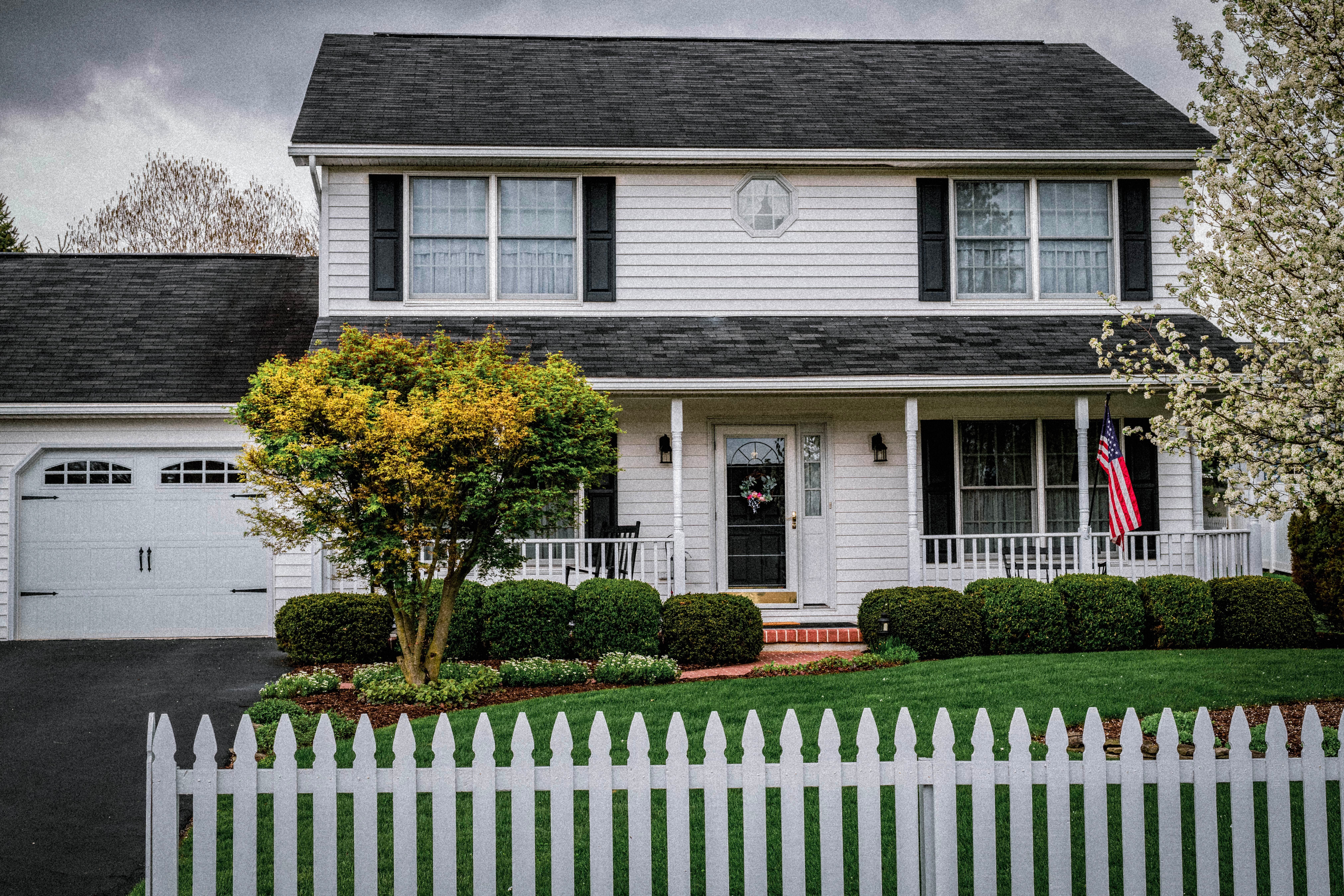
I grew up in a quiet place, in a house on top of a hill surrounded by birch trees on a road with no name, three and a half miles outside a town of about 1,700 people. (There are fewer now, closer to 1,400.) It was so dark at night in the winter that you could not see anything except the leafless birches, glowing like enchanted staves in the moonlight; a whisper in that cold empty air sounded like an explosion.
But I know an even smaller place, an unincorporated community in the Upper Peninsula of Michigan. It is so small that it has no official population statistics, though there is a post office. The driveways there are more like game trails, running a third of a mile or more from the gravel or dirt road. Residents do not get many visitors, especially uninvited ones. But not long ago a black SUV rolled into one of these places; a man emerged and without so much as a comment on the fine summer weather asked the owner whether the place was for sale. He thought that it would make a nice rental property (“Have you ever heard of AirBnB?”) and explained that he was able to offer a very large sum, more than four times the original purchase price. The owner told him to leave—his home was not for sale.
Most readers of this publication will agree that housing is a political issue, and an important one. Like “education” (or at any rate, tuition and fees; the two are not really synonymous) and health care, the cost of housing has outpaced inflation. It is interesting to consider whether anyone would be talking about half a century of wage stagnation if a Yale undergraduate degree could still be financed by a 40-hour-a-week summer job, or if our existing rate of government spending on medical care (already higher per capita than that of any European country) translated into some kind of minimalist single-payer coverage, especially for those of us who do not think a sprained ankle warrants an X-ray.
Unlike a college degree or even health insurance, there is no “opting out” of the housing market. One cannot simply choose to become an electrical line technician instead, or take a gamble that you are young and healthy enough not to waste $1,000 a month on premiums for insurance you won’t use. Pace Stephen Malkmus, you’ve got to pay the rent before you pay your dues. And the rent (or, as the case may be, the mortgage payment) is still too damn high.
Why it is too damn high is a question about which there is little agreement. The Left correctly points out that housing has become another unremarkable asset class—hordable, fungible, and, in the long run, almost certain to pay off. Stories like the one about the black SUV. are now very common even in rural America. It is difficult to obtain accurate nationwide statistics about property ownership, but it is estimated that 40% of all single-family homes available for rent in this country will be owned by private equity firms within five years. Hundreds of thousands of houses that would otherwise be owned by Americans in their late 20s or early 30s have been swallowed by institutional investors who outbid would-be mortgage holders and offer cash.
This phenomenon is not entirely new. The savings-and-loan collapse of the 1980s should have led to more strident regulation aimed at restoring the stable post-Depression world of local and regional banks, which were managed by local WASP grandees working with small builders and issuing mortgages to the same people whose savings they held. Before the advent of junk bonds, it all worked in a bland, unimaginative way, just as 6% interest and the certificate of deposit did in the days before half the American people became stockholders.
But by the 1980s there was no interest in a return to sanity. Instead, policymakers allowed further consolidation; in the 1990s the vacuums of Wall Street swallowed thousands of smaller banks and building firms. Since then the reach of speculation has expanded from mortgage-backed securities and the financing of grotesque mega-construction projects to the direct purchase of single-family homes. There is something almost indescribably grotesque about a world in which algorithms determine that an unremarkable ranch house built in the early 1970s is an “investment” opportunity, as if it were a parking lot in Los Angeles or the probable site of a new NFL stadium.
This argument—that speculation is to blame for the housing crisis—is gaining some currency on the Right, where much is made of the fact that trillions of dollars of American real estate is foreign owned. (This, too, is not exactly a new problem; at the height of the glamorous Japanese “Bubble” era, the panic over imported VCRs and Toyotas extended to Japanese ownership of Manhattan’s Exxon building and a majority stake in the nearby Rockefeller Center.) The obsession with overseas investment—however warranted—tends to elide the fact that the financialization of housing is ultimately a homegrown problem, one which President Donald Trump of all people is almost uniquely unsuited to address.
“Just Move”
For Trump, the idea of housing as anything other than an investment is probably unthinkable, even when it comes to his own residence. Three decades ago, Bill Pulte, the founder of PulteGroup (the pioneers of all those hideous subdivisions with names like “Concord Green”) confessed his horrifying fantasy of achieving a 1950s General Motors level of market saturation. His grandson is now in charge of the Federal Housing Finance Agency, Fannie Mae, and Freddie Mac. Like the president, Pulte the Younger has suggested the solution to housing costs is 50-year mortgages, which would allow lower monthly payments in exchange for trillions of dollars of additional interest. Needless to say, the present administration does not take this issue seriously.
So much for the Left, and for MAGA. In recent years the issue of housing has become the province of bland technocratic liberals, who are increasingly indistinguishable from libertarians. Basically indifferent to—or unable to account for—the financialization of the economy, they instead emphasize supply; to them the real problem with Manhattan is not that a Chinese insurance company owns the Waldorf Astoria but that there are not nearly enough McDensity gentrilux pods available. Their enemies span the four corners of the Earth, in number like the sand on the seashore: height and façade restrictions; interminable zoning board hearings; mandatory parking; “historic district” busybodies; a thousand discretionary and non-discretionary reviews and panels; the necessity of consulting wetlands maps last updated during the Ford administration; the impact of shade studies, the impact of bird studies, the impact of impact studies, the impact of studies of impact studies; tree canopy ordinances and protections for scenic viewsheds; undisclosed easements and the messiness of neighborhood associations; anagogic secrets about being “up to code” known only by retired fire marshals; and so on.
It amounts to a kind of generational struggle with older members of the same social class to which they either belong or aspire. Here one suspects a simple failure of imagination. Most so-called “YIMBYS” simply cannot imagine themselves being 30 or so years older and a few million dollars richer; if they could, they could probably occupy the mental space of a bien-pensant environmentalist lawyer or retired principal of a “magnet” school who does not want to live next to a building that looks like a combination between an Apple Store and a parking garage and functions as an adult kindergarten for people who look like extras from The New Girl.
This leaves only the vestigial non-MAGA Right, for whom “market forces” are simply infallible. A price always communicates appropriate information; it is always efficient. For the handful of extant unreconstructed Tea Party types (who apart from the actual GOP donor class itself seem to exist only in the halls of Congress), the only possible response is “just move.” This argument at least has two (admittedly somewhat dubious) virtues; it is both simple and honest.
Housing vs. Home
As it happens, I think each of these explanations has some merit, including the last one. New York City (where I happened to find myself on the night of Zohran Mamdani’s mayoral election) is somehow even more inhuman and antiseptic than it was ten years ago; there are fewer shabby dive bars than ever; more empty scaffolding-clad buildings emblazoned with the names of shadowy half-unreal-sounding developers or “groups,” all awaiting yet another Starbucks (at least until the employees unionize).
Ultimately, I find it hard to disagree with Michael Bloomberg’s blunt assessment that the city itself is “a high-end product, maybe even a luxury product.” However much some of us might fantasize about the pre-Giuliani city, it is difficult to imagine making such an obviously desirable location cheaper without deliberately raising crime rates or imposing a national lottery system for would-be New Yorkers (which I would myself support if I thought it were politically feasible). As things stand, complaints about affordability there hold all the moral force of a teenager’s lament for the days before modern tourism when impecunious American poets chose self-exile in Paris.
Everyone is missing the point, even though some of them gesture vaguely—in some cases even accidentally—in the right direction. Any conversation about the price of “housing” simply begs the question. It assumes a world which none of us actually inhabits, namely one in which something called “housing” exists—a vast undifferentiated stock, like inhabitable pink slime.
No one wants “housing”; everyone wants home. “Housing” might go at any price or none; home is no more synonymous with “housing” than music is with “acoustic vibrations.” The absence of meaningful relationships with family and neighbors, the unwilled chaos of lives subsumed into digital communications platforms, the lack of any connection between economic and social life, our alienation from the natural world as it disappears into what Heidegger called “standing-reserve”; the shoddiness and ephemerality of the so-called “built environment”—even those of us fortunate enough to have secured “housing” find it increasingly difficult to see ourselves at home.
To explain what I mean, let us consider a particularly odious neologism: referring to the indigent as “unhoused.” The plight of those who are mentally ill or addicted to drugs and living on the streets is essentially tragic; yet when they are referred to as “unhoused,” it becomes a mere inconvenience at worst, and at best a value-neutral description. The “unhoused” are simply temporary non-participants in the accumulation of equity or the accrual of interest on their security deposits. An “unhoused” man or woman might be so only for a while, or only for incidental reasons, in the same way that he or she might be “undressed” (e.g., after getting out of the shower) without being habitually nude.
To be “homeless,” meanwhile, is to be like Aristotle’s solitary wanderer, the “outcast who is a lover of war,” outside the political community entirely, a condition that is not simply economic but ontological. “Homeless” properly understood should have the quality of the German unheimlich, literally “unhomelike” but usually translated as “uncanny.” The admixture of cruelty and indifference which leads most of us to walk past the homeless without so much as a word or glance is, I think, a half-conscious acknowledgement of their uncanniness. We avert our eyes because, like characters in a primitive CGI production, the homeless really are uncanny; they look like but do not in any recognizable sense act like or fulfill the role of people; they are separate not only from the public world of commerce and polite social intercourse, but even from the private reality of belonging to and dwelling in some particular place.
This lack is the one salient fact about them which most of us will ever know. It is sometimes visible in their faces, as indeed it would be visible in mine if thousands of people walked by me each day without betraying any knowledge of my existence. (While the two words are not etymologically related, it is difficult for these rote behaviors not to suggest a kind of fortuitous affinity between heim—and its Old English descendant hām—on the one hand and Greek and Latin homo; it is, at any rate, striking that when we say something does not remind us of “home,” in the sense of belonging to or having or being at home, we use an adjective that when applied to persons means frighteningly almost-human.)
Where the Heart Is
Back to “housing prices.” Housing talk, as I say, does not meaningfully address the question of home even when it attempts to euphemize homelessness. Indeed, most proposed solutions to the “housing” problem ignore the deeper question of home; inadvertently, I think, they propose homelessness as a condition to which the rest of us should aspire.
What the YIMBY pod people and the “just move” libertarians implicitly assume is that homelessness is not a tragedy, as I have suggested, but rather a kind of universal model. They see the absence of home as our natural state; we should thus be able, or even obliged, to live no place in particular so long as the available supply of “housing” meets our demand for it. Frictionless mobility is the unquestioned ideal. DoorDash replaces diners; remote work supplants workplaces; ugly new buildings provide housing in the middle of neighborhoods and the middle of nowhere. This vision—which in a sense already exists—rests upon the assumption that rootlessness and atomization are welcome, or at the very least inevitable. As W.H. Auden wrote:
All the conventions conspire
To make this fort assume
The furniture of home
My argument cannot be dismissed as a simple series of aesthetic hangups. It is possible for a family to purchase a really attractive house in rural America—a classic “old pile”—and move there only to find themselves no more at home than they would be in Fairfax County, Virginia, the ugliest place in the world. If anything, such a life—in which one can be anywhere because one’s presence is required nowhere—might prove far less “homely.”
By comparison, a third-generation resident of a Fairfax County subdivision—invariably named “Old Creek” or “Elm Corner” in a place where both water and trees would look as out of place as a castle or a griffin—might know all of his neighbors and work at the same place or at least in the same industry as his father, in addition to shopping at the same strip mall along the same “stroad” and attending the same house of worship. Home is, in fact, where the heart is; the question is not whether a body can be found to “house” that particular organ, but whether we can keep it beating.
What, then, is to be done? How can we create—or find—“home”? One ludicrous solution which I have never seen floated even in the furthest reaches of online illiberal Catholicism is the revival of serfdom. As recently as the seventeenth century, it was technically illegal in England for many people to reside beyond the boundaries of the parish in which they were born, lest they become destitute and reliant on tithes from the wealthy in their new districts. Any comparable restrictions on modern freedom of movement are (obviously) impossible and would bring hideous consequences.
But what does all of this mobility get us?
Not a single one of my friends from high school still lives in our hometown. In the small town where I live now, teenagers who aspire to the professional classes, or even, increasingly, to jobs in the trades, cannot imagine sticking around after graduation. This is the rural “brain drain” problem. A shrinking population finds itself with fewer and fewer economic opportunities. Social life breaks down. Restaurants and other small businesses close; the cannabis “dispensary” and the payday lender and the Dollar Tree become the only signs of commerce. Those who remain find themselves in the grip of various social pathologies—especially drug addiction—which cannot be shaken off. And even for those who do not fall victim, the only upside is telling a mysterious stranger that you do not wish to sell your home.

Very thick writing. So many analogies, contrasts, etc. But overall a well-targeted essay. The obvious but difficult solution is a new anti-trust campaign, i.e., breaking up of huge financial conglomerates, the Amazons of the world as well, and add agri-businesses and pharma giants. Since these finance our politicians, it ain't likely to happen. Which brings us to term limits to reduce the power of big money. Oh, well. Where can we begin? Frank Tinari
Sorry, while you write well, this essay is mostly waffle to justify restriction: it is unquestionably a fact that places like New York and California are building far too little and are paying the price for it, which is shrinkage and eventually the loss of dynamism.
In more poetic terms, you need to let go of the dead hand of history , and embrace the future, man, it could be so amazing, garden cities as far as the eye could see, beautiful and convenient and full of community. We have the technology to do it and the wealth to do it in the richest country in the world, there’s no reason to accept the shitty tiny apartments or potholed streets that we have to put up with.