

Slam The USMCA Back Door
For the trade agreement to survive, it must keep China out of North America.

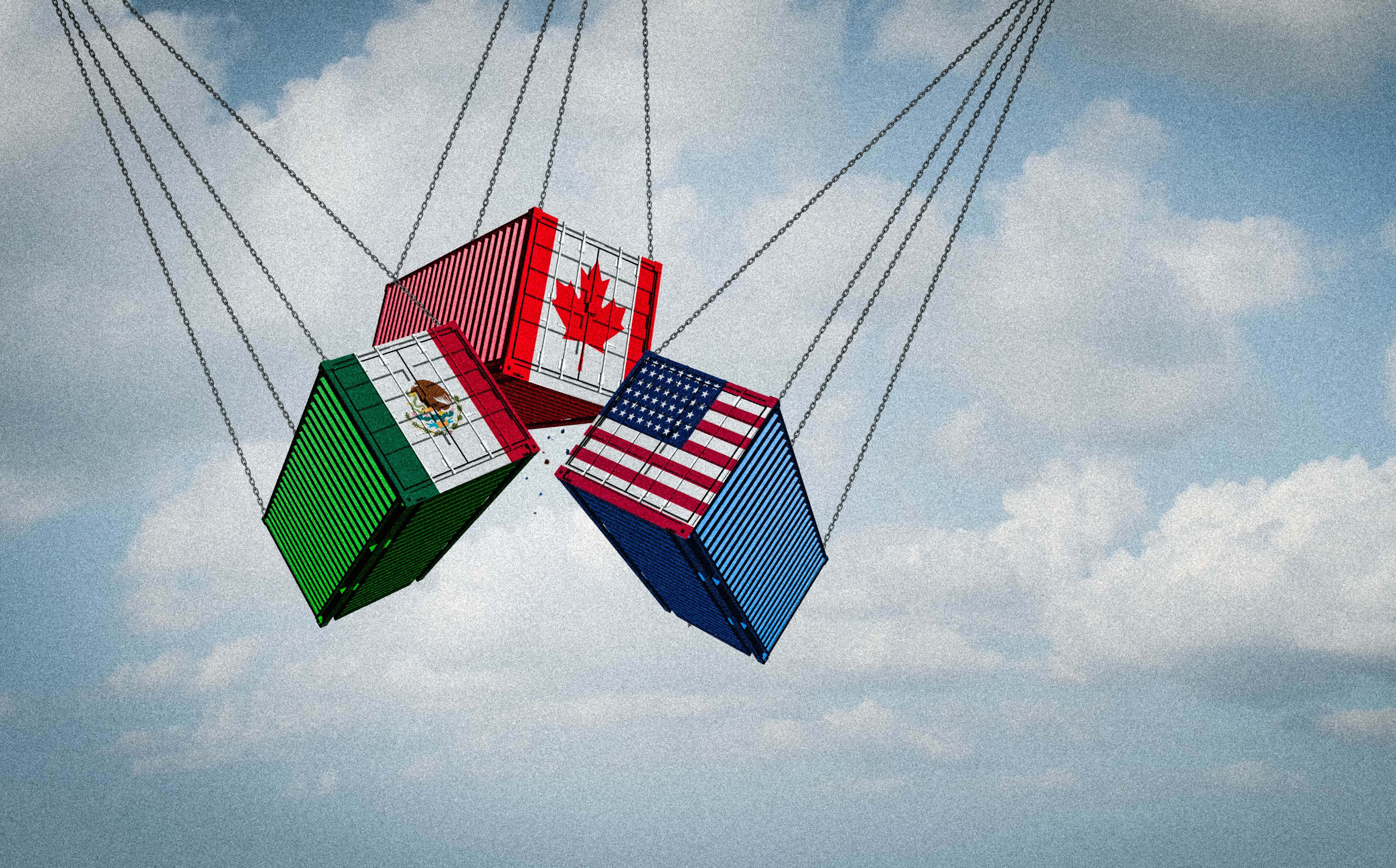
When Fox News asked President Trump last month if the United States was looking to update the U.S.-Mexico-Canada Agreement, he was unambiguous: “I’d rather be independent.”
Having declined to renew the agreement for a full 16-year term, the Trump administration triggered an annual review process. If the three countries can’t agree on how USMCA should change, it will automatically expire in 2036—or earlier, if the U.S. decides to leave. U.S. Trade Representative Jamieson Greer says the United States is now seeking separate interim arrangements with both countries to be concluded by the end of the year, while talks on “really important” issues continue into 2027.
What’s clear is that the agreement cannot continue in its current form. USMCA retains the essential features of its predecessor agreement, the North American Free Trade Agreement, and the world has changed too much since NAFTA was ratified in 1993. NAFTA sought to achieve maximum integration between the U.S., Mexico, and Canada, and zeroed out tariffs on virtually all traded goods.
That was before anyone worried about American deindustrialization—or China. NAFTA’s premise was that American industry would get rich exporting to the rising Mexican middle class. Instead, American firms quickly realized they could turn low-wage, lightly regulated Mexico into an export platform to serve their existing American market, and rapidly offshored production.
The year before NAFTA took effect, the United States ran a $1.7 billion goods surplus with Mexico. By 2025, that had become a $197 billion deficit. Meanwhile, in the mid 2000’s Chinese producers started sending inputs to Mexico for assembly, which qualified them for tariff-free treatment, and reexporting the finished goods to the United States. China got the benefits of NAFTA without signing on to the agreement.
Trump has long promised to reverse these trends. In his first term, he renegotiated NAFTA and turned it into USMCA, adding rules that stripped tariff-free status from exported autos if they used too many non-North American parts or low-paid labor.
In his second term, Trump used his “America First” trade policy to levy across-the-board tariffs, incentivizing global firms to serve the American market by producing within it rather than exporting to it. The administration imposed especially high tariffs on China, recognizing that Beijing uses massive industrial subsidies to eliminate competition and leave the U.S. dependent on Chinese producers. Global flat tariffs were designed to shift fundamental trade flows back toward balance, while China-specific tariffs would reduce the U.S. economy’s dependence on its chief adversary.
Both of these goals are impossible to fully achieve with two neighbors who remain wide open to China and enjoy tariff-free access to our market.
This is a contradiction that USMCA can no longer bear. Under the agreement, goods originating in Mexico or Canada can be exported to the U.S. tariff-free. This functions as a glaring invitation for other countries to circumvent tariffs by shipping inputs to Mexico or Canada for assembly and export to the United States. Only autos face rules limiting this behavior. That might have worked when the U.S.’s effective tariff rate was around 3%, but now that the U.S. has erected a high tariff wall, everyone is looking for a back door. Trump’s tariff wall has two—one through each of our neighbors’ yards.
No country has been a more enthusiastic exploiter of this strategy than China, which is surging investment into Mexican manufacturing operations. Mexico does not reliably track Chinese investment, but one 2025 report found 200 discrete Chinese manufacturing and infrastructure investments in Mexico worth a combined $15 billion, observing that they “tend to cluster in the [Mexican] states with the tightest commercial and logistical linkages to the United States.”
That is supported by econometric evidence, which found that Mexican exports to the U.S. increased following U.S. tariff hikes on China, while Mexican suppliers increased the Chinese content of their exports. A June 2026 Federal Reserve study found that U.S. tariffs on China accounted for 53% of Mexico’s subsequent export gains in the American market, with Chinese production or processing in Mexico alone accounting for roughly 14% of the total increase. By simply relocating manufacturing operations to Mexico, Chinese corporations can still stuff U.S. supply chains full of their products.
It’s not just Mexico. After Canadian Prime Minister Mark Carney signed a “strategic partnership” with China in a misconceived attempt to signal independence from the United States, Canada agreed to import Chinese electric vehicles at low tariff rates. As the Financial Times reported:
With its manufacturing base hard hit by Trump’s tariffs, Canada’s industry minister Mélanie Joly also met BYD, Chery, Geely and Shanghai Launch Automotive Technology in China this month to discuss investments as part of her attempt to drum up hundreds of billions of dollars in non-US trade. Joly said all four of the Chinese carmakers were “willing to explore creating joint ventures” to build cars in Canada.
Mexico and Canada clearly don’t have much incentive to curtail this behavior on their own. In fact it’s quite the opposite. They realize full value from USMCA by monetizing their U.S. market access—a scarce and valuable asset—in the form of foreign investment.
The Trump administration is alive to this concern. Last year, Ambassador Greer told Congress:
With the USMCA, it’s important that Canada and Mexico not be used as an export platform for third countries. That’s not what we want. USMCA should be an agreement that promotes manufacturing in America and that we can rely on our partners to the north and south, if needed. It can’t be a situation where countries can just come in, China, Vietnam or somebody, build a factory in Mexico, assemble it with parts from there and send it across and get the benefit of an agreement where they’ve taken no obligations. So I want to make sure that it truly is an agreement that helps America first.
Now that the annual reviews are underway, the Trump administration must decide how to achieve that goal and prevent USMCA from undermining its America First trade policy. President Trump has suggested that the U.S. could simply walk away. We certainly have the leverage: trade with the United States constitutes about half of both Mexico and Canada’s entire GDP; combined trade with Mexico and Canada represents less than 6% of U.S. GDP. Meanwhile, Trump’s tariff wall has even further increased the importance of USMCA for Mexico and Canada. Fully 83.6% of imports from Canada and Mexico now seek USMCA certification to avoid tariffs, up from around 50% in 2025. That turns the agreement into an exceptionally powerful tool to shape the North American market.
We should not reject this opportunity. Further, leaving USMCA would deal a serious and sudden blow to many American industrial firms that built trans-national supply chains in the wake of NAFTA. The better move is to use America’s leverage to get a deal that supports the administration’s mission to reverse deindustrialization, reduce dependence on China, and return America’s trade relationships to balance.
Mexico
The presence of a low-cost, low-regulation jurisdiction with tariff-free access to the U.S. market risks bleeding out the Trump administration’s reindustrialization strategy. Production (and the attendant jobs and investment) that might have been relocated to the U.S. to avoid tariffs instead goes to Mexico. As the FT reports:
Mexico has quietly become a cornerstone of the AI boom, providing 40 per cent of US imports this year of the computer servers that are widely used in the data centres powering artificial intelligence. Taiwanese manufacturers are rapidly expanding factories in Mexico to assemble servers, which are now the country’s top US export, overtaking autos that dominated its trade for decades….Servers and related hardware made up almost one-fifth of the $317bn of goods Mexico exported between January and May, more than double the same period a year earlier. Taiwan, in turn, is now Mexico’s third-largest trading partner, up from eighth place in 2022. Taiwanese companies have spent more than $1.6bn since 2020 on Mexican factories that offer geographic proximity and tariff-free access to US tech giants spending hundreds of billions on data centres.
The U.S. doesn’t have a free trade agreement with Taiwan—it has a bargained-for Agreement on Reciprocal Trade that applies 15% tariffs on Taiwanese exports. Absent USMCA, that might have induced Taiwan to expand AI server factories in America. But thanks to Mexico’s open door, Taiwan gets the same market access and lower costs by expanding south of the border instead. We might as well have a free trade agreement with Taiwan, and, for that matter, China and any other country that freely trades with Mexico.
This is the back door in action, and the administration must close it. If the United States is going to provide Mexico with privileged entry through the tariff wall, it can reasonably insist that Mexico help guard the wall.
There are two basic approaches that the administration can pursue to achieve this: a rules-of-origin approach and a customs union approach.
Rules of origin require that a minimum percentage of a product’s value actually be added in a USMCA country, using USMCA inputs, in order to get USMCA privileges. Strengthening these rules would build on the existing formula that the first Trump administration applied to autos.
Conceivably, this regime could extend to other important products such as AI server hardware. But it’s extremely difficult to verify whether a given product satisfies these requirements. Instead, enforcement depends on customs officials auditing paperwork in an attempt to trace every foreign input incorporated into every product exported from Mexico. There are intriguing proposals—and even successful trials—to run rules of origin enforcement through blockchain technology. But as it stands, such a large enforcement burden may stretch the tool beyond what it can comfortably bear.
There is another option that could prevent the benefits of USMCA from accruing to foreign producers: a customs union. Under this model, Mexico’s access to the U.S. market would be conditioned on Mexico mirroring U.S. trade policies with respect to China and other major exporters. If Chinese inputs and investment faced the same barriers in Mexico as they do in the U.S., there would be no opportunity to route them through Mexico in order to access the American market.
Mexico has already moved substantially in that direction. In late 2025, it approved tariff increases of up to 50% on vehicles, steel, and other goods from China and several other Asian economies. Bloomberg reported that the U.S. has asked Mexico to “mirror Washington’s tariff wall against Chinese steel and aluminum by imposing Section 232-style duties on imports from outside North America.”
Yet even more is needed. Mexico has no clue just how deeply China has tunneled into its economy. Two prominent Mexican academics recently called attention to “China’s expanding footprint in strategic infrastructure, digital networks, and security-sensitive technologies” in the country, while noting that “[a] difficult truth is that Mexico still lacks a consolidated and transparent picture of China’s footprint in its economy—where capital is embedded, through what ownership and financing structures, and with what implications for data governance, logistics corridors, energy systems, and industrial resilience.”
To take just one troubling example, Hutchison Ports, the China-based company that the Trump administration recently kicked out of the Panama Canal, is the single largest private operator in Mexico’s port system, handling up to 40% of the country’s containerized cargo.
The most realistic customs union option is requiring Mexico to enforce an investment screen that denies USMCA privileges to Chinese companies and limits Chinese investment in key sectors of the Mexican economy. Meanwhile, Mexico could match the United States’ China tariffs—or perhaps even global tariffs—on a subset of strategic industries, including autos, steel, AI and telecom equipment, semiconductors, and critical minerals in exchange for some amount of tariff relief.
However, the likeliest outcome is that customs union-style tariff matching is combined with enhanced rules of origin, at least for certain products. Although tariff matching can prevent other countries from accessing the U.S. market through Mexico, it probably isn’t capable of closing the massive U.S. trade deficit with Mexico, a key aim for the Trump administration. For that we’d need rules of origin, which could require that goods contain a minimum percentage of United States content to receive USMCA privileges. That would be a more direct path to closing the deficit, and the administration is likely to pursue it.
Canada
Despite fundamental trade policy challenges, USMCA negotiations with Mexico have been proceeding successfully. The same cannot be said for Canada. Because it is a developed country with high labor and regulatory costs, Canada shouldn’t represent the same back door risk as Mexico. But for political reasons, our northern neighbor is doing its best to change that.
Prime Minister Carney, elected on a promise to confront Trump and reduce Canada’s economic dependence on the United States, retaliated against the president’s global auto tariffs by implementing a tariff regime applicable only to American vehicles—and then punished American manufacturers that transferred production out of Canada to the United States by reducing their tariff-free export quotas. According to the White House, American auto exports to Canada fell by 22% following Canada’s new policy.
In response, the White House made the unprecedented move of announcing new 50% tariffs on $20 billion of Canadian exports, with no exception for goods traded under USMCA rules. The administration used Section 338, a law that had never been previously invoked, and set a deadline of Aug. 19 before the tariffs would take effect. The Trump administration essentially signaled that it is ready to remove the “C” from USMCA.
The media has sided with Canada. After all, Carney was merely retaliating against existing U.S. tariffs. But this is a shallow analysis. Trump’s countrywide tariffs have always exempted USMCA-compliant goods, giving Canada a massive advantage relative to the rest of the world. Section 232 national security tariffs on autos, steel, aluminum, lumber, and copper affect Canada and don’t come with a USMCA exemption, but these tariffs are applied sector-wide on a global basis and don’t target Canada specifically.
There’s another factor that the media seems to have forgotten: Canada signed a strategic partnership with China. Under the strategic partnership—their term, not mine—Canada essentially reduced its tariffs on Chinese electric vehicles in exchange for lower Chinese tariffs on canola seeds. The Prime Minister’s office explained that it was “working with urgency and determination to diversify our trade partnerships” and predicted that “within three years, this agreement will drive considerable new Chinese joint-venture investment in Canada.”
Following this agreement, Chinese producers could establish subsidized manufacturing and supply-chain platforms inside Canada, localize enough value to satisfy USMCA’s content rules, and then use Canada’s preferential access to compete in the American market. USMCA regulates product origins, but it has no provision preventing a nonmarket adversary like China from controlling the capital, technology, and commercial strategy behind a member country’s production.
This leaves the United States with a clear roadmap. We would never have signed our initial free trade agreement with Canada if it was in a “strategic partnership” with the Soviet Union. We now find ourselves in a similar situation. If Canada wants to integrate China more deeply into its economy, the United States should deny Canada the privilege of preferential access to the American market. Otherwise, market access for Canada means market access for China, which would defeat the goal of ending our economic dependence on our chief adversary.
Carney believes that Canada’s economic dependence on trade with the U.S. is a weakness that must be remedied. But he is likely to end up with the worst of all worlds: the destruction of Canada’s most valuable global asset—geographic proximity and tariff-free access to the American market—with nothing to show for it except a marginal increase in agricultural exports to China.
None of this had to happen. Unlike Mexico, with which the U.S. has a large and growing trade deficit, U.S. trade with Canada is relatively balanced. Compared to Mexico, it looks much more like a bull case for free trade: two countries at similar levels of development with similar economic and legal systems pursuing comparative advantage. Canada and the U.S. have longstanding trade disputes in areas like lumber and dairy, but the fundamental issues posed by the Mexican labor-and-regulatory arbitrage strategy don’t apply to Canada.
Instead, the issue is purely political. It is understandable that Canada would react intemperately to Trump’s “51st state” rhetoric. But signing a strategic partnership with China is more than intemperate. Indeed, considering what Canada stands to lose, it’s considerably more reckless than Trump’s rhetoric. The president of the Canadian Vehicle Manufacturers’ Association accurately summed up the risk: “Actively courting Chinese automakers is incompatible with renewing our far more important trade relationship with the U.S.”
Canadian negotiators are sweating out a deal with the Trump administration to remove the Section 338 tariffs before the Aug. 19 deadline. But Canada is seeking an even bigger concession: relief from all of the Section 232 national security tariffs, which are applied on a global basis to help reshore critical industries. So long as Canada maintains a strategic partnership with China, that should be a non-starter. Canada cannot demand exemptions from measures designed to protect strategic American industries while inviting subsidized Chinese producers into the same North American supply chains.
Canada is likely to come down from full relief and propose tariff rate quotas (that is, quantities of exports that can enter at reduced level before the full tariff kicks in) on certain Section 232 products, possibly in exchange for tariff-matching those products on China. But Swiss-cheesing national security tariffs with exemptions weakens the critical reshoring incentive they provide. That incentive is working: A recent KPMG survey of 275 Canadian manufacturers found that existing tariffs had driven 29% to move some or all of their production to the United States.
Canada should be given a simple proposition: if you want preferential access to the American market, including any exemption from sector-wide national security tariffs, you must mirror measures we have taken to block China from distorting that market. Anything less is a triangulation strategy that the U.S. should not and need not abet. If Canada wants to “diversify its trading relationships” away from the U.S. and toward China, perhaps we should do some diversification of our own.
 |
|