


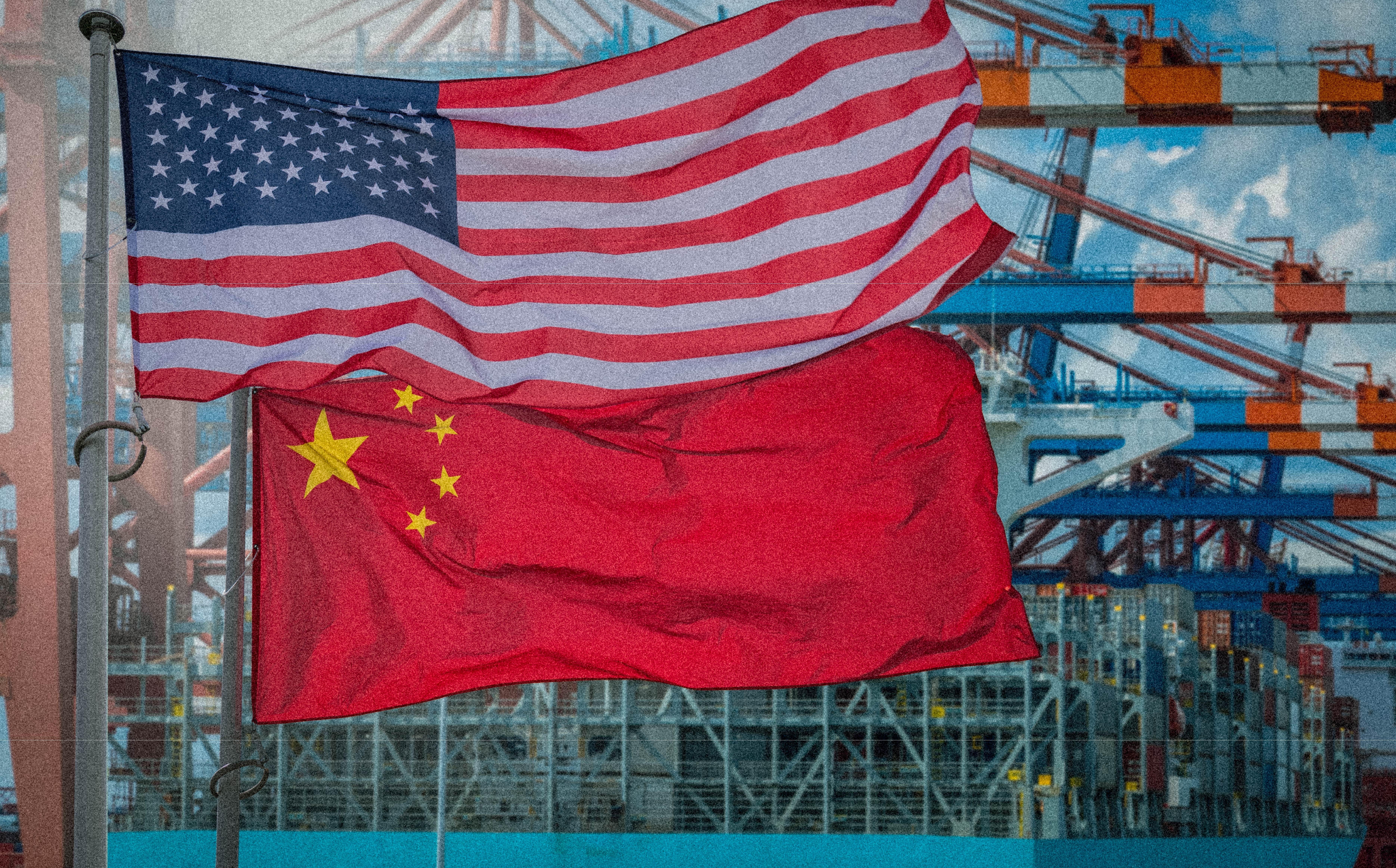
Can the Western world afford to disentangle itself from China’s economy? A better question might be to ask whether it can afford not to.
Focusing only on the first question makes the answer seem obvious. Earlier this month, consulting firm EY published a study arguing that the “cost of replicating China-linked supply chains” for the United States and Europe could reach nearly $24 trillion by 2050. The group’s press release reads, “even partial decoupling risks locking in structurally higher prices, leaving consumers and taxpayers to absorb the trade‑offs,” giving the distinct impression that such decoupling does not make financial sense.
But any serious discussion of the costs of decoupling should put those costs in perspective, compare them to the costs of staying put, and consider that decoupling over a quarter century would be substantially more cost-effective than a sudden collapse of economic ties if, for example, China invades Taiwan.
Decoupling from China will certainly have costs. Companies who purchase inputs heavily subsidized by the Chinese state will have to pay more for alternatives. The West will need to make strategic investments in technologies where China leads, such as robotics and electric vehicles, if it wants to compete in those industries.
The EY study tallies the costs of Western investment in manufacturing, infrastructure, and research and development at $23.6 trillion—a large headline number. But let’s add some context. Using simple assumptions of 2% U.S. GDP growth through 2050 and 1.5% GDP growth for Europe and the United Kingdom, total economic output from the West will reach more than $1.7 quadrillion in nominal dollars. In that case, $23.6 trillion turns out to be less than 1.5% of total GDP.
For further comparison, the U.S. will spend about 3% of its GDP on defense this year, while the European Union, where defense expenditures are rising, will spend more than 2%. If China remains America’s preeminent strategic competitor over the next several decades—a view that most U.S. foreign policy and elected officials share—spending about half of what we spend on defense in order to decouple from the Chinese Communist Party is not an unreasonable proposition.
Even that comparison is likely too generous. Most of what EY counts as the cost of decoupling is actually investment to produce goods needed to do so, such as mines, processing facilities, and electrical grid equipment. These investments would not only create resilience against China but would employ millions of our own people in construction and production.
Weighed against those potential costs, meanwhile, are the costs of not decoupling and instead maintaining today’s strategic dependencies.
The U.S. and Europe got a taste of that cost last year when, in response to President Trump’s April 2025 trade war, China began restricting a range of rare earth mineral exports to the U.S. and its allies. Within weeks, U.S. automakers and other industries were warning of potential plant slowdowns and closures, ramping up pressure on the Trump administration to cut a deal to reduce trade tensions.
This summer, the International Energy Agency published a study arguing that if China fully implemented its rare earth restrictions, the cost to the West would be $6.5 trillion per year “of downstream production outside China … across the automotive, high-tech, defence and energy sectors.” Unlike EY’s $24 trillion estimate of an aggregate decoupling cost through 2050, this estimate is of annual costs until alternative supplies are created. Thus, a single year of the disruption IEA describes would consume more than a quarter of the entire purported 25-year decoupling bill.
A separate estimate, from Bloomberg Economics, looked at the potential cost of dependency on Taiwan for semiconductors. The model estimated that if a war between China and Taiwan cut off global supplies of semiconductors from both countries, it could cost $10.6 trillion in economic damages in the first year alone.
China has repeatedly demonstrated its willingness to use this leverage to its advantage, and not only against the United States. Just last week, China cut off 14 European countries from obtaining access to a variety of Chinese inputs, including critical minerals, in response to Europe sanctioning 14 Chinese and Hong Kong firms over their support for Russia in its war against Ukraine.
The mere threat of cutting off supplies gives China substantial leverage at the bargaining table, potentially forcing the U.S., Europe, and other allies to make trade and national security concessions in order to avoid losing access to key inputs. It is hard to put a specific dollar figure on this loss of national autonomy, but the costs are nonetheless real and substantial.
Decoupling will not be easy, but it can be done with sound policies carried out across several years.
First, sound policies. Governments need to use a combination of industrial policy tools such as grants, loans, and purchase commitments, plus tariffs, tax policy, and innovation policy to encourage both a market for non-Chinese products and the development of capacity to make them. Sound policies also spread the cost of building economic resilience across stakeholders—the companies making new investments, their customers, end consumers, and the government—so that no single group absorbs them in full.
The second critical component is time. Opponents of decoupling tend to focus on how hard it would be to do so overnight. It is undeniably true that short-term decoupling would be hard and expensive. Despite the Trump Administration launching an aggressive, multifaceted campaign over the past year to create non-Chinese supplies of rare earths, the U.S. and allied economies will likely remain dependent on Chinese rare earths for at least the next several years.
But over time, those new investments will pay off, and decoupling will become more affordable. The right question is not whether we could decouple by the next quarter, but whether the investments we make this year and next leave us less exposed by the 2030s.
There may, of course, be a handful of economic sectors where U.S. entanglement with China is anodyne. Children’s toys and footwear perhaps come to mind. (Though wouldn’t it be better to source toys and footwear from U.S. allies?)
We should all hope that at some future point a new government in China brings about profound changes to the state-backed economic policies that have done so much to hollow out manufacturing in the U.S. and, today, Europe as well. We should also hope that the same government drops Xi Jinping’s authoritarianism and allows China’s billion-plus citizens the political freedoms they deserve. But until that time, the U.S. and China will remain geopolitical competitors. Whether to decouple is a choice within our means—one to be considered seriously—rather than being dismissed out of hand due to overblown and ill-contextualized cost estimates.
The reality is that the U.S. can afford to decouple if we put our mind to it and execute a strategy over time. Getting there—the investments we make today—will cost trillions spread over a quarter century. Staying put risks trillions in a single year. Washington should have a full and frank debate over the merits of decoupling, and should not be susceptible to over-blown cost estimates and other fear tactics intended to suppress, not inform, debate.

Well done! In other words, factor all the pros and cons based on a long-term perspective.
However, if we had done this previously, we never would have gutted our own industrial and manufacturing capability and sent it all to China.
In the 25 years of this century US imports rose by 10% of GDP (from 5% to 15%) while exports remained static at 11%. US business, workers, and government services lost a full 10% of US GDP every year over 25 years. In 2025 dollars/GDP $31 trillion/yr x 25yrs = $770 trillion lost to the country. If technology, capital and market access were not transfered globally and instead the resources invested in the US. We could have maintained the year 2000 domestic supply rate. Globalization was a mistake. A big one. No way to finesse a soft landing.