

Pregnant in Public
On Usha Vance and right-coding motherhood.


The role of the Second Lady is inherently political. And for much of American history, so was pregnancy. Usha Vance’s pregnancy and birth is thus the latest chapter in a centuries-long debate about the role of women in public society.
Perched in a white dress and heels, Usha Vance seems care-worn but happy. Two of her other children lace their arms around her, not quite posed, with their feet dangling like the subjects of a Mary Cassatt painting. Her husband might be the vice president of the United States, but in this picture he is an afterthought.
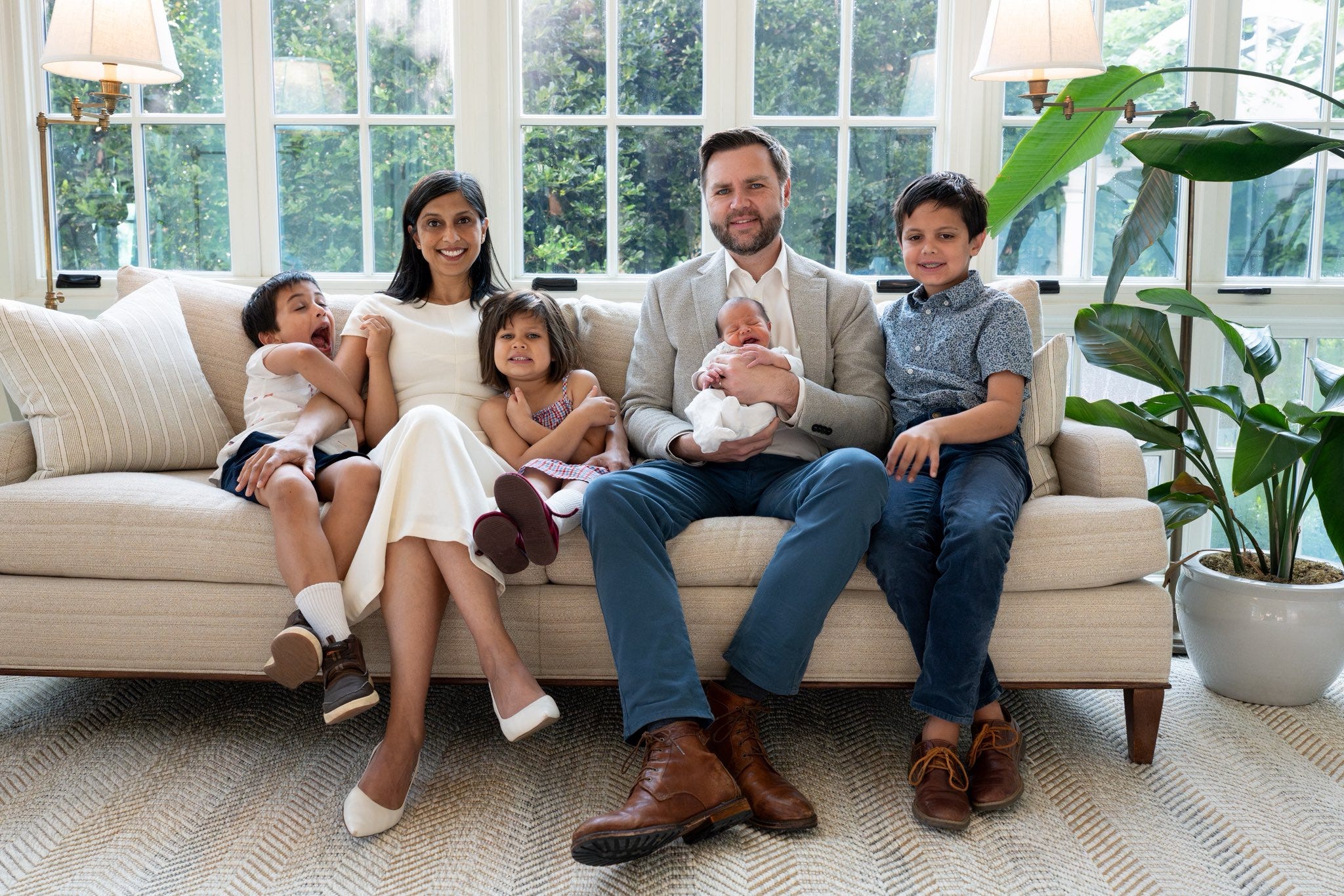
(Image credit: Second Lady Usha Vance on X)
The photo, released by the Vances last month to announce the birth of their fourth child, represents the exceptional. The last time a child was born to a sitting first family was 63 years ago, and to a second family over 150 years ago. The American people aren’t used to birth in and around the White House.
The Vances are not only ending the drought, but putting their family life front and center in the process. In the months leading up to the birth of her fourth child, Usha made the performance of motherhood part of her brand as a public figure, real-life marketing for her husband’s signature pro-family policies. The Vances walk the walk in a way that’s much more countercultural than it first appears.
While forefronting the vocation of motherhood as the Second Lady might seem rote, it is atypical in the contemporary era. In the twenty-first century, all of the second spouses have been mothers—well, except Doug Emhoff—but this status serves as biographical information, not a description of how they spend their days. Following the inauguration ceremony, their children (usually grown) remain off-camera.
Instead, the archetypical second lady centers issues outside of the home: Lynne Cheney fought pop music obscenity, Karen Pence promoted art therapy to support veterans with post-traumatic stress disorder. Jill Biden cultivated the notion that her career came before her ceremonial role. “She’s a good teacher who happens to be the second lady,” a teaching colleague told Politico. “Not a second lady who happens to be a teacher.”
Usha Vance’s public appearances instead convey an aspirational, timeless but not really trad style of motherhood: showing off her chicken coop in a pair of overalls, reading Winnie the Pooh on her children’s literacy-focused podcast. Yet she is hardly a trad wife. Rather, as a Yale-educated attorney who practiced law through the early childhoods of her three older children, she is the realization of second-wave feminism’s loftiest promises. Women can have it all—at least, Usha can.
Naturally, this doesn’t sit well with many of her professional-managerial-class colleagues. The New York Times characterized Vance and other high-profile expectant mothers in or around the Trump administration as the Right’s new directive on womanhood itself:
If the bare-chested, muscled mixed martial arts fighters of the U.F.C. match that President Trump hosted on Flag Day were the poster guys for MAGA’s image of masculinity, then the pregnant women of Trump world are one half of their feminine counterparts. Along with the sheath-clad, lip-filled, pageant-haired Mar-a-Lago set, they offer an image of idealized womanhood that gives literal shape to the pronatalist movement.
“It almost feels like a memo went out,” said Jill Filipovic, the host of the “Week in Women” podcast. “They have quite intentionally opted to present themselves as, ‘I am really pregnant, and this is what women were chosen to do,’ and they are happy to say that both with their looks and their mouths.”
Vance swatted away this charge with a bit of sarcasm. “Now that we know the political significance of my $8.75 coral maternity dress from Old Navy, can’t wait to hear what the New York Times has to say about my elastic-waistband pants and compression socks!” she posted on X, complete with a digital receipt for the dress.
But the Times isn’t entirely wrong. To dismiss the political significance of a public pregnancy is to write off over a century of American history, and to suggest that Usha Vance’s public persona is accidental would require a level of naïveté crossing over into the willfully obtuse.
Simply existing as a pregnant woman in public was taboo well into the twentieth century. In 1904, dressmaker Lena Bryant (her first name was misspelled “Lane” on a bank loan) started selling clothes for pregnant and “stout” women through personally printed catalogs because newspapers refused to advertise maternity clothing. In 1952, CBS brought in a minister, a priest, and a rabbi to temper the obscenity of I Love Lucy’s landmark episode announcing Lucille Ball’s real-life pregnancy. In other words, pregnancy in the public eye is not a conservative tradition—much the opposite.
The recent coding of high-status, high-publicity pregnant women as conservative speaks to a cultural shift initiated not by the Right, but by the Left. The same progressive political commentariat that promotes abortion as health care and motherhood as a flight of fancy for the nannied class cannot observe pregnancy as a neutral, natural state of being.
The subtext of Usha Vance’s critics is the following: to choose pregnancy is to submit to the patriarchy. Andrea Dworkin wrote in her seminal 1983 book Right-Wing Women that choosing motherhood is simply a way to become “slightly less disposable”:
The only dignity and value women get is as mothers: it is a compromised dignity and a low value, but it is all that is offered to women as women. Having children is the best thing women can do to get respect and be assured a place.
Today’s fourth-wave feminists take Dworkin’s words a step further: pregnant women are worthy of derision. In a post-Dobbs climate, joyful pregnancy is an act of betrayal. The line between “wife” and “trad wife” is blurry.
The Times piece does not just imply that MAGA men find the image of pregnancy politically advantageous, but that they are somehow putting the women up to it. When Usha Vance announced her fourth pregnancy, Time’s Chad de Guzman wrote:
[JD] Vance, in particular, is an outspoken pro-natalist. He has sounded the alarm on declining birthrates, branded Democrats as “childless cat ladies” and “anti-family and anti-child,” and called Americans’ lack of desire to have children as a “civilizational crisis.”
Of course, women outside of the political class do not really think this way. Even in America’s most liberal communities, baby showers are being thrown and foil-wrapped lasagnas delivered every day of the week. For as often as JD Vance was pilloried as “weird” during the 2024 presidential election, his family’s birth announcement is pretty normal.
In fact, outside of elite media and political circles, centering one’s public persona around pregnancy and motherhood can be hugely lucrative. Women are a household’s primary consumers, and motherhood-focused content resonates online. In an era where clicks and views translate to dollars, this can be big business for another kind of public figure.
Over the past five years, the number of social media mom-fluencers has jumped by 101%. Fortesa Latifi wrote in her book, Like, Follow, Subscribe: Influencer Kids and the Cost of a Childhood Online about a family who makes $8 million a year putting their home life in the public eye. Authentic-seeming family content, similar to that of Usha Vance, is both enormously popular and profitable because women enjoy watching it.
The Left-leaning commentariat ridicules pregnant women at its own peril. Democrats on the whole still command reliable support from women, but the current iteration of the party’s messaging saw it lose ground with them in the 2024 election. And when it comes to young men, who already lean to the right overall, those who supported President Trump ranked having children ahead of career or financial independence in their own personal definition of success.
Most regular people want to have children, and they don’t think about doing so as a political choice. When the family itself becomes a political battleground, the Left loses.
 | A guest post by
|
Usha Vance paused her career to raise her children. That fact destroys 100% of the TDS-colored, anti-traditional family premise of this piece.
For all the handwringing about falling birth rates, it sure would be nice to see someone trying to subsidize day care.