



For three decades, social democracy was the most successful product of a working-class movement that had long contained both revolutionary and reformist elements. Between 1946 and 1973, United States GDP grew by 3.8% annually, and by 2.4% on a per-capita basis. Unemployment averaged 4.8%, and real median family incomes rose at a rate of 2.8% per year, more than doubling over the time period. What’s more, this growth was stronger at the bottom and relatively weaker at the top, meaning income inequality fell substantially.
The Keynesian economic consensus in Western industrial democracies during this period produced strong economic growth, low unemployment, rapidly rising living standards, and government action to provide protection and security for the average citizen.
Reflecting these positive developments, the social democratic-oriented Democratic Party received high levels of electoral support. In the six elections between 1932 and 1948, Democratic presidential support averaged 55%. After the liberal Republican Dwight Eisenhower won two terms in the 1950s, the Democrats again averaged 55% presidential support in 1960 and 1964. And during almost all of this period, the Democrats controlled both houses of Congress.
But as the 1970s dawned, three factors converged and reinforced one another to undermine social democracy—and eventually lead to its death. First, the social democratic economic model lost effectiveness; second, the social democratic base got smaller; and third, the social democratic influence within the Left weakened.
Let’s start with the economic model. With the end of the post-war Bretton Woods system and the OPEC oil price shock of 1973, inflationary pressures that had been building up inside the U.S. and other advanced countries could no longer be contained, producing high inflation rates and high unemployment, or “stagflation.” Social democrats failed to develop an alternative to or extension of the postwar Keynesian system, leading to the end of the Keynesian consensus.
A conservative counter-revolution in economic thinking filled the vacuum. Conservatives, of course, had never been happy with the Keynesian consensus, as they were ideologically opposed to the idea that the unregulated market contained intrinsic flaws that only the government could correct. So when the Keynesian system wobbled, they seized the opportunity to reinstate their views and discredit the government’s role.
They succeeded beyond their wildest dreams.
Leading the charge was free market economist Milton Friedman, who explained in his academic work how inflationary expectations could derail the Phillips curve favored by Keynesian economists. With his wife Rose, Friedman published in 1980 the enormously influential Free to Choose, a no-holds-barred polemic in favor of self-interested individuals making “rational,” unregulated decisions and against anything that interfered with this process, especially government action. As far as Friedman was concerned, the government’s economic role should be limited to little more than controlling growth of the money supply.
This economic philosophy was no mere reform or adjustment of the Keynesian system but a complete turnaround—a true counterrevolution. In short order it came to dominate economic policymaking in the U.S. and other advanced countries. Deregulation, privatization, and rapid globalization became the order of the day, while Keynesian fiscal policy, especially the central role of public investment, was shunted aside. In the U.S., this led to deregulation of the transportation, energy, telecommunications, and financial sectors.
The philosophy came to be termed “neoliberalism.” While initially promulgated by the Right, it came to be accepted on the Left, including within the ranks of social democrats. They more or less accepted this turn in policy making as inevitable and sought to focus their economic policy on defending welfare state programs and, where possible, extending them. This development undercut a key pillar of the social democratic project.
The second factor was the diminution of the social democratic base. Broadly speaking, the Left’s coalition between 1870 and 1970 was primarily based in the industrial working class, with peripheral support from reformist elements of the white-collar middle class and the agrarian sector.
But the industrial working class peaked in size by 1970 and experienced a precipitous decline afterward. The general pattern across Western countries has been a decline from 40-50% of the workforce to less than 25% in a very short historical time span.
To put these changes in perspective, consider that industrial employment in the United States, after rising for 150 years, is now back to the level it was as a percentage of the workforce in 1820, when 70% of employment was agricultural. Today, services constitute well over 75% of all employment, meaning agriculture and services have essentially swapped places, while industry has wound up back in the same place as it was 200 years ago.
Finally, as the industrial working class has shrunk it has also become less supportive of the mainstream Leftist parties that historically promoted social democracy. Most of this support went to parties of the Right, and especially of late to Right-populist parties. The Keynisian social democratic model of economics declined in tandem with the constituency that provided its support.
This brings us to the closely-related third factor in the long, slow death of social democracy: the dramatic weakening of the influence of social democracy within the broad Left. This was an inevitable consequence of the replacement of traditional working-class voters within the Left by educated and professional voters.
The U.S. has seen an astonishing rise in educational levels. In 1940, three-quarters of American adults aged 25 and over were either high school dropouts or never made it to high school at all, and just 5% had a four-year college degree. By 1960, the proportion of adults lacking a high school diploma was down to 59%, by 1980 it was less than a third, and by 2024 it was down to just 6%. Concomitantly, the proportion with a bachelor’s degree rose steadily, reaching 39% in 2024. Quite a change: moving from a country where only one in 20 adults had a college degree to one where nearly two in five do.
As the educated class has become more numerous, it has realigned toward Left parties—and realigned them in tandem. In the United States of 50 years ago, professionals were actually the most conservative occupational group. Now they overwhelmingly vote Democratic, while the broad working class leans Republican.
Across Western countries it is the working class, especially in former Left strongholds, that has swollen the ranks of Right-populist parties, while educated professionals have become fiercely loyal to the erstwhile social democratic parties. As they have become the foot soldiers and activists for these parties, the professional class’s influence has grown apace, amplified by their vast influence in the commanding heights of cultural production, including in the media, the arts, academia, and non-government organizations. This has turned the volume way, way down on the influence of the working class, formerly the beating heart of these parties.
Put these three factors together—the declining effectiveness of the social democratic economic model, the diminution of the social democratic base, and the profound weakening of social democratic influence within the left—and you have the recipe for the long, slow death of social democracy.
The Rise of the Brahmin Left
If social democracy has been on a long journey to oblivion, what has taken its place?
The best term for this phase change is the “Brahmin Left,” a term coined by economist Thomas Piketty to characterize Western Leftist parties increasingly bereft of working-class voters and dominated by highly educated voters and elites. The Brahmin Left has evolved over many decades, but its influence spiked in the twenty-first century. The chart below illustrates this trend for the United States.
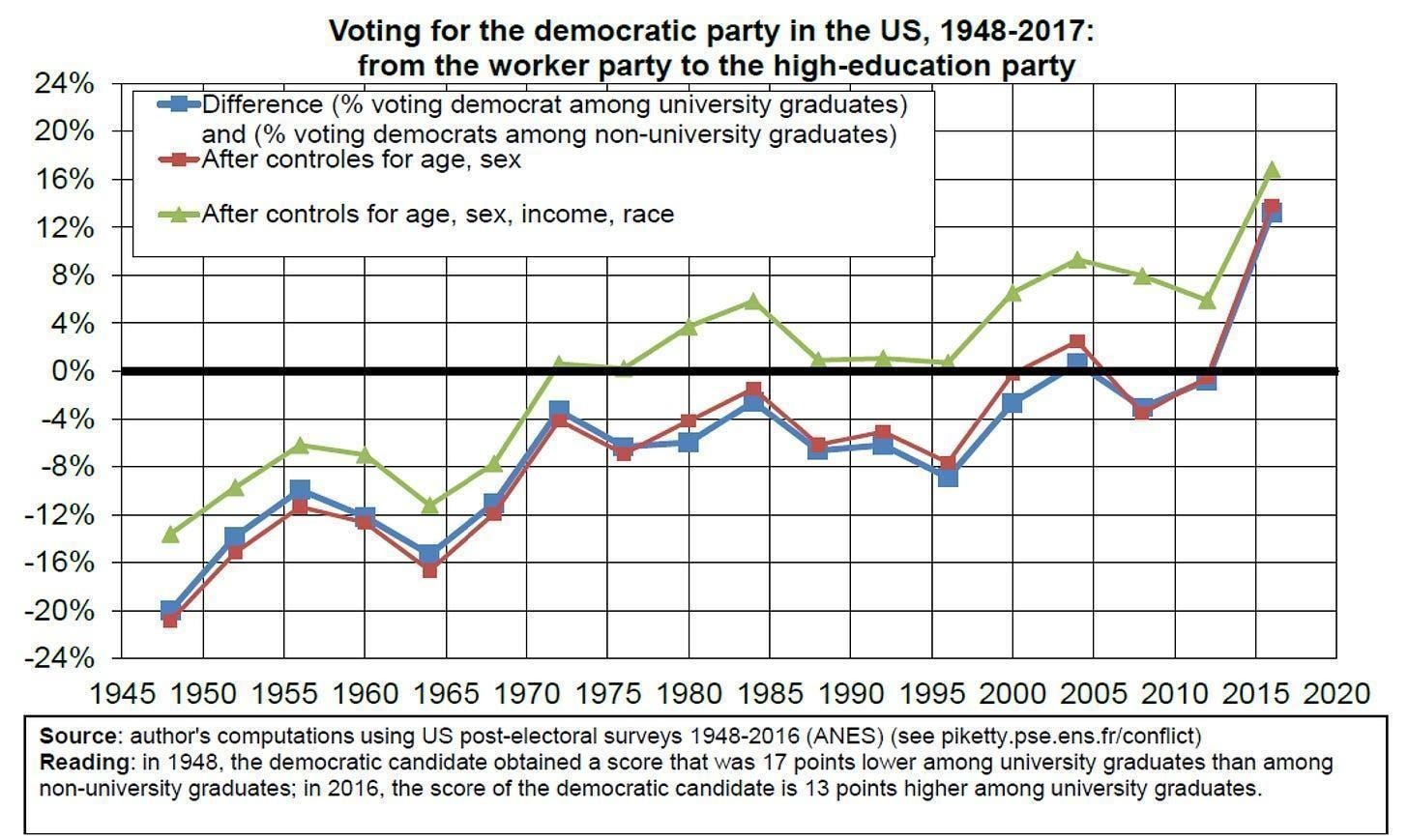
The chart does not show our most recent elections, but surveys indicate that education polarization spiked further in 2020 and 2024. Including those data would thus make the pattern even more striking.
Brahmin Left parties continue to favor redistribution, even as they have lost their working-class character and overriding commitment to an economic model of capitalism that could produce better market outcomes for workers (a phenomenon sometimes termed “predistribution”).
But what really defines the Brahmin Left parties—and marks their decisive break with social democracy—is a shift of priorities toward sociocultural issues of primary concern to their educated constituencies. These issues generally harken back to the movements of the 1960s around racial and gender equality, the environment, and cultural tolerance, and are of far less interest to most working-class voters.
The opportunity costs of this new focus meant that the economic concerns of blue-collar voters were necessarily reduced. It was much more a zero-sum game than social democratic leaders were initially willing to admit, even if over time this fundamental fact became glaringly obvious.
The second and most critical effect of the sociocultural focus was that catering to professional class priorities bred ever more reliance on these voters and the need to accommodate them as their preferences became more politically extreme. And that is exactly what happened.
Consider the four biggest changes in Leftist priorities in the twenty-first century. These are neo-racialism, mass immigration, gender ideology and transgender “rights,” and climate catastrophism and the rapid green transition. None of these were of, for, or supported by the working class but rather reflected the increasingly radical priorities of professional-class voters.
Neo-Racialism
A key moral commitment of the twentieth-century Left was to make societies colorblind. It was unfair that racial discrimination could truncate the life chances of nonwhites, therefore the Left strenuously advocated for ending discrimination and unequal opportunity. They won the argument, in the process pulling social democrats and social democratic-oriented parties in their direction.
Americans today believe, as did Martin Luther King Jr., that people should “not be judged by the color of their skin but by the content of their character.” In a 2022 survey, 92% of respondents agreed with the statement that, “our goal as a society should be to treat all people the same without regard to the color of their skin.” This is what Americans deeply believe in: equal opportunity, not, it should be noted, equal outcomes.
But a funny thing happened on the way to the twenty-first century. Instead of treating the colorblind society as a noble ideal, these increasingly Brahminized parties lost faith. Prodded by increasingly radical professional class activists, they began to favor color-conscious remedies like affirmative action that went far beyond anti-discrimination and equal opportunity, and to oppose colorblind policies if they did not produce desired outcomes by race. Indeed, the very use of the term “colorblind” has become Right-coded, evidence of supporting racism rather than opposing it.
It contradicts logic and common sense. And it has led the Brahmin Left parties to take positions with little purchase in social or political reality that are offensive to the basic values most working-class voters hold.
Mass Immigration
Which brings us to mass immigration. Historically, social democratic political parties were suspicious of uncontrolled immigration, even as they opposed xenophobia and supported moderate levels of legal immigration. But in the twenty-first century, immigration surges abetted by the erstwhile social democratic parties have led working-class areas to move Right, both in Europe and the U.S.
The Brahmin Left on both continents refuses to see anything wrong with a de facto policy of mass immigration, which is considered an unalloyed good contributing to a more diverse society. Therefore, to oppose mass immigration is to oppose diversity, which can only mean that you are racist and xenophobic. It’s that simple.
This attitude has been a huge mistake because in fact there are rational reasons for voters, especially working class voters, to oppose mass immigration. Where are the Brahmin Left politicians who are willing to unapologetically proclaim the following fundamentals of a realistic immigration policy?
Huge numbers of people are willing to break the laws of rich countries to gain entry. If you do not enforce the law, you will get more law-breakers and therefore more illegal immigrants. If you provide procedural loopholes to gain entry into these countries (e.g., by claiming asylum), many people will abuse these loopholes. Once these illegal and irregular immigrants gain entry to these countries, they will seek to stay indefinitely regardless of their immigration status.
Tolerance of flagrant law-breaking on a mass scale contributes to a sense of social disorder and loss of control among a country’s citizens, who believe a nation’s borders are meaningful and that the welfare of a nation’s citizens should come first.
There is, in fact, such a thing as too much immigration, particularly low-skill immigration, and negative effects on communities and workers are real.
If more immigration is desired by parties or policymakers, from whichever countries and at whatever skill levels, that immigration should nonetheless be regular, legal immigration approved by voters, including working-class voters, through the democratic process. Backdooring mass immigration over the wishes of voters because it is “kind” or “reflects our values” or is deemed “economically necessary” leads inevitably to backlash.
These are the realities of the immigration issue, and each and every one of them has been ignored by the Brahmin Left parties during the first quarter of the twenty-first century.
Gender Ideology
Social democratic and social democratic-oriented parties were able to absorb basic conceptions of women’s rights and sexual equality that emerged in the 1960s. The idea was that women and men should have equal rights and that there is no “right” way to be a man or woman—gender non-conforming behavior is just a different way of being a man or woman. Therefore, no one is born in the wrong body.
But then things changed. Perhaps nothing would surprise a time traveler from the twentieth-century Left as much as the adoption of transgender “rights” as a defining issue. Brahmin Left parties in Europe and very much here in the United States have uncritically embraced the ideological agenda of trans activists who believe gender identity trumps biological sex, and that therefore, for example, transwomen—trans-identified males—are literally women and must be able to access all women’s spaces and opportunities.
In reality, sex is a binary; males cannot become females and females cannot become males. Transwomen are not women. They are males who choose to identify as women and may dress, act, and be medically treated so they resemble their biological sex less. But that does not make them women. It makes them males who choose a different lifestyle.
Gender ideology now thoroughly dominates Brahmin Left parties. Nowhere has it been clearer that the priorities of radical professional class voters, activists and NGOs take precedence over those of the working class.
Climate Catastrophism
At the end of the twentieth century, climate change was an issue for social democratic political parties, but generally a peripheral one. A time-traveler from the year 2000 would be shocked to discover how the status of the issue evolved in the intervening decades. Far from peripheral, it became a core part of the Brahmin Left’s political identity.
The working class has not been impressed. In the United States, these voters view climate change as a third-tier issue, and overwhelmingly prioritize the cost and reliability of energy over its effect on the climate. Making fast progress toward net-zero emissions barely registers with them.
The Democrats’ assurance that the clean energy transition will deliver prosperity has fallen on deaf ears. Working-class voters—rightly—do not believe the green transition is delivering or will deliver prosperity, nor do they believe the end of the world is nigh if the green transition doesn’t proceed really fast. And Bill Gates thinks they’re right!
Conclusion
Could social democracy be resuscitated—rising Lazurus-like from its terminal condition? Is a working-class-oriented politics still possible that aims to both promote a dynamic capitalism and channel the benefits of that dynamic growth?
Perhaps. But a good part of the problem here is that Democrats, broadly speaking, have lost interest in the general goal of economic growth and a richer country. That goal has taken a back seat to others deemed more important, like fighting climate change, reducing inequality, pursuing procedural justice, and advocating for immigrants and identity groups.
The invaluable Deciding to Win report analyzed word frequency in Democratic Party platforms since 2012 and found a 32% decline in the appearance of the word “growth” compared to a 150% increase in the word “climate,” a 1,044% increase in “LGBT/LGBTQI+,” a 766% increase in “equity,” an 828% increase in “white/black/Latino/Latina,” and a 333% increase in “environmental justice.”
Getting from these priorities to a revival of social democracy will be very, very difficult. Of course, there is no law that says a working-class-oriented politics aiming to promote dynamic capitalism and channel the benefits to ordinary workers can only come from the Left. But that’s a story for another day.

Hands down the best piece ever published on the Commonplace Substack. The author has done a masterful job making very astute and likely accurate observations. My only nit is with Friedman and not the author, I’ve seen plenty of people make hugely irrational money decisions, including me!!!
I think you left out an important point: that a significant portion of the "Brahmin left" is anti-capitalist. My impression is that socialism was never that popular among the working class in the US. Those who are socialist or socialist-adjacent are never going to be interested in promoting growth.