

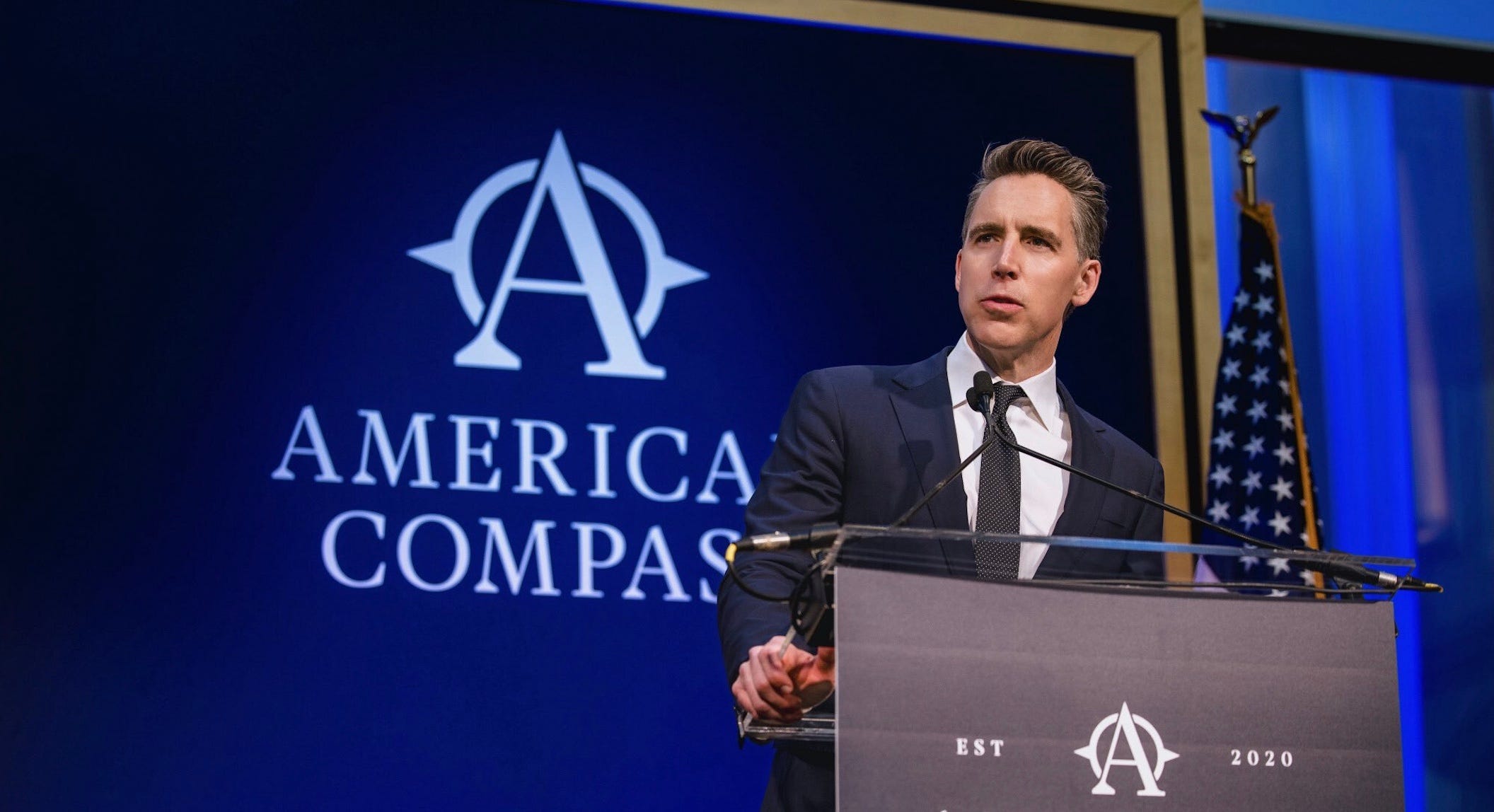
Excerpted from remarks delivered at American Compass’s New World Gala on June 2.
It is a pleasure and a privilege to be here tonight among patriots, among friends, and in a seminal year for the Republic and the liberty that we cherish together, the 250th anniversary of our nation.
Our Founders aimed at the most difficult of tasks—to bring forth in this weary world a novus ordo seclorum, a new order for the ages—and they succeeded. We are its heirs and beneficiaries. We must ask ourselves tonight if we are prepared to perpetuate and safeguard what they gave us, what God has given us in this time of test and challenge, for we are confronting new questions of technology and science that will test our commitment to the great moral covenant that binds us together as a nation.
The decisions we must soon make about the most powerful technology of our lifetimes—the technology of artificial intelligence—are among the most difficult we have yet faced as a people. The decisions will go far beyond questions of economics or policy. They are questions of labor and the family, of freedom and the value of human life. They are fundamental questions of our identity. They are questions about the nature of this republic given to us by God, and they come to us at a moment when that republic is in signal danger.
Two generations of feckless policy in Washington have inflicted economic destruction on the middle class, deconstructionist lessons taught in the academy have all taken their toll, and they have torn the moral fabric of our national life. The greatest test of our age and the highest task of our time is to repair that fabric and reclaim the moral vision that binds us together as a people. AI is only the proving ground—our moral covenant is the heart of the matter.
Can we keep this republic under God?
A Covenant Formed
I begin here because this is what makes America who we are. Our national motto proclaims that we are one nation under the Almighty’s providential care, and that has been true since the days of our earliest founders. Before Washington and Madison and Jefferson, before Benjamin Franklin and Benjamin Rush, there were the Puritans—those brave and venturing souls who crossed the cold Atlantic to found the city on a hill.
They left behind them a continent full of kings and bishops on which they chose to turn their backs. They left behind a whole world of ideas, the medieval world, which was controlled by one idea above all—that everything and every person has its place in the eternal chain of being, that nothing moves, no one rises. The prince was born to rule, the peasant was born to work, and each must remain in his place in the grand and eternal hierarchy.
Well, our forefathers thought differently. They read the Good Book differently. They read it to say that God called each man to be a saint, that he endowed each person with eternal import. “The poorest he in England hath a life to live as the greatest he,” they said. And they were willing to cross an ocean for that conviction, to go to a wilderness for it, to brave the great American desert, as they called it.
They dreamt of a commonwealth here in this place where every man might pursue his calling and work out his salvation, where men together might live in liberty under God. And they swore a covenant on the deck of a ship called Arbella. In the year 1630, they pledged their lives, their labor, and their very souls to the service of God and the freedom for which he had set them.
It was there in that moment that the United States of America was born. It was in that moment that they brought forth a new order for the ages. For the first time in history, a commonwealth was born not by conquest, not by blood, not by the divine right of kings but by the free consent of free men pledging to live together under the laws of God, to give themselves to his moral laws, to make them real in time and history, to make them the charter of a nation.
And this is the answer, by the way, to that question that has so occupied the conservative mind of late—are we a propositional nation or are we an ethnic one? Are we founded on a set of abstract ideas or according to a specific racial lineage? And the answer is neither.
We are founded on a covenant, on an oath that runs deeper than blood, on a pledge made at a particular time by particular people to themselves and their posterity, to live before God and under him. Every nation shares a moral order, that’s what makes it a nation. Societies are not bound together by abstract enlightenment principles that float around in midair, nor are they bound together by blood—certainly our nation has never been.
They’re bound together by moral beliefs, by a shared vision of what is right and what is good, what is just and what is honorable, what human life means, and why it is worth protecting. And that vision, call it our national religion if you like, determines who we are as a people and the life we lead together. That vision is what has made us who we are today.
Since that moment on that fateful Atlantic crossing all those long centuries ago, we have tried to steer the ship of our state according to the covenant faith our forebears left us, and the profound vision of liberty that it offers up. John Winthrop, the man who led the Puritans, put it best:
“The liberty we cherish,” he said, “is not the liberty common to the creatures to do whatever you choose, to go wherever you list. It is not the so-called freedom where the strong oppresses the weak and the rich steals from the poor and the elite rules over the rest. That is the freedom of the belly, the freedom of the beasts.” The old world knew all about that liberty. They lived it. Our forefathers crossed the Atlantic to escape it and in search of something better.
They looked for the liberty, as Winthrop said, between God and man. This is the liberty that protects the worker and his wages, the liberty that cherishes the widow and the orphan, that turns on consent and sees rights not as privileges to be won by the hand of the strong but as gifts given to each from the hand of God. “This is a liberty,” Winthrop said, “to do that only which is good and just and honest.” And that’s the liberty that we have loved and lived together as a nation from the first.
By that vision we’ve shaped our whole society and our economics.
A Covenant Kept
That history is relevant now for a reason. I know there are those, particularly in my party, who say that we built the greatest and most prosperous economy in the history of the earth by letting nature take its course, by letting the free market and the gods of capitalism do what they will. It is simply not so.
We have chosen time and again to shape our economy, no less than our society, by the moral vision of liberty. We have chosen to put people before money. We have chosen to protect the working man as well as capital. We have chosen to shelter the poor. Just consider when Abraham Lincoln signed the Homestead Act in 1862 in the midst of the great war that nearly unmade us. He offered 160 acres of public land to any citizen willing to work it.
What did he not do? He did not create a new landed gentry of the West. He did not permit the capitalists of New York or Philadelphia to have serfs beyond the Mississippi any more than he was willing to allow the South to have slaves. No, he acted on the moral principle that in a republic, every man deserves to earn his own way, by his own labor, through his own calling. Lincoln embraced the moral architecture of the covenant.
Or, when Samuel Gompers and the early labor movement demanded a limit to the hours in a workday. The mill owners heard an economic argument, but the truth is the men appealed to theology more than economics. They said that a man is not a machine, that he has a family and a soul and a Sabbath, that his hours do not belong finally to the man who signs his check but just as much or more to the God who made him. The eight-hour work day was the outcome. It was covenant economics.
When the industrial reformers worked to end child labor, they appealed to moral liberty. When they fought for workers’ pensions, they appealed to our moral principles. When they created social insurance to guard against the ravages of the industrial economy, they looked to our moral covenant.
It is that great covenant that has made us the wonder of the world, a mighty republic with a middle-class economy and a politics of We the People. It is that covenant we must renew today. For we hear now in this age the old voices of the old form of liberty better known as license. AI is not inherently evil. It’s not inherently anything. It’s a tool, but it is the most powerful tool of our lifetimes. And the question before us tonight is, whose hands will hold it, and to what ends? For such a tool of power can serve liberty or it can serve license.
It can serve our moral covenant, the freedom that is good and just and honest, the freedom that uplifts the worker, that shelters the child, that disperses opportunity to the many. Or it can serve the liberty of license, the freedom of the belly and its passions, the freedom of the strong to take what they can and bend the weak to their will.
Let me be blunt. Left to itself, artificial intelligence will not choose moral liberty. It will choose the passions. It will choose appetite. It will gather power into the fewest hands the world has ever seen and call the result progress. That is the rule of the strong over the weak. That is the dissolution of our moral covenant. It is the oldest temptation in the history of humanity, now just dressed up in silicon.
Make no mistake about which liberty so many of the barons of big tech have chosen. Listen to how they talk of disruption, of moving fast, of breaking things, of a world to be remade by whoever is bold enough to seize it. You strip away that jargon and the sometimes-good intentions, and you’ll find the temptations of an old creed that says the strong should rule because they are strong, that the future belongs to whoever is powerful enough to make it, that might, in the end, makes right.
That is not progress, it is the state of nature. That’s the law of the jungle, scaled now to the cloud and bankrolled to the tune of hundreds of billions of dollars. It is the very thing John Winthrop and his hearty band of Puritans crossed an ocean to escape, a world in which no covenant stands above the will of the powerful.
So we must choose. Together as Americans across this country, we must choose. In deciding how to govern this technology, we are not merely writing policy. We are renewing or surrendering the moral basis of our life together.
The covenant does not keep itself. Every generation must swear it again. We will swear it, or we will break it over artificial intelligence.
A Covenant Renewed
We do not have to imagine the stakes because they’re right there in front of us. We are watching a handful of companies assemble a concentration of capital, of information, and of political power without precedent in the American experience. The covenant is being tested in real time, and the choice is ours—for now.
We can already see the shape of our fate if we make no choice at all. We are becoming a country in the shape of a “K.” A small upper arm of the K is rising: The developers, the engineers, the investors, the founders of the firms with the compute and the capital. The economist’s curve and the executive’s bonus and the venture capitalist exit. All of them bend in the same direction. All of them are bending up.
A long lower arm of the K, however, is bending in the opposite direction. The truck driver, the paralegal, the local newspaper editor, the recent college graduate, all of them are being pulled down. The country is sorting itself onto the two arms of a single letter. The upper arm grows fabulously rich. The lower arm gets quietly replaced. …
I suggest to you that a republican and democratic people cannot accept it. But who will speak for them? That’s the question of the hour. Who will speak for them?
Neither political party in our country has offered a defense of our moral covenant that the nation needs. For too long, working Americans have been given a choice between a party that believes their values are bigotries to be unlearned and a party that believes their wages are externalities to be minimized.
There’s a party of the faculty lounge and a party of the boardroom, a party that tells the working man his church is the problem and a party that tells him his pension is too expensive. Neither party has spoken for him. Neither party has been worthy of him.
President Trump made this point over and over again in his national campaigns, and the Republican Party establishment has tried to ignore him. Artificial intelligence is the issue in our day that is going to force the old parties to confront their failure.
True to form, these two voices are offering two similarly unfulfilling answers on AI. One voice sounds beholden to the Silicon Valley elite. It’ll tell you that artificial intelligence is the greatest tool in human history and the proper role of government is to step out of the way and just let the future come.
The other voice sounds beholden to the petty grievances of identity politics. It may warn about the dangers of artificial intelligence, but it has no vision for how to use them for the working man. It’s more concerned with plotting where that working man ranks on the hierarchy of intersectionality than with the needs of his family. It does not have to be this way.
Conservatism is not the defense of a particular economic arrangement. It is the defense of the permanent things of moral order, of the dignity of the person, the family, the individual, the poor. Those permanent things are the covenant handed down.
Left to itself, artificial intelligence could dissolve every one of them, but we will not leave it to itself. We must not. We must act. We must pursue another way rooted in our Founders’ moral vision. Let me just suggest three lines of effort, three fronts on which we must act, and act soon.
First is labor. …
Every industrial transition in America has carried with it the same worry that the machines would eventually take all the work. We have forestalled that eventuality every single time in American history by choosing to bend the technology to the citizen, and not the other way around. We have demanded that technology serve our highest ideals, and we must do so again.
Some thinkers among the tech elite believe they’ve got the answer. They call it universal basic income, a monthly check to keep displaced workers fed and quiet and content while a few people grow richer than anybody in human history has ever imagined. What a hollow answer. What a terrible idea.
A republic of free citizens cannot be built on a check. Remember Samuel Gompers and the eight-hour day. Work was never only about wages. It was about dignity, the soul, the Sabbath, the conviction that a man is not a machine. Pay a man to do nothing and you’ve not solved this problem. You’ve deepened it, and you’ve degraded him.
Decades of research show that meaningful work ranks right alongside faith and family and friendship as one of the pillars of a happy life. We do not reach new heights of flourishing by putting Americans on a stipend. We reach them by honoring their labor. We must regulate—yes, I did use that verb—regulate artificial intelligence in the economy to ensure that it aids the worker but does not displace him.
Take autonomous vehicles for example. I’m for every advance in technology that you can put into a cab with a commercial driver who makes their living on the road. Everything you can do to make his life better, I’m for it. But I am against replacing the commercial driver. We should prevent AI from taking over jobs that only humans ought to do, such as dispensing medication, providing personal counsel, or arguing in court, to name just a few. These are not anti-technology principles, they are about putting people ahead of money. This is covenant economics.
The second line of effort involves data centers. …
The companies that build these facilities are some of the wealthiest enterprises ever to operate on the face of the earth. They are wealthy enough to bring their own power. They are wealthy enough to protect residential rates. They are wealthy enough to safeguard local water. The president was right to ask them to do all of these things. And they should be prohibited from building further until they agree to do so.
The third front is protecting our children. The most dangerous frontier of artificial intelligence today is not the boardroom. It’s not even the battlefield. It’s in your home. It’s in the bedrooms of your children and in the palms of their hands. … Documents leaked from Meta last year showed that the company’s own internal guidelines had explicitly authorized conversations with minor children that Meta itself described as “sensual.” That’s their word. Meta approved this in writing, behind closed doors, of course. They approved it. Why? To maintain engagement, to keep their user base, to drive revenue.
Here is the old liberty of the strong in its plainest and ugliest form, the freedom of the belly and the passions, the feeding of the weakest souls among us. The Puritans had a word for a man who would trade a child’s innocence for engagement and revenue. That word was not “entrepreneur.” And a moral people should not grant behavior of this sort to go forward. …
Reclaiming Our Citizenship
Behind every one of these fronts—labor, data centers, children—there is a deeper question. Who decides? Who will set the terms of the artificial intelligence era? ...
I’m for the republic. I’m for the citizen. I am for labor, the community, and the family. I’m for the worker. I’m for the small town. I’m for the constitutional inheritance that says this country belongs not to a board and not to a bureau, but to the people of the United States.
And let me offer a word to my own party, because the Republican Party has a choice of its own to make, a choice that may well define its identity for the next half century. We can be the party of the boardroom. We can be the party of the donor and the share price, the party that measures a man by his market value and a policy by what it does to a stock. Or we can be the party of the covenant, the party of the good, the just and the right, the party of the worker and the family and the small town, the party that remembers our commitment to justice for all, to the sanctity of the individual, to the dignity of labor, and yes, to the priority of the poor.
But we cannot be both. We must choose. A party that bends the knee to money and power will not in the end act to defend the things that money and power cannot buy. So I’m asking my party to choose, to stand with our moral covenant and not with the barons, to be once more the party of the American who works with his hands and prays on his knees and asks only that his country keep its faith with him.…
We are not raw material on the hands of those who build the machines. We are persons made in the image of God. Just days ago, Pope Leo XIV pressed this very message, issuing an encyclical that called on all people of goodwill to reject the temptation to build a Tower of Babel, as he put it, rather than a city that promotes human dignity. Will Americans understand that message? We’ve been living by it for 250 years. For we know in the end that license is not liberty at all. …
On the deck of that ship in the year 1630, a company of free men and women swore an oath to live before and under the Almighty. Their covenant is still ours to keep, and its terms have not changed. The technology is new, but the choice is old, and the people who must make it, a free people governing themselves under God, are still here. The republic is still ours, and we shall keep it.
Josh Hawley is the senior United States senator from Missouri.
This is well done and inspiring. I am not 100% onboard with the depth and breadth of the fear, but I do agree that it is, yet another big inflection point in technological advancement that is a crucible, for the human condition.
But I have a very straight-forward and rather obvious counter to the problems it can cause. It seems frankly asinine to me that I even need to mention it.
Today the total federal, state and local government spending on job creation and retention is about $400 billion per year. You heard that right.
The federal SBA programs exist exclusively for public policy goal. Now, the primary SBA loan programs are non-subsidy (pay for themselves with borrower fee revenue), but every year $50 - $100 billion in loans and grants are made to small business that hires.
Almost every other federal government agency has some type of economic development loan and/or grant program... generally several. State and local government do the same.
We do this while we also encourage our domestic corporations to offshore. It is idiocy.
I agree that UBI would be a terrible idea. We absolutely KNOW that the value of a good job fills human needs far in excess of just the ability to pay for rent and buy food.
What need is first an agreement that nobody has any right to be ensured a level of prosperity. Housing is not a right. Food is not a right. Healthcare is not a right. These are outcomes and we should never legislate outcomes. Instead, we should agree that every able-bodied person should have a right to have reasonable access to work and a career... basically an agreement that they require the means to earn their own outcomes.
Reasonable access to a job, should be a right for anybody that needs or wants to work.
This fits in the pocket of the ideas and expectations of our founders.
We need a new "Job Act" passed by the federal legislature and signed into law by the President. That act should include tax and regulatory carrots and sticks to encourage business to hire real human workers. There should be more funding to help business work with schools for specific job training. There should be enhancements in SBA programs and other programs to get capital to business that is supporting domestic job creation and retention. Labor surplus areas, etc., should get extra help for business that hires to locate there.
This should be a bipartisan effort. Only those politicians embedded with the big corporate and Wall Street donor pool would resist as these new directions threaten their corporate profit maximization and corporate primacy.
People having the ability to earn their own reasonably good life is the bedrock of our county's moral foundation. It is why we have been a successful diverse nation. It is why class conflict after the gilded age, when the Fair Labor Act was passed, became a de minimis social and political challenge... because everyone could see that they had reasonable access to earning their own better life.
Get everyone working and solve many, if not, most of our key social problems. Conversely, having fewer and fewer working for a living... plan on civilization decline into a dystopian hell.
The moral foundation Senators Hawley calls for produced the 13 distinct cultures of the colonies, which continue to exist today.
Without the framework of government developed by the Founding Fathers based upon their interpretation of the Enlightenment, however, these 13 cultures would reside in 13 different countries, much as they did in Europe prior to the EU.
The path to the worthy future Senator Hawley desires, as a result, requires understanding differences and making good judgements. The moral foundation he calls for, in other words, requires the capacity to work with the abstract ideas he wishes to subordinate.