

Falling Fertility Is a Bipartisan Tragedy
No one should celebrate the widening fertility gap between conservatives and liberals.


Conservatives and liberals are splitting along fertility lines more than ever before, a gap that will only grow more pronounced as the next generation takes shape.
Some right-leaning commentators are running victory laps over the “more conservative world” of the future. After all, counties that voted for Donald Trump in the 2024 election had higher fertility rates than ones that voted for Kamala Harris. Republican states have higher fertility than Democratic states, and parents are more likely to move from blue states to red ones.
But it’s a Pyrrhic victory. Yes, young women are increasingly swinging to the Left and, at the same time, losing interest in marriage and parenthood. But this presents a problem for young men who hope to start a family. Even if conservatives stay committed to marriage and childrearing, we could see a mismatch between the sexes that prevents it from happening.
In the 1990s, conservative women between the ages of 35 and 45 had, on average, 2.1 children, compared to 1.7 among liberal women. The latest data from the General Social Survey shows that today’s conservative women in the same age range have an average of 2.3 children, compared to 1.6 among liberal women.
According to a new brief from the Institute for Family Studies, liberals are more likely to cite mental health concerns when thinking about parenthood. About 19% of liberals said their mental health was not good enough to have kids, compared to 10% of conservatives. Additionally, 18% of liberals worry about passing bad genes or inheritable conditions to their offspring, a significantly higher than that of conservatives (10%) even when controlling for parental status and other variables.
Data also suggests that the fertility divide may widen even further in the years to come.
One longstanding poll, the Monitoring the Future survey, asks American high school seniors about their ideal family size. From the late 1970s through the early 2010s, the vast majority of both liberal and conservative teens said they wanted to be parents someday.
But over the past decade, left-leaning teens have shifted dramatically away from the parenthood ideal.
Today, fully 23% of liberal teens say they don’t want kids, and an additional 10% are unsure. Those identifying as “very liberal” are the least likely to want children, with 39% saying they don’t know or do not want kids.
On the other side of the aisle, just 5% of conservative teens say they don’t want kids and 6% say they are unsure, consistent with survey results in previous decades.
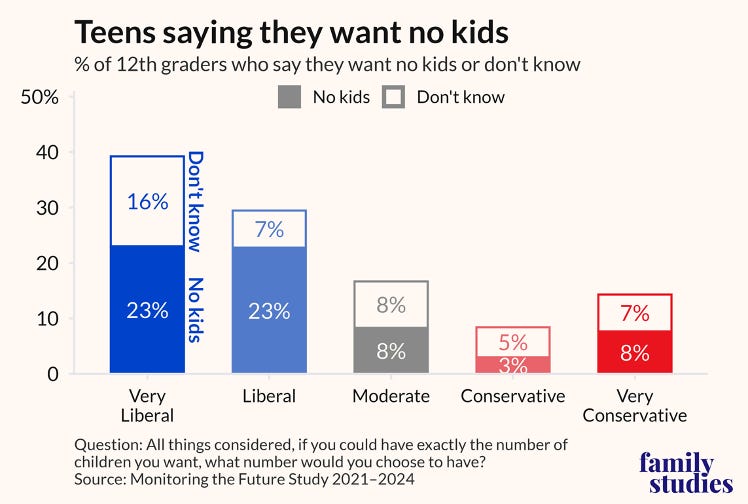
The data is even more eye-opening when it comes to the two sexes, with teenage boys now more likely to say they want kids than girls.
Almost a third of 12th-grade girls, 31%, say it is unlikely or uncertain they will want children if they get married, compared to 22% for boys. The same figure sat at 16% for both girls and boys in 2009, before the present gap emerged.
Historically, teenage girls were more likely than boys to say they expected to get married in the future. The Monitoring the Future survey found that between 1976 and 2010, 83% of 12th grade girls said they expected to marry one day, compared to 76% of boys. But the gap narrowed in the 2010s as girls became more skeptical of marriage. Following the COVID-19 pandemic, only 67% of 12th grade girls say they expected to marry, versus 72% of boys.
The ideological divide largely explains the diverging family ideals between American boys and girls. Liberal boys are about as likely to say they want no kids as liberal girls. Conservative girls and boys are about as likely to desire parenthood. Once you control for political views, the difference between boys and girls nearly disappears. Girls identify as liberal at higher rates, which accounts for the new dissensus on parenthood between the sexes.
It’s unclear whether becoming liberal makes teens desire kids less, or the other way around. It is plausible that fearing marriage and kids moves people Left, and wanting kids nudges people to the Right. As my colleague Lyman Stone has argued, the Left-Right political divide might be emergent of deeper disagreements over sex, marriage, and kids.
In a time where young adults already struggle with dating and coupling, the last thing American men and women need is ideological divisions on whether to have kids after getting married.
The root cause of this swing is hard to pin down, though the trend correlates strongly with the wide adoption of algorithmic social media platforms. As has been widely discussed, social media provides users with divisive content about the opposite sex, and makes it easy to access pornographic materials as well. Teenage social media usage also correlates with poor socialization and worse mental health, neither of which will help people become successful parents.
With increasing rates of anxiety, depression, and loneliness among younger generations, mental health concerns could play a larger role in fertility decisions moving forward, especially among the liberal-identifying youth.
Although it is unclear whether liberal ideology leads directly to greater mental health concerns or vice versa, the survey data reflects a consistent association between liberal political views and fears about parenting and childbearing.
Given these trends, progressive commentators are sounding the alarm over the possibility of a more conservative political climate.
The Financial Times’s John Burns-Murdoch fears that “progressives risk ushering in a more conservative world,” going so far as to blame conservatives for the Left’s reticence to take fertility decline seriously.
Blaming the Right for the Left’s fertility problem is odd. For decades, progressives have worked to decentralize marriage and parenthood in culture and public policy, often celebrating singleness and a childfree lifestyle over the burdens that come with kids.
But the problem of low fertility will impact everyone, regardless of your political outlook. Fewer children, more loneliness, and greater division between the sexes will only add to America’s social strife.
Widespread isolation can lead to political extremism and other unhealthy social behaviors such as drug abuse and violence.
At a larger level, this generational shift could portend a remarkable change in the body politic. Family formation has been a near ubiquitous ideal for young Americans historically. Even with the cultural revolutions of the 1970s and 1980s, young adults were constant in their desire for family life. But if recent trends persist, we may see a future where the family loses further ground in American political life and cultural imagination. With low marriage rates, low birth rates, and an aging population, the American family desperately needs broad support.
In the long run, political polarization around parenthood is a game no one wins.
 | A guest post by
|
Young liberal women are essentially married to the government. The government provides the financial stability that previously was provided by marriage. It will be interesting to see what happens if that stability disappears. It could be by ideology if conservatives control government but in the end, the unsustainable debt will finish it off.
Meh. Birthrates are falling worldwide. Too many factors beyond political views. Most people in the US pay no attention to politics or liberal/conservative leanings.