


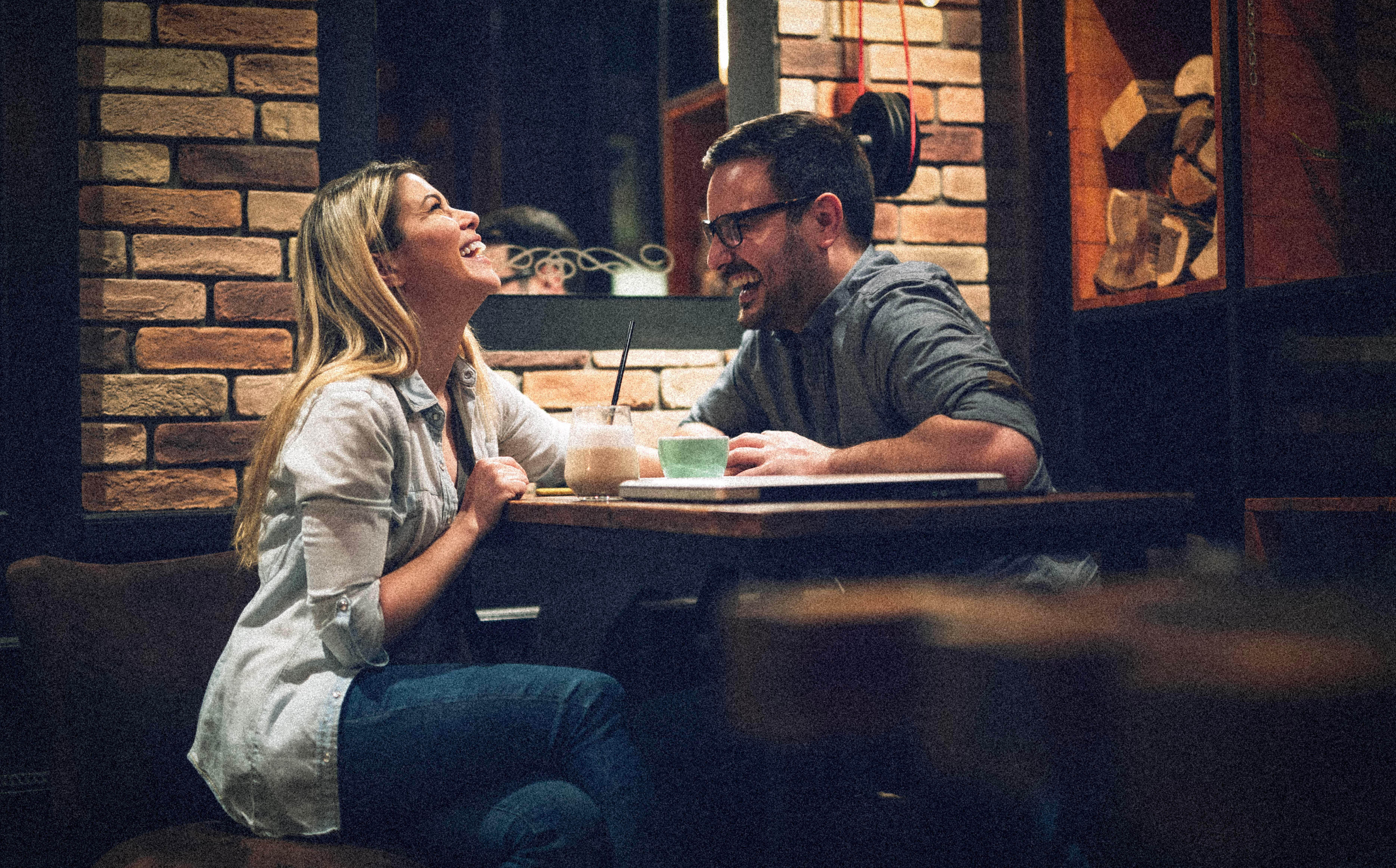
During my early-millennial adolescence, the mere thought of approaching a prospective date could send my stomach twisting. What should I wear? What should I say? What will she think? What, fear of all fears, if she says no?
One thought that never accompanied these palpitations: Who did she cast her last ballot for? Or, what if she asks me about mine? I can recall multiple semi-serious relationships lasting six months or more that involved not a single conversation about politics.
To my generation, such issues were irrelevant to our relationships, and our own parents were often in cross-partisan couplings. One of the most pervasive Boomer stereotypes is the staunchly Republican dad married to the Left-leaning mom, dutifully heading together to the polls to cancel out each other’s votes. It’s a heart-warming cliche that has played out millions of times across our republic, including by my own parents. It has also stood as a testament to that republic’s health: politics was less central to life and to identity, people separated political disagreements from personal judgments.
No longer. Politics now permeates an ever-widening swath of the ordinary American’s life, from school curriculum to parenting style. Courtship is suffering the consequences.
It can be hard to imagine a single dinner these days passing without a fraught discussion of Trump or immigration or abortion or some other hot-button topic. Depending on which survey you consult, roughly 70% of Democrats now say they would not date a Republican. Indeed, in the highly customizable world of online dating, many people pre-screen potential mates to avoid sharing a meal with someone who is likely to disagree about any of them.
On one hand, it’s reasonable to seek a mate who shares your values, many of which can be revealed through political preference. And as a practical matter, it makes sense to steer clear of anyone who might call you a fascist or a radical lunatic on the first date, just as few people like arguing with distant relatives at the holidays.
On the other hand, a politically filtered dating scene is a wildly ineffective one, with many negative effects downstream. The first problem is that political preferences are not distributed equally across the sexes. Single women are much more likely to identify as Democrats, while single men are more likely to lean Right.
That split coincides with the two major parties becoming somewhat gender-coded in approach. The Democratic Party hits hard on themes of compassion, caring, love, and helping the needy and downtrodden. Republicans, even before the Trump era, were associated with male-coded words like freedom, liberty, and individual responsibility. During the 2024 election, Trump trotted out uber-macho pro wrestling legend Hulk Hogan and “Detroit Cowboy” Kid Rock at the Republican National Convention, while Kamala Harris was endorsed by self-described cat lady Taylor Swift.
The result, as National Marriage Project director Brad Wilcox has pointed out, is that there are now two liberal women for every one liberal man, and two conservative men for every one conservative woman. With young Democrats more than twice as likely to say they won’t date a Republican as the reverse, the problem is especially acute for conservative men—and, conversely, for liberal women. The intense tribalism shuts out millions of couples who might otherwise be compatible.
Because I have been off the market for a long time (sorry, ladies), I consulted a few unmarried friends and family members, all of them far from Washington, for their sense of the scene.
All agreed that politics are inescapable in online dating—and inescapable once the conversation moves offline. Many singles list their affiliation upfront in their profile, writing “no Trump supporters” or, on the flip side, “I am a Trump supporter, understand that now.” It can be rather aggressive.
Things are no better face to face. Politics, I was repeatedly told, is guaranteed to come up on the first date, makes for awkward conversation, and absolutely presents a barrier to further connection.
A Gen Z man I spoke with attributed the trend to age-based differences, saying that “my generation is very political.” This person was a self-described liberal who wouldn’t date a Trump supporter.
But a Boomer told me the same factors now impact his age bracket, and agreed that this wasn’t the case 20 or even ten years ago. A “lean conservative” type, he’d rather not talk politics with prospective dates but has come to accept that’s no longer a luxury available to him.
“It’s almost like a litmus test,” he told me. “We used to ask Supreme Court nominees about Roe v. Wade. With dating, politics has become that litmus test—and it always comes up in the first conversation.”
Another young single surmised that politics comes up so early in part because there are a lot of people swimming in the dating app world and it’s helpful to narrow that down. Politics provides the easiest proxy for a broader set of values. She remembered an older relative who dated online around 2010 and wanted to be sure that any matches shared her religious ethics and morals. Today, politics is that filter.
But while partisanship may be an efficient filter, the data do not suggest that it is an effective one. The marriage rate has plummeted, in turn pushing the American birth rate to an all-time low. This represents a tragedy, with more people sleeping alone who don’t want to, and fewer people experiencing the joys that children bring to the world. The focus on intra-party matches is not making them happen more quickly, it instead appears correlated with matches not happening at all. (In the world of matches that have occurred, polarization is much less prevalent: As liberal as women may skew overall, married women narrowly backed the GOP in 2024.)
People with different political views can be compatible at the individual level. Most people’s direct political involvement, no matter how heated they get in conversation, consists only of casting a vote roughly once a year, or even once every four years. There is much more to life, and any couple will need to struggle through conflicts much more concrete and consequential. A nation whose citizens do not believe they can handle their political differences has a more fundamental problem—its citizens are unprepared to handle relationships altogether.
Maintaining perspective, openness to conversation, and tolerance for disagreement are valuable skills in any relationship, but particularly in one as fraught and perilous as dating in search of the special one who will become your spouse. If you’re unprepared to navigate the million other challenges of a marriage, politics might be an easy way out. But the escape is to loneliness, not happiness.
In the concept of ordo amoris, the outer circle of love is supposed to represent the world outside of our national borders, followed by a smaller but stronger one representing fellow citizens, and then concentrating down to your local community, your neighbors, your family and, finally, the person with whom you have chosen to share a life. Politics belongs mostly to the outer circles, where disagreement is inevitable and democratic processes mediate the conflict. Pulling it right to the center of our lives creates intractable personal conflicts that radiate back outward into intractable national ones.
This is nothing to be celebrated, and it was not always the case. For the sake of our relationships, and for the sake of the republic, we have to get people back to dating the other political party.
One of the few advantages of being old and not caring anymore. My marriage broke up long ago for other reasons but it would have never survived the politics of this era.
I was dumped because I voted for Trump. I am a seventy-something widow who had a great relationship with a gentleman for over 5 years. On the first date I told him I leaned conservative, so he knew. I am so many things other than my voting record as I tried to communicate to him. Such a shame.