


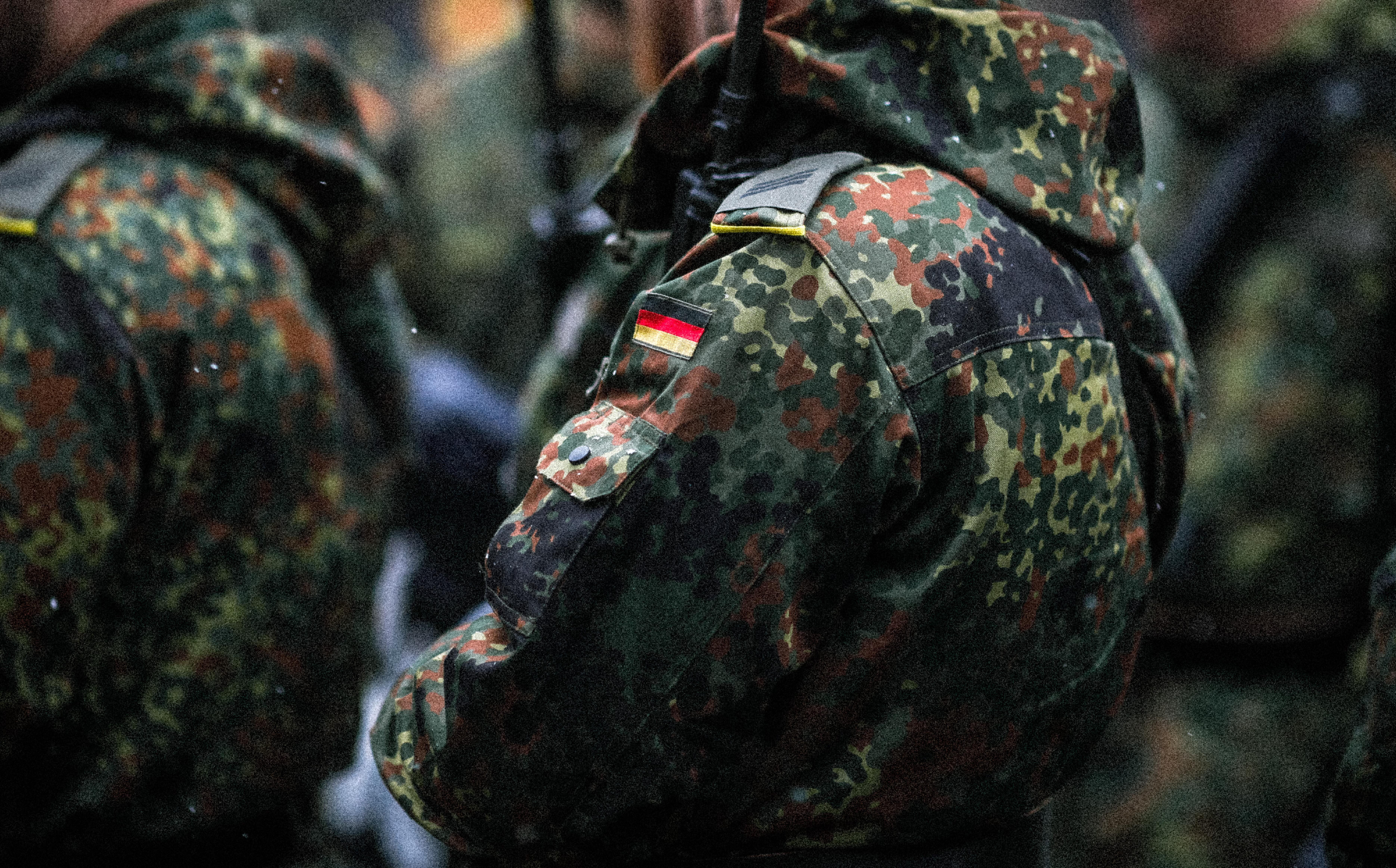
It has become conventional wisdom that Europe, and specifically Germany, is rearming itself. The widespread belief is that the continent, spurred by America’s decreasing interest in NATO, has finally decided it’s time to arm up in a significant way.
European Commission President Ursula von der Leyen set things off by announcing in early 2025 that the EU would increase defense spending by €800 billion by 2030. That amount is, of course, less than the United States spends on defense in a single year, but for Europe it constituted a bold statement. Her speech was followed, months later, by the German government’s announcement that it would increase defense spending to 3.5% of GDP by 2029.
Both pledges turned out to be false. Von der Leyen’s claim proved to be worth only €150 billion, the rest being entirely hypothetical. Even the €150 billion figure is somewhat of a mirage, as almost one-third of that amount will go to Poland, which has already rearmed itself. Germany’s promise, meanwhile, was quietly walked back just months later with a second announcement that the true figure would only be 3.05%.
These later developments underscore the reality that Europe, far from rearming, is really just playing for time—and that goes double for Germany. All of their promises—the EU’s 2030 pledge, Germany’s 2029 declaration—are set to be realized after U.S. President Donald Trump leaves office.
This is not a coincidence. While past presidents, including Barack Obama, politely asked Europeans to increase their defense budget, Trump’s threats to leave NATO have resulted in agreements like the Hague Summit Declaration, which saw all NATO members save for Spain agree to spend 3.5% of GDP on their military and another 3.5% on military-adjacent expenses. This is not American hyperbole: NATO’s General Secretary Mark Rutte wrote that Trump “[drove] us to a really important moment.” But that moment too comes to fruition only in 2035.
For the time being, German Chancellor Friedrich Merz and his government are hoping that their pronouncements—always promising change just far enough in the future to not require real action in the present—will satiate Washington. Germany’s leaders have pledged to become the most powerful military in Europe by 2039, but the truth is that the country is economically, societally, and politically incapable of doing so.
It’s the Economy, Stupid
Germany in the post-World War II era earned a reputation as the “engine of Europe” due to its immense production capabilities. But, as Michael Lind pointed out last year, if Germany is still an engine, it is quickly running out of gasoline. The country’s economy, across practically all sectors, is in dire straits.
Germany’s energy costs were exploding even before the Iran war started. In December 2025, Germans paid 39.6 cents per kilowatt hour of electricity (Americans, by contrast, pay roughly 15 cents). These high prices have come as Germany’s decades-long energy strategy—buy cheap Russian gas—has completely collapsed. When combined with its mid-2010s decision to eliminate all nuclear power plants from the country, Berlin has no easy way of fixing its energy problems in the near future.
The country’s most famous economic attribute, its industrial base, is collapsing as well. Germany shredded 160,000 industrial jobs in 2025 alone; that same year, Volkswagen closed a factory in its homeland for the first time ever. Industrial production has continued to fall this year, contrary to an expectation of growth.
Then there is the demographic crisis, which is afflicting all of Europe but has hit Germany particularly hard. The country is down to 1.35 births per woman, a fact which helped motivate some German leaders, including former Chancellor Angela Merkel, to encourage mass migration from the Middle East and Africa. The argument holds that new arrivals will work for cheap and fill gaps in the labor market, but the reality is not so simple. Mass migration produces its own economic costs: Germany spends around €30 billion per year on migrants and refugees alone.
All of these factors, combined with generally weak economic growth, have forced the government to tighten its belt. One of the first targets is Germany’s bloated welfare state, with Merz’s government recently announcing billions in cuts paired with increased fees to the country’s health care system. Germany is also considering sin taxes on tobacco, alcohol, and sugary products in order to raise funds.
These cuts are deeply unpopular and have helped make Merz the world’s worst-polling democratic leader, with only 19% approval of his government versus 76% disapproval (though it should be noted he is not far behind his neighbors, British Prime Minister Keir Starmer and French President Emmanuel Macron, who sport similarly low ratings). Any new military spending would require even deeper cuts that the voting public is unlikely to support.
Ain’t Gonna Study War No More
Germany was once, for obvious reasons, known as a country which did not shy away from conflict. But that Germany is gone, and its modern equivalent is deeply unprepared and unwilling to assume a war footing.
Even though the Iran War has driven gas prices higher, Americans are by and large remaining calm. Polling shows the war is very unpopular, but it has not yet created mass marches similar to those seen during the Iraq War. This is partially because the war is still not affecting most Americans outside of gas prices; but Americans may also simply be more accustomed to bombing the Middle East.
Germans, on the other hand, have not fought an offensive war since 1945. And the enemy they would be rearming to confront in modern times, Russia, remains ill-suited to motivate German citizens to sacrifice their welfare state, generous paid vacations (20 days per year, a minimum most Germans surpass), and state-funded retirement plans. Until 2022, when Moscow launched its full-scale invasion of Ukraine, German leaders were still encouraging the country to work with Russia.
Merkel, just one year prior to the invasion, lauded construction of the Nord Stream 2 pipeline, which would have increased the already immense amount of oil Germans bought from Russia. Furthermore, the part of Germany which would actually be “threatened” by Vladimir Putin, the east, is dominated by the nationalist Alternative for Germany (AfD), which seeks closer relations with Russia even today.
Russia has had an extremely difficult time making headway in Ukraine; after their initially large gains, further movement has been sluggish, making it hard for the average German to imagine Russian troops breaking through the rest of the country and heavily armed Poland before reaching their borders. Convincing the German population that they must rearm to face the Russian threat has therefore proved difficult.
That’s not to say German leaders aren’t trying. The government passed a law at the end of 2025 requiring that all citizens receive a military questionnaire upon turning 18. The document asks about their willingness and ability to serve and provides information on how to join. Men are required to answer.
This is significantly less of a burden than the American selective service, which still requires men to register for the draft. But young Germans came out in force to protest the milquetoast move, with demonstrations drawing thousands across the country. A 2024 poll found that 57% of Germans would not even fight to defend their country, and there are no indications that the number has fallen since.
If the Russo-Ukrainian War ends anytime soon, German society may be even less willing to make sacrifices to rearm, especially if Russia seems exhausted from the war and unwilling to start another.
The Art of the Impossible
Otto von Bismark, the man who forged the German Empire in the 1800s, once said that “Politics is the art of the possible.” But poor decisionmaking by German leaders has created an impossible political situation.
Merz’s government is toxically unpopular, yet there are no good options to escape from the political pits. The country, like most in Europe, has operated for decades under what is called a cordon sanitaire, an unofficial policy keeping all populist-right or nationalist parties out of governing coalitions.
This has kept the nationalist AfD out of power anywhere in the country, and whenever the party breaks through, even on a regional level, it becomes national news. For example, in 2020 the leader of the German region Thuringia was elected with the help of AfD parliamentarians, even though he did not seek their help and did not agree to a coalition government with them. The outcry, including from then-incumbent Chancellor Merkel, was so fierce that he was forced to resign less than a month later. Earlier this month, the German Greens in Saxony were horrified when their own motion—on slaughterhouse regulation—passed with surprise support from the AfD.
Thus, the Christian Democratic Union, Merz’s center-right Germany political party, cannot make significant change because the only other party willing to do so, the AfD, is entirely off-limits. That leaves only the Social Democrats (SPD), the far left (Linke), and the Greens, none of whom will countenance the kind of large-scale austerity needed for increased military spending.
The CDU’s hands are tied. The AfD consistently outperforms them in the polls (a recent poll put AfD at a record high 29%, well ahead of the CDU’s 22%). The only alternative is an ungovernable “coalition” of the CDU-SPD-Greens-Left—a mix of the center-right, center left, left, and left. Even that may not gain a majority amid AfD’s surge. If the poll results represented real seats, it is possible that the only realistic coalition would be an AfD-CDU majority, a prospect that all major CDU officials, and certainly Merz, have ruled out.
In short, it is difficult to see how Germany acts on its promises to rearm. It is economically unfeasible sans deeply unpopular welfare spending cuts, and German politics generally have become an unsolvable maze, with coalitions built solely on the notion that each party involved is not the AfD.
It is quite possible that German officials secretly know all of this and have never actually planned to rearm. Berlin, like other European capitals, hedged its bets during Trump’s first term in hopes that it would not need to deal with him again. That strategy worked—for four years. Now, Merz may simply be hoping that by 2029 he is again facing a friendly, Atlanticist, Joe Biden-style president who will be more lenient on the rearmament issue.
The Trump administration should act accordingly. Germany’s promises are not worth the headlines they are printed on. No matter how many summit agreements they get or how many seemingly positive news stories appear about rearmament, Germany’s leaders are simply never going to rearm unless significant, overwhelming pressure is placed upon them, such as the removal of a significant number of American troops. That’s where the administration should start. Reducing Brigade Combat Teams, a move recently announced by the Pentagon, is a good first step. Significantly troop reductions should follow. America has over 30,000 troops in Germany, a number that should shrink by at least two-thirds.
Even then, it’s possible that there may simply never be a rearmament coming. Because Merz, and Germany, may be all out of options.

Europe has fallen on the dead weight of its own social welfare. Will America be next? The Democratic Party and millions of fans of Mamdani are certainly trying. It is insane for those on the right to oppose Trump in the name of preserving the democratic norm. That norm will turn America into Europe in our own life time (I am 65)
Like most thinkers in the "new" right, Tony makes clear his disdain for our now former western allies. MAGA has made clear their antipathy toward democracies, be they in Europe, East Asia, or elsewhere. They're much more comfortable with fellow authoritarian regimes, hence our new alliance with Russia, the love affair with Orban, the endorsement of the fringe AdF party in Germany, etc. All of this is to the benefit of China, who MAGA ironically likes to finger as our most important adversary.
The "new" right has been successful in jettisoning our former allies and embarking on an America Alone strategery. They seek a return to a 19th century, multi-polar, might makes right world. Our sights have been lowered to dominance of the western hemisphere, with Russia and China left to dominate Europe and Asia. Stephen Miller has laid this case out explicitly.
The implications of this "new" approach have recently become clear. We stand alone in MAGA's disastrous Middle East war with only Israel as an ally (sadly an ally with different strategic goals than ours, assuming we even have a strategery). And our president's hat in hand pilgrimage to China exposed an America that had lost its former partners, greatly weakening the president's hand in his talks with Xi. China's scale dwarfs ours if we stand alone, with scale being a major determinant of major power conflict. With our former allies, we met or even exceeded China's scale. I'd rather have had our president face Xi with a phalanx of allies at our back.
Don has eliminated the former world order. Let's hope he knows how to build a new one. Judging from his daily incoherent bleats and slurred public statements, I'm not optimistic. He's far more focused on pocketing corrupt loot, pursuing political enemies, and plastering his name on things.
Good luck America.