


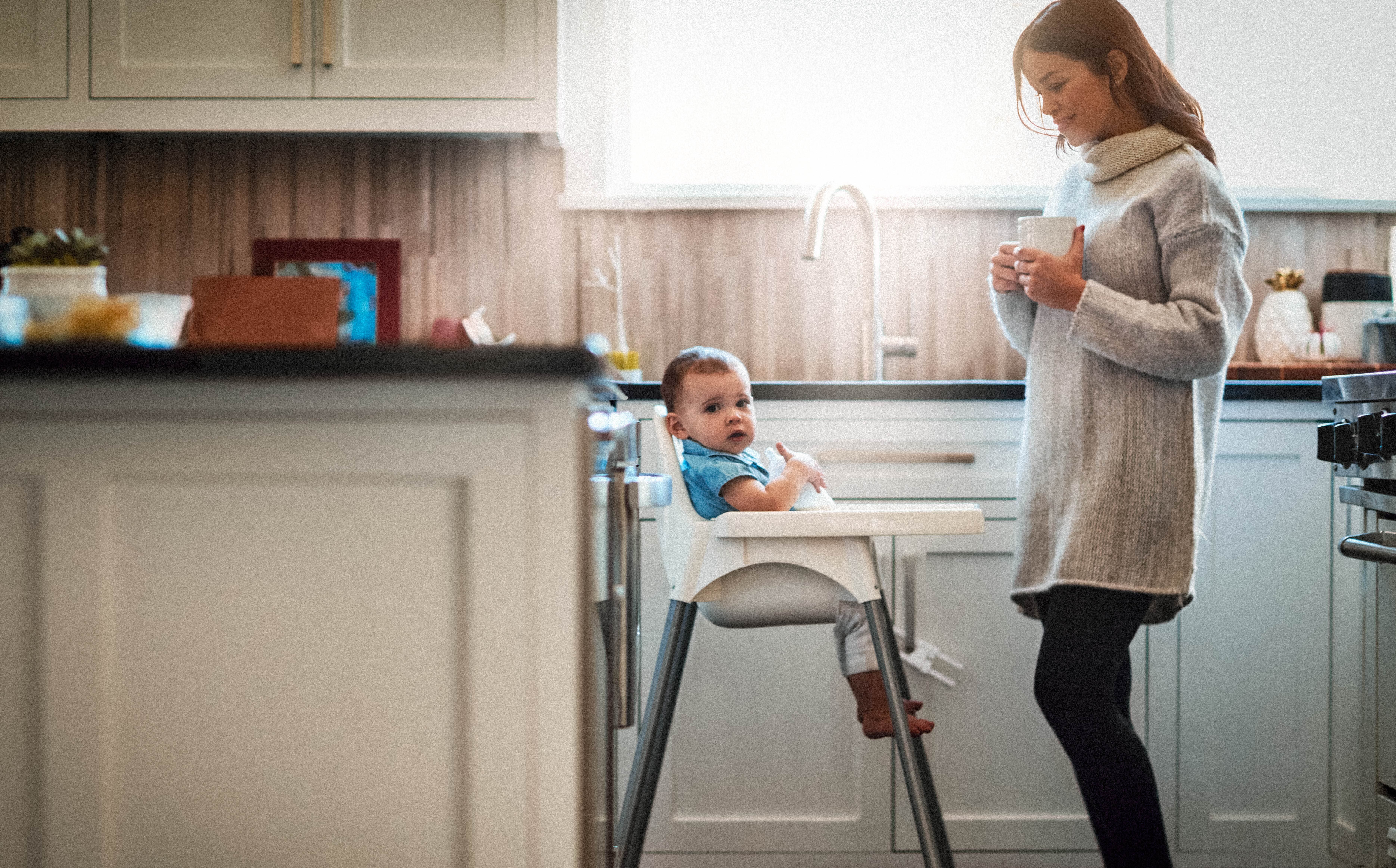
The right-of-center views itself as the protector of families. GOP leaders have dubbed it “the party of parents.” A new Heritage Foundation report is titled, “Saving America by Saving the Family.” At the 2025 March for Life, Vice President JD Vance said he hopes for an America in which the “benchmark of national success is not a GDP number or our stock market, but whether people feel that they can raise thriving and healthy families.”
These are correct and noble ambitions, but making them a reality will require more than slogans and pledges, no matter how sincere. Specifically, it will require giving moms—and high chairs—a seat at the family policy table. Doing so demands that we recognize the complications of having babies both in the room and in the wider world. And despite notions to the contrary, the New Right is leading the way in this space.
When it comes to having and raising children, the perspective of young families—and especially young mothers—is invaluable. No sensible person would try to overhaul the trucking industry without the input of truckers. Military strategy is not planned without the expert input of military members. Crafting family policy is no different, and doing so without mothers is as ridiculous as fighting a war without generals.
Moreover, involving moms in policymaking is a direct rebuke to the small number of loudmouthed misogynists on the Right who argue that women have no place in public life. Figures like Dale Partridge have achieved notoriety using catch-phrases like “Repeal the 19th”, referring to the constitutional amendment that gave women the right to vote. “A great way to destroy a place is to put women rulers in charge,” he once claimed.
No durable, electable, right-of-center coalition should have anything to do with those who believe repealing the 19th Amendment is desirable, and including mothers at the table is a great way to combat them directly. Let them froth at the mouth about removing women from the Supreme Court on their own time. The New Right’s priority should instead be helping a typical working-class mother of three in Ohio who’s losing sleep over whether she can pay her electricity bill.
Here is the hard reality: The United States must pay more attention to family policy. For decades, federal officials and politicians professed interest in supporting American families while only erratically providing real help. Declining family formation underscores the urgency of this issue, and moms who spend their days changing diapers, driving kids to baseball or ballet practice, and folding laundry must be able to share input on the decisions that will impact them the most.
For example, when deciding what (if any) funding to provide for external childcare options, we should listen to mothers who understand that a plurality of families would rather care for their young children at home. Ditto mothers who can explain why many working moms would rather have their children cared for by grandma or someone with a shared religious background rather than an external childcare center that bills itself as better for “kindergarten readiness.”
Even with regard to larger questions—manufacturing policy, war, immigration, etc.—moms often bring valuable insight on the home front that sophisticated experts may lack. In my own research, I was surprised to hear an incredibly insightful analysis of the Affordable Care Act’s “family glitch“ from a married stay-at-home mom who was dealing with the fallout. She may not have been a health care professional, but her assessment was sounder than that of many experts I’ve heard, because she had real-world experience with what the glitch actually meant for families.
Some mothers have a seat at the federal policy table now, but typically only those who follow a narrow path: work full-time for a think tank or in Congress, find childcare, and pursue policy aims through the job. There’s nothing wrong with this—moms who work full time are a valuable resource in policymaking, and we should all be grateful for them.
But the New Right should go further and think broader. Questions about marriage, children, and the spousal division of labor are among the most intimate any family will face. Good policymaking in this area requires sustained and thoughtful input from the people in the trenches: young moms raising little ones while also balancing the family budget and getting dinner on the table.
The Road Map
Any introductory political theory class will teach that “a political decision [is] legitimate only if it has been made in a process that allows for equal participation of all relevant persons.” Research indicates that policy is often more effective and better targeted when it includes input from those it seeks to impact. Both philosophically and practically, good family policy isn’t solely driven top-down by elites; it instead draws on the experience and preferences of ordinary people.
A number of religious, centrist, and right-of-center groups have already made serious efforts to include moms and their young kids at professional events, a good first step on the road toward better family policy.
Young mothers are often troubled both by isolation and a loss of identity as they adjust to life with a new baby. Dixie Dillon Lane, a homeschooling mom of four and author of the forthcoming book Skipping School, feels that professional culture, even on the Right, often intensifies these issues.
“I think we have a habit of presuming that children and their mothers are not really part of the public—we treat them as private ‘goods’ that should be hidden away as a sort of embarrassing underclass,” she told me. “That’s so shortsighted.”
The most obvious way to help is simply to allow mothers to bring their kids along to events. Leah Sargeant, author of The Dignity of Dependence, noted that some conference organizers provide child care enabling her to visit with children in tow. Plough magazine, for example, has a dedicated playroom with sitters at their writers’ conferences. The Ethics and Public Policy Center offered childcare to young moms attending a recent family policy conference, and Capita, the independent think tank at which I am a fellow, allows me to bring my babies to work events and tolerates (usually all of) my four children interrupting essentially every work Zoom meeting at which I’m present.
Nadya Williams, who homeschools her children and is the author of several books, told me that the presence of children can even change the professional environment in positive ways. Heated tempers, ego clashes—these often melt away in the presence of a child. Events that explicitly welcome families often take on a different dynamic from the typical sterile conference room. American Compass hosts an annual retreat that is overtly family friendly, with presentations frequently including a handful of babies and their mothers, and plenty of programming designed for kids and spouses. This encourages a network effect: A critical mass of young children makes it much easier for moms to attend compared to one that is otherwise absent of little ones.
To be clear, attending events with kids in tow is challenging. Babies cry, and obviously should be taken out of the room if they start to cause a disruption. I’ve missed portions of speeches or events because of fussy kids. At one Baron Public Affairs event, I missed almost all of the formal proceedings because I was trying (unsuccessfully) to calm down an irate little one.
I’ve even presented several times while holding one of my babies—including, on a very memorable occasion, at a side proceeding on motherhood at the United Nations headquarters in New York City.
Public speaking with a baby is much harder than public speaking without one, since your attention is necessarily divided. Once they are toddlers you’ll probably need child care of some sort to participate until your child becomes old enough to sit through short events. Still, with flexibility and thoughtfulness on both sides, it is possible to have moms and their children present.
Welcoming moms and babies to in-person events, while important, is not the only way to include them. Virtual or hybrid events can be a boon for any mom who usually is a full-time caretaker. I’ve been grateful for the many family policy discussions that allow for virtual participation, such as those hosted by the Niskanen Center. As Nicole Ruiz at The Third Oikos points out, this technology allows households to reshape their day in a way not seen since the Industrial Revolution. Likewise, moms with small children at home have for decades participated in public policy through writing. Phyllis Schlafly, the most prominent example, raised six kids amid a prolific career as a writer and conservative grassroots organizer.
None of this, by the way, is to imply that dads aren’t also important in family policy discussion. Dads are, of course, vitally important to creating and effectuating well-designed family policy. So are single people, who often play vital roles in caring for elderly parents and communities. But statistically speaking, those caring for young children, the elderly, and others are likely to be mothers.
The media loves to allege that the New Right, the Old Right, and orthodox religious groups are hostile to women and mothers in public life. While acknowledging there are indeed issues, especially among very online conservatives, that is far from the full story. Conservatives and those holding traditional religious beliefs are in many ways charting a course that the Left and secular groups would do well to follow when it comes to bringing moms and their children to the literal policy table.

I was at a Chamber of Commerce board meeting where the presenter spoke about the need for childcare so that mothers at home can get off the sidelines and into the workforce. I responded that my wife, who stays at home with our six children, is on the front lines. We have to change the conversation so that economic output is not the sole measure of a person's value. The value of motherhood, in itself, needs to be recaptured in the public conversation.
"No sensible person would try to overhaul the trucking industry without the input of truckers. Military strategy is not planned without the expert input of military members. Crafting family policy is no different..." I agree w every bit of this, & w your assertation that moms belong at the table when crafting policy. And, as female human who started her career in healthcare and continue to write about both health and education, I can't help but notice that people are CONSTANTLY trying to overhaul and reshape nursing and healthcare without meaningful input from nurses. Constantly trying to overhaul and reshape education without meaningful input from teachers. Can't help but notice that the common thread here is that women are excluded....