


Editor’s note: This is the second in a two-part series comparing the U.S. and Canadian economies. For an American perspective on Canada, read Jeff Reimer’s “Is Kansas Really Richer Than Canada?”
“No way! I don’t believe you.”
This is what I often hear when I tell my Canadian friends that Ontario ranks 48th of the 60 U.S. states and Canadian provinces in GDP per capita. Ontario sits just above states like West Virginia which are known for their poverty, and well below even the so-called rust belt states like Ohio and the flyovers like Kansas. New York and California are so far ahead of us that we can barely see them.
For many Canadians, this stings. Ontario, where I live, is the beating heart of the Canadian economy; its machine; its engine. Whereas Kansas is… where’s Kansas again?
It turns out that Kansas is in the top half of the rankings, at 29th, a full 19 spots ahead of Ontario. If Ontarians think they live in an economic engine, we need to come to terms with the fact that it’s sputtering. Here, as demonstrated by Canadian economist Trevor Tombe in The Hub, is the evidence:
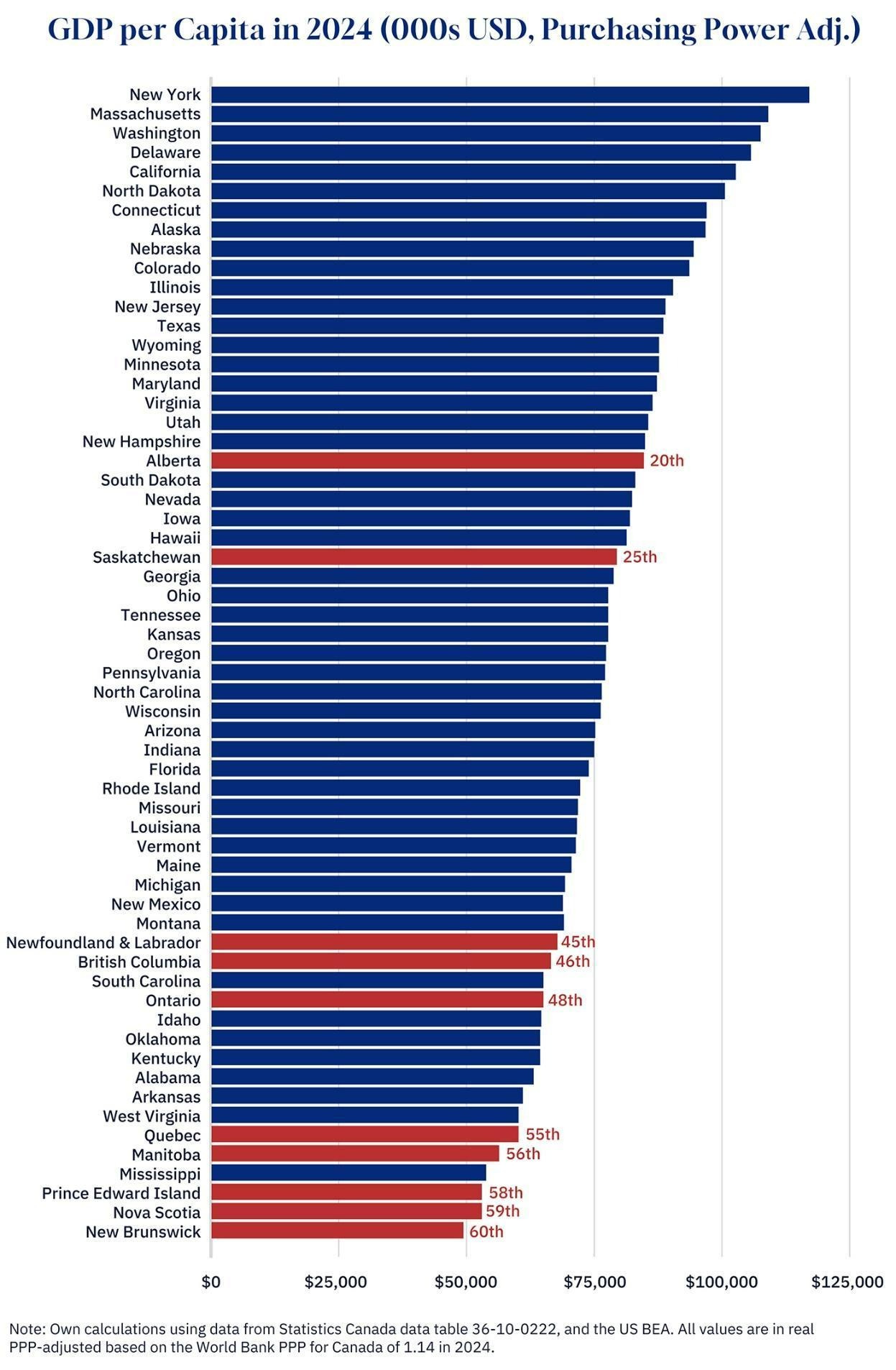
But how real is this? What about (and this is something I hear immediately after sharing the data) taxes, what about health care, what about transfers? Isn’t America much more unequal? Yes, Kansas might produce about $25,000 more per person, and yes, the median Kansan household makes slightly more than its Ontario counterpart before taxes and transfers, and yes, the Gini coefficient in Kansas is slightly higher (.455 vs. .447 on market income, though my hunch is that it’s significantly higher than Canada’s after taxes and transfers).
But how does that feel on the ground? Does it make any difference to an everyday household? To find out, I took a trip straight into the belly of the beast: Kansas itself, the Wichita area to be specific.
My partner in this endeavor, Jeff Reimer, is as close to an American version of this Canadian apple that you will find. We each have four children of similar ages, we hold white-collar jobs at a think tank, our wives are professionals, and we both send our kids to independent Christian schools. We’re both in reasonable middle-aged health.
I visited the Reimers in their home in Newton, just outside of Wichita, and cooked with them, ate with them, prayed with them, and lived alongside them for a few days.
Leaving Toronto’s Pearson International Airport, I knew I was bound for America because there were no instructions in French, the accents were American, and the snacks had more sugar. Otherwise, the passengers on board—business men and women in suits, salespeople heading back from their traplines, engineers, families—were impossible to distinguish as being from one country or the other.
Upon landing in Denver, the first stop on my trip, the differences became more obvious. For starters, the military’s place in the American consciousness is far, far higher than it is in Canada. U.S. military veterans are honored on billboards in American airports and are even given priority when boarding. You can hold whatever opinion you want about the justice of American wars (I have many thoughts), but Americans honor and respect their military in ways that, at least to me, appear pretty healthy.
While that might be expected, the airport also showcased another difference—the outsized influence of the U.S. charitable sector. You might see one or two charities advertised in Canada, but in Denver I counted a multitude of foundations sharing their work and encouraging Americans to give away their money. There were two for veterans, one for adoptions, and another for a foundation that “chooses values we hope most individuals would find encouraging and relevant,” whatever those are. This too can be found in the economic data: America’s culture of generosity far outpaces that of Canada.
Americans also have an extremely pluralist system of higher education. School advertisements abounded in both Denver and Wichita: this community college promises that, this state university is best at this, you can live your best life at this university, which is just down the street from the other one which, did you know, also has a great basketball team? Americans love their schools like they love their moms, a connection which is lost on most Canadians.
Americans also love to travel. Hamilton, Ontario, the city where I live, includes about 500,000 residents, with another 1.35 million living within a 45-minute drive. The city of Wichita is about 20% smaller than Hamilton, with only about 650,000 in the wider metropolitan area. Yet Wichita’s arrivals and departures list contained 40 flights from six different airlines. Hamilton had 17 from three airlines. American prosperity indeed.
Jeff picked me up and took me on a tour of the outskirts of Wichita before we headed for some Kansas barbeque. Wichita, a typical prairie town, sprawls like a man who’s eaten too many ribs and drank too many beers (American beer sells for a buck or two less per pint than it does in Canada).
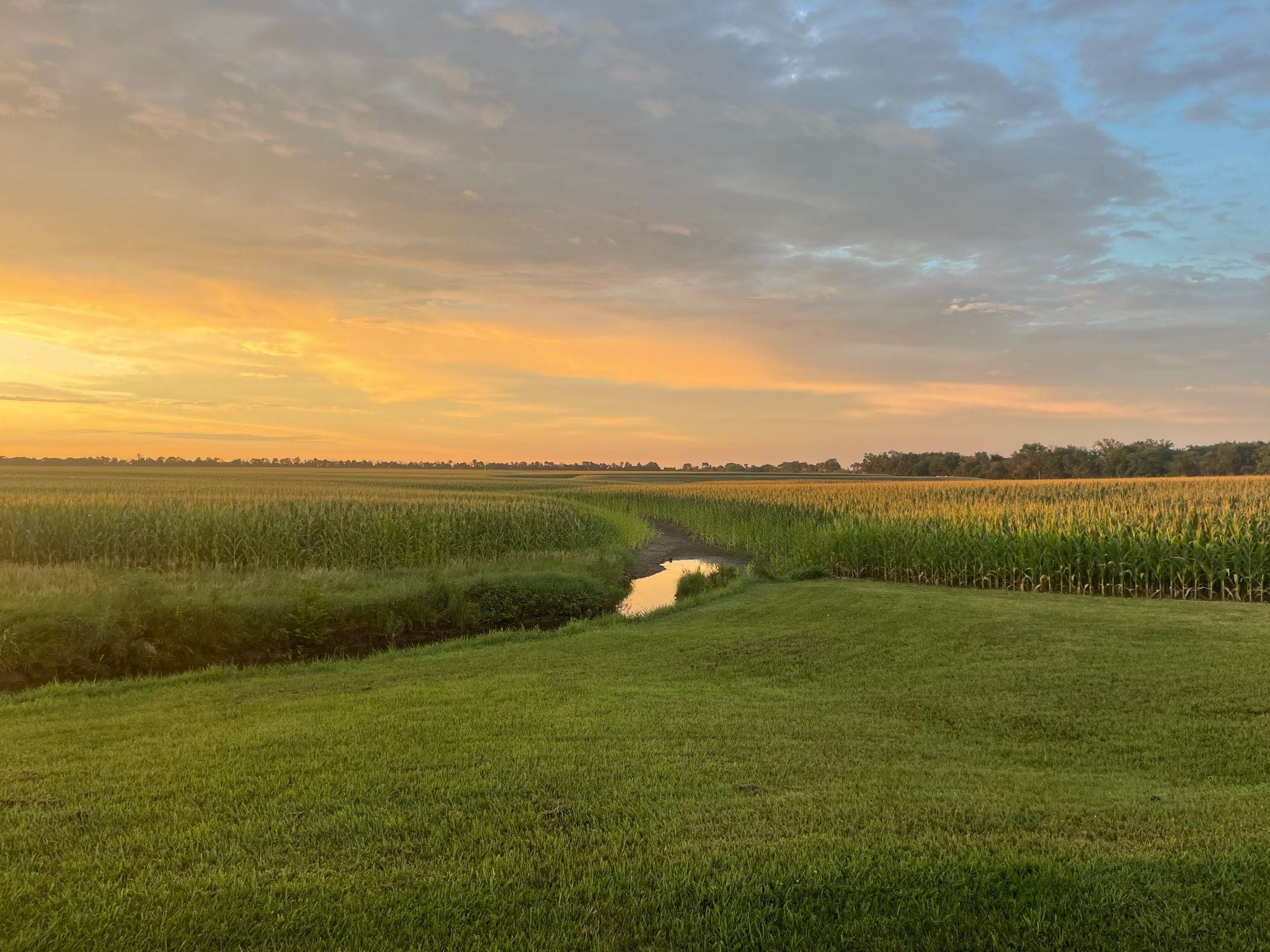
A rolling cornfield near Wichita (photo credit: Jeff Reimer)
Finally—and this one was a significant shock for me—in America, medical providers seek you out rather than the other way around. U.S. hospitals have ads indicating that they want you to come, whereas in Canada our hospitals are so full you get the sense they would prefer you’d just stay home. That may sound harsh to Canadian ears, but it’s a fact. American medicine competes for your business; Canadian health care worries they don’t have the capacity to treat you.
Jeff was quick to remind me that this state of affairs has both strengths and weaknesses. The Reimers have experienced significant health challenges within their family and were treated ably and quickly by the best doctors in the world. But, were they not rich in social capital, the experience could have bankrupted them.
Over lunch at a small Mexican restaurant run by new American citizens (the American dream lives, and it’s delicious!) we discussed the benefits of a pluralist system (competition driving service) but also how the profit motive can alter the nature of care for human beings in less-than-positive ways.
In other areas, Wichita and Hamilton were surprisingly similar. Comparing notes, Jeff and I were surprised to see that education and hospitals, rather than manufacturing, were the largest employers in both cities (Wichita is known for making chemicals and airplanes, while Hamilton is home to a famed steel industry). Despite that fact, both cities also boast significant food processing sectors. Kansas, an American breadbasket, ships millions of tons of wheat to population centers around the world, while Hamilton is a hub for mustard, sugar, and grain.
For a bit of cultural exchange, Jeff then took me to an American grocery store (the subject of much fascination for European World Cup visitors this summer). We both have big families with growing, ravenous, teenage children, and groceries make up a large portion of our families’ budgets.
I was expecting American food to be significantly cheaper, and in some areas—mainly in milk and things made from milk—it was. That was not a surprise. Canada’s dairy cartel is one of the main irritants in the otherwise (and don’t let Trump tell you differently) successful trading relationship between our two countries. But overall, a basket of basic goods costs only about 50 cents more in Canada than in the U.S. If you removed milk, cheese, yogurt, olive oil, and ibuprofen, Canadian groceries were actually about four dollars cheaper. But either way, the difference is not huge.
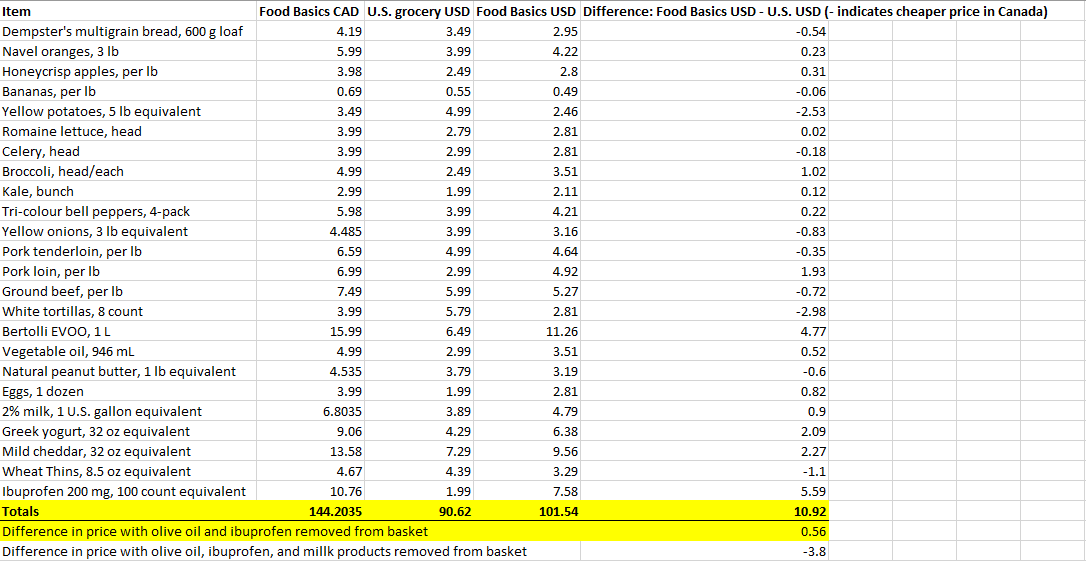
Numbers provided by Brian Dijkema
Medicine is another story.
I took a run in the middle of a hot, dusty, windy, and absolutely beautiful Kansas day, with meadowlarks, the official state bird, singing to me on each step. The next day I had a few aches, and I learned that pain relief costs about half as much in Kansas as it does in Canada.
Medicine is one of the biggest differentiators between the United States and Canada, though it also cuts both ways. As previously mentioned, the competitive American medical sector means that Americans receive better, more advanced health care than Canadians, in a more market-oriented environment.
It’s all more readily available, and you have greater access to newer and often better drugs. We have good care in Ontario, but there’s a reason that wealthy Canadians often go to the states for care. When it comes to drug and treatment development, America is far in advance of not just us but the rest of the world as well.
The downside of U.S. health care is that you might go bankrupt after receiving it. There is a real tradeoff for segments of the American population who make too much money to receive state support yet not enough to afford their own insurance. That can make Canada’s slow, dysfunctional, yet fully socialized medical system look good by comparison.
Bottom line: For employed white-collar professionals like our families, America’s medical system is likely superior, while for the un- or underemployed, Canada’s is probably a better fit.
The other major economic differentiator comes in housing. While Jeff’s home is slightly larger than mine, we both have similar-style houses in the suburbs, only mine is significantly more expensive. Yes, I live close to Canada’s biggest city, while Wichita lies far from the big U.S. cultural centers, but the price comparisons aren’t even close.
Even when comparing Hamilton to Pittsburgh, the U.S. city it most closely resembles, prices are much lower south of the border. For families like ours, that makes a huge difference, and that goes double for young families just getting their start. It’s a pure, cold economic advantage for the American family and one that, when combined with higher wages, explains why many young Canadian professionals are hopping south.
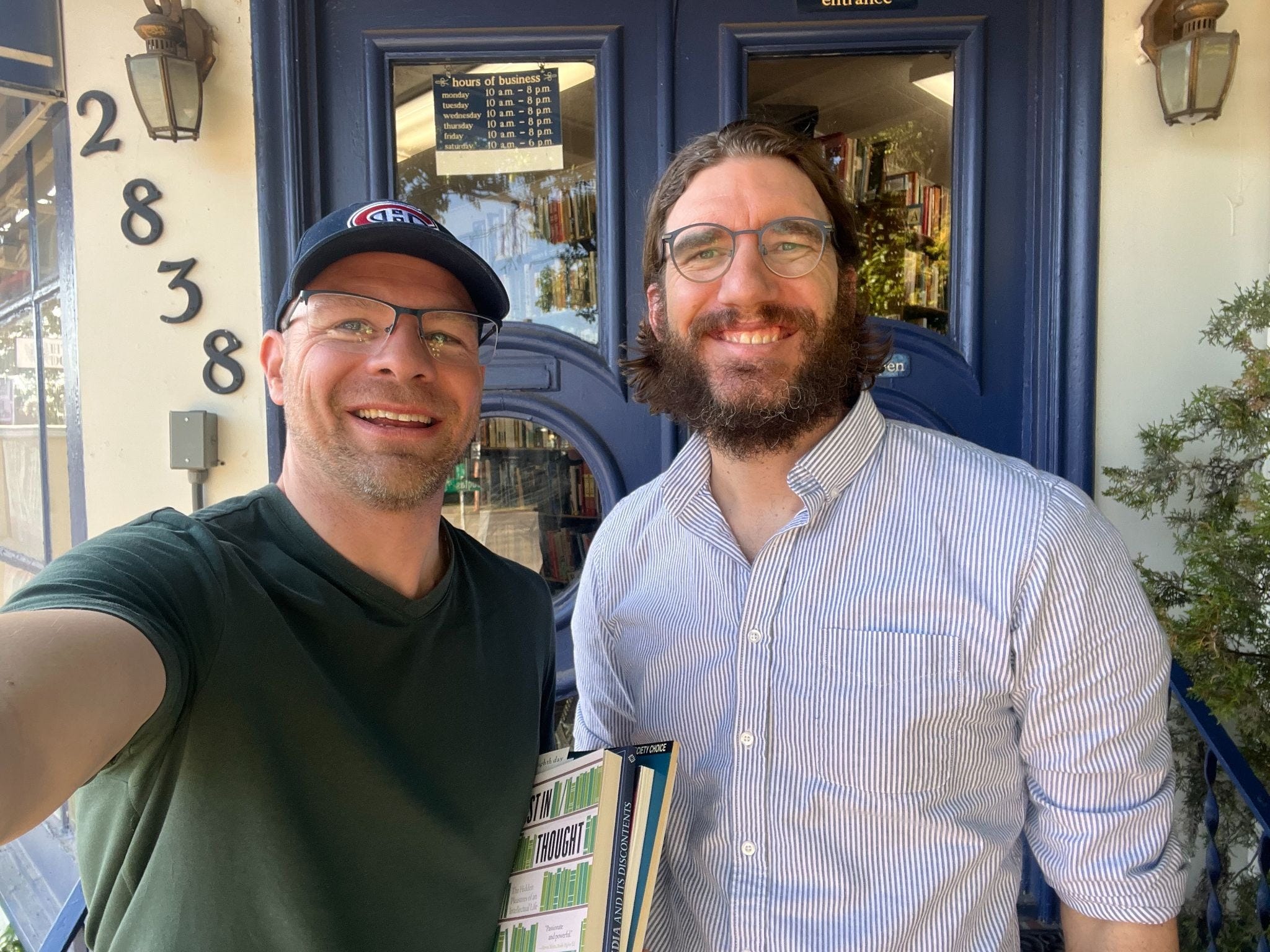
Our two intrepid reporters visit Eighth Day Books in Wichita (Reimer at right, photo credit: Brian Dijkema)
Underlying the cost differences in medicine and housing is what I think is one of the biggest differences between the two countries: in the U.S. there is an expectation of dynamism. This too can carry significant downsides. Touring Wichita and suburban Newton, the downside of dynamism was visible everywhere. Many houses constructed in the 1990s looked derelict, revealing how cheap construction doesn’t last. There were streets full of boarded-up buildings; drug addicts pushing shopping carts to the local rehab center; crumbling concrete grain elevators that, at blood-red sunset, wouldn’t look out of place in a dystopian novel.
The same thing seemed true when it came to the dynamism of American Christianity, which was on full display. The number of churches was not that different from Hamilton, but their makeup was. There were many small congregationalist churches fitting in alongside the mainlines, but also plenty that appeared to be dwindling, small, even derelict.
In general, much of the Wichita area had a workaday feel. One gets the sense that this could be a good place to raise your kids or start a business, but it might also be a place where you could just fade, like the cheap vinyl siding of a 1990’s house.
But the dynamism runs both ways. I visited a bookshop that, despite being located in the middle of the continent, seemed to have built a real, legitimate, grassroots culture of arts and letters. There were churches engaged in full theological debate—even through their architecture—with each other and with the wider culture that would not have been out of place in fourth-century Nicaea.

Outside Eighth Day Books (photo credit: Brian Dijkema)
All of which brings you back to the contrasts of America. Pope Benedict XVI, upon visiting the White House in 2008, said he came to the U.S. as “a friend, a preacher of the Gospel, and one with great respect for this vast pluralistic society.” As a friend myself, I too find it hard to have anything but respect for America’s vastness and its pluralism. It is huge and it contains multitudes both good and ill. I love it differently from my home and native land, but I love it nonetheless.
But overall, what struck me most was not the differences but the similarities.
John Keegan, the great war historian, once said that “a Canadian is an American who rejects the revolution.” This is true. Both are new world countries. We Canadians rejected the revolution, but the commercial, legal, and social culture of both countries are remarkably close. Each of us, when visiting Europe or Asia, are more likely to be mistaken for each other’s countrymen than anyone else.
Our histories are different, and there are many differences between our politics and our cultures writ large. These would likely be felt more acutely over time as habits and expectations seeped into one’s daily life, one’s family, and one’s community. Kansas is richer on paper, but the experience of life there—economically speaking—was not markedly different from my life in Canada. As I ate a dinner of pork chops, broccoli, and sweet potatoes identical to the one that my wife and I would cook for our family in Hamilton, and as we played cards after the meal, and as the kids drifted off to bed, the experience suggested that all happy countries, like all happy families, are alike.

Interesting comparison. It reminds me that the US and Canada are much more alike than they are different, and that one of Canada’s biggest problems is that we stubbornly refuse to accept this. Instead we cling to the idea that we’re unique, and make that supposed uniqueness our identity.
One minor quibble: I wouldn’t say that “We Canadians rejected the revolution,” as “we” weren’t here at the time, and there was no Canada, formally. More accurate to say that Canada was eventually formed by British subjects, indigenous people, and Americans who rejected the revolution.
GDP per capita obviously only measures so much. It's easy to compute your own "gross domestic happiness" or whatever you're trying to measure, but getting anyone else to agree with you is pretty much impossible.
So, it's a measurement that economists have agreed on and applied consistently, more or less. You can compare one state or country to another, or one year to another, which is definitely not nothing. What it means to its citizens is up to them.