


Editor’s note: This is the first in a two-part series comparing the U.S. and Canadian economies. For a Canadian perspective on America, read Brian Dijkema’s “Is Canada Really Poorer than Kansas?”
In December of 2024, recent Canadian export to the United States Jordan Peterson claimed that “the richest province in Canada is poorer than the poorest state in the United States.” The statement garnered much attention, not least because he made it something of a talking point, repeating it the following January in an interview with Pierre Poilievre, then thought to be a lock as Canada’s next prime minister. Since then, the claim (and others like it) has become a standard trope in discourse surrounding the two nations.
What Peterson said is not quite accurate, but it’s more exaggeration than mistruth. While most Canadian provinces are richer per capita than the poorest U.S. state (Mississippi), that isn’t saying much: In a combined ranking of all 60 states and provinces, eight of Canada’s ten provinces sit solidly in the bottom third, and provinces constitute five of the six poorest of either jurisdiction. So while fact-checkers were eager to pounce on Peterson’s claim, arguing that it doesn’t hold up exactly, that it holds up as well as it does comes as a shock—especially when the state in question happens to be located in the Deep South or in “flyover country.”
But why should it be shocking? What leads us to assume Canada’s relative prosperity when compared to parts of the U.S.?
I went and visited Canada myself to find out. But first, here is my pet theory.
In the imagination of the progressive Canadian technocrat from a cultural and economic center like Toronto (which is located in Ontario, ranked 48th of the 60), cultural ascendency must eventuate in economic ascendency. And that is exactly what Canadian technocrats had for a good ten years. Former Prime Minister Justin Trudeau, the virtual incarnation of the Liberal Party’s progressive, globalist economic politics, was in power from 2015 to 2025. Though he was elected before Donald Trump, Trudeau had barely been in office a year when Hillary Clinton lost the U.S. presidential election and all the assumptions of the American progressive establishment came crumbling down.
Trudeau then positioned himself (and Canada writ large) as the North American successor to Obama-era optimism and as the refined, urbane alternative to crass MAGA populism: rational, science-based, clearly on the right side of history. Many Americans bought into this narrative. Threatening a move to Canada is something of an American tradition, but in 2016 it was put on loudspeaker, with many coming to view the great white north as a fantasyland of liberal prosperity. Canadian elites, rather than pointing out that the grass is always greener on the other side of the 49th parallel, began to believe the hype themselves.
Trudeau held an invincible confidence in his own future vindication. Under his administration, spending increased and regulatory ambition abounded. But the future is a fickle god, and you cannot, it turns out, regulate your way into the eschaton. During Trudeau’s tenure, Canadian provinces slid closer and closer to the bottom of such combined provincial-state GDP rankings, and Canadians were shocked! Shocked I tell you! The racist, science-denying, Trump-voting, backwater red states were supposed to be on the losing side of history. Trudeau’s cultural ascendency resulted not in economic ascendency but in spools of red tape wound tighter and thicker around Canadians’ lives.
My theory is vastly oversimplified, and probably gives the United States too much credit for the outcomes of Canadian policy (we Americans always think too much of ourselves). Be that as it may, how does all of this play out on the ground? We have the numbers and the stats and the theories. What does it feel like to live in one place versus the other?
Enter two men, intrepid travelers, a Canadian and an American, friends and co-workers, each with an affection for the other’s country and a healthy-though-not-uncritical love of his own. My counterpart, Brian Dijkema, and I are both employed by the Canadian think tank Cardus. Much about our lives is similar, save our location: He lives in Ontario; I reside in Kansas.
The terms of our assignment: to visit and observe a day in the other’s life. We are both in early middle age, married with four children, both knowledge economy workers, neither wealthy nor poor, trying to do right by our families, our jobs, our churches, and our communities. I hail from Newton, Kansas, a small town near Wichita. The following stems from my visit to Dijkema’s home of Hamilton, Ontario, population 569,353.
7:30 a.m.: Brian and I meet up at Pür and Simple, a bougie breakfast joint located in the parking lot of a large strip-mall complex called the Meadowlands. (They name developments, a friend once quipped to me, after the things they pave over.) Brian manfully downs a five-egg omelet, while I take care of an egg-and-sausage bowl. Each of our dishes costs around $20 Canadian which, accounting for the exchange rate, is comparable to a similar American dining experience.
After breakfast, Brian drives me around Hamilton and points out the varying levels of wealth. Many of the homes were built in the 1980s and are modest but comfortable. Several, however, are being torn down to make way for much larger ones, some tasteful and beautiful and livable, others your kind of standard McMansions, yet others boxy, ostentatious monstrosities. Housing prices are on the rise, and sturdy, modest, middle-class homes are being squeezed out of the market along with the people who might have owned them.
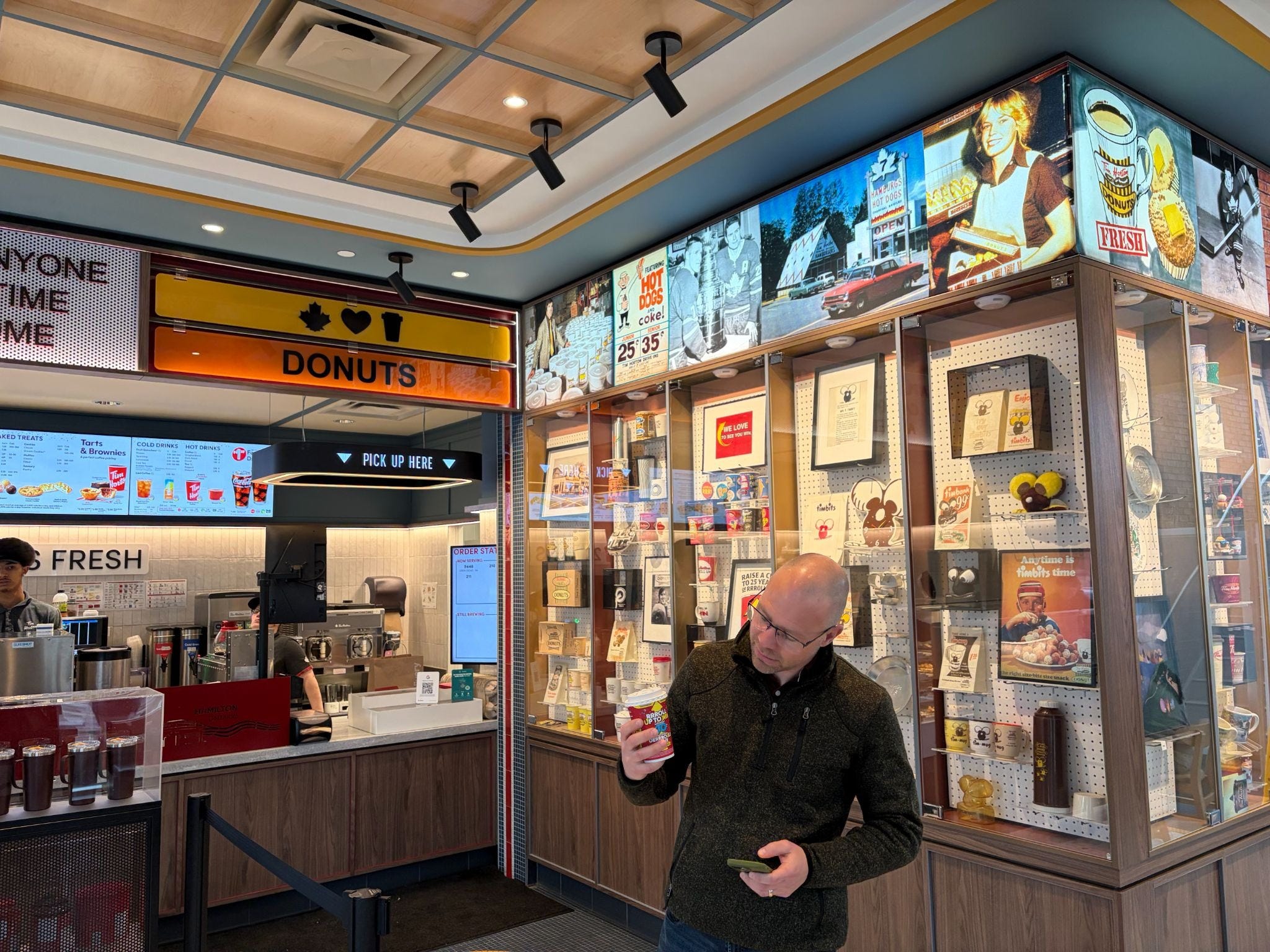
Photo credit: Jeff Reimer
Brian lives on “the Mountain,” a misnomer Hamiltonians are happy to use and eager to explain. Hamilton Mountain is not a mountain but an elevated area atop the Niagara Escarpment, a cliff-like slope that cuts straight through the city on its 650-mile journey across the Great Lakes basin. Most everything on the mountain is suburban in character, an alternating patchwork of residential neighborhoods and shopping districts. Sprawl is limited only by regulatory decree—namely, a greenbelt protecting local agriculture and wildlife. And it really is a belt: As Torontonians flee skyrocketing housing prices and make their way to Hamilton, elevating home values here, an outer rim of housing has cropped up beyond the greenbelt where prices are lower.
Driving back down the mountain, Brian and I emerge from the forested road that angles down the escarpment into what feels like a completely different city. This is the old steel-industry town akin to Pittsburgh. Lower Hamilton is wedged between the westernmost tip of Lake Ontario (known as Hamilton Harbour) and the escarpment, so sprawl is limited by geography. The only way to build is up. Lower Hamilton is older and grittier, denser and more urban. Wealth and poverty are closer neighbors down here. Upper Hamilton was developed after the end of history, when postwar consumer capitalism had achieved its cultural hegemony; below, the longer history of the twentieth century is told in narrow brick buildings, old apartment high-rises converted into public housing, church façades converted into posh apartment buildings, and whole blocks cleared out for even posher residential high-rises.
One might be tempted to see in lower Hamilton, particularly the many grand but empty mainline churches, the story of religion’s decline and the rise of secular, post-Christian society, and in some ways they’d be right. But for those with sharper eyes, churches are everywhere. Catholic and Orthodox houses of worship maintain a strong institutional presence. On Barton Street, which Brian calls “the most interesting street in Canada” for its layered sociological richness and demographic diversity, Holy Trinity Polish Catholic Church sits nearly next door to St. Anthony of Padua Roman Catholic Church, down the street from Holy Spirit Ukrainian Catholic Church. Several blocks south we pass the ugliest, most garish Catholic church in lower Hamilton—which, Brian says, is full of pious, rosary-praying Vietnamese church ladies. Many of the churches that look derelict have in fact been converted into other churches: Presbyterian buildings into Jamaican Pentecostal ones, Methodist edifices into Nigerian charismatic communities, to say nothing of the dozens of other international churches in abandoned storefronts and run-down office buildings, a makeshift sign the only indication of the worshiping community within. Most of these places wouldn’t even show up on Google Maps, yet their presence is an indicator of the large immigrant population that calls Hamilton home.
Closer to the lake—and to the factories that depend on its shipping channels—residential areas are dominated by small, old union homes from Hamilton’s steel days. Brian points out the occasional house still inhabited by a retiree, clean and fastidiously well kept. But mostly they are dilapidated and in ill repair, a fading shadow of modest, working-class prosperity. Not the kind of place you’d want to find yourself late at night.
Urban renewal, of the kind that has rejuvenated city centers over the past 20 or 30 years with breweries, bistros, and bohemian retail shops, dots lower Hamilton, though not as much as I expected. Some of the lakefront has been developed into a park with greenspaces and restaurants and sidewalks. It seemed vacant and forlorn, but then again this was early March in Canada. A snowstorm blew through the day I left.
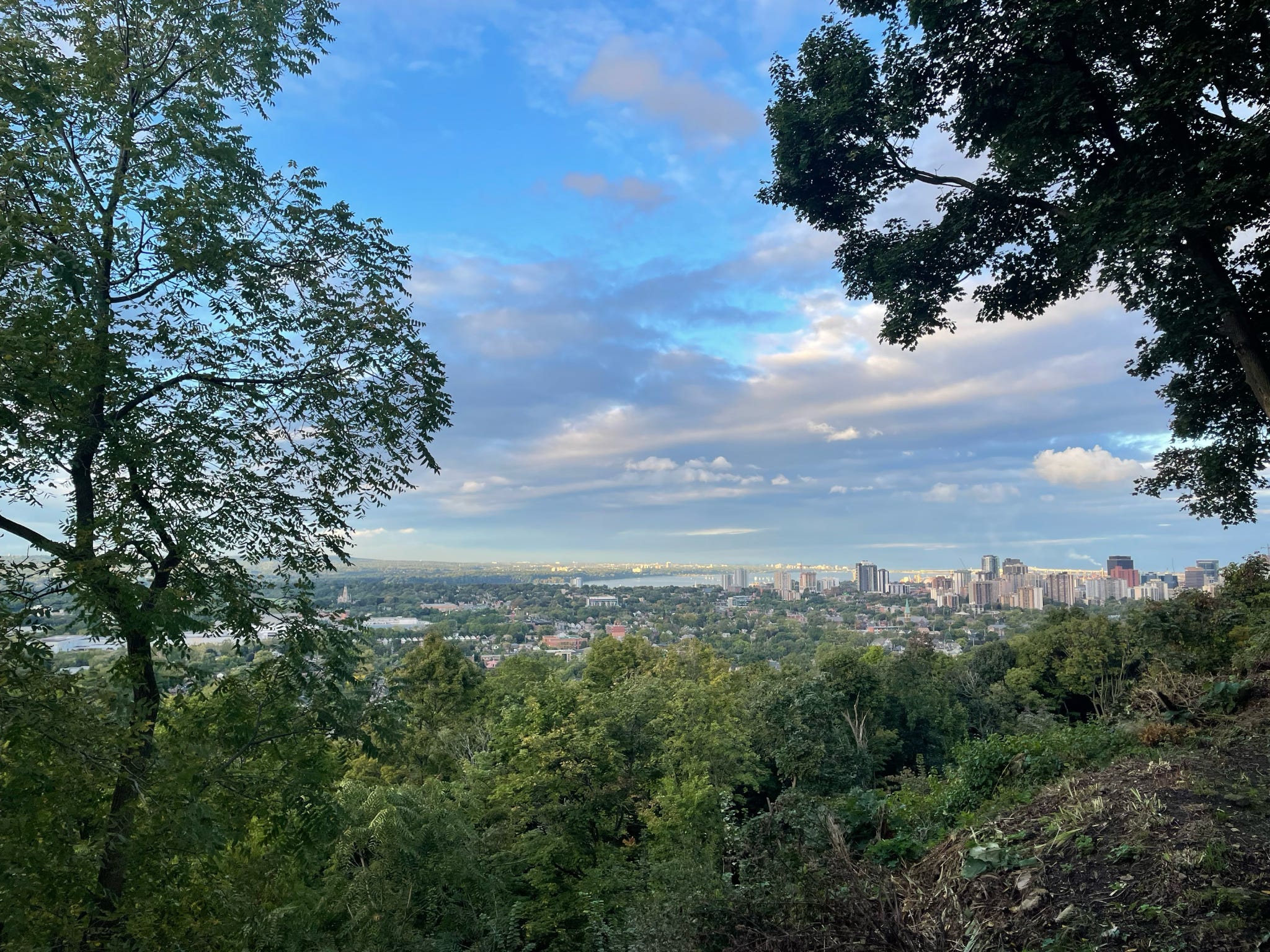
Photo credit: Jeff Reimer
All this is familiar enough to my American eyes: secular modernity’s hollowing out of traditional institutions, haltingly optimistic attempts at urban renewal, indicators of increased immigration. All of it seems slightly accelerated compared to the U.S., in keeping with Canada’s stronger political and social ties to Europe. There is standard political corruption too, even mob activity, which Brian points out here and there. But two forces of entropy stymie civic renewal and growth in Hamilton in a way that seems unique to Canada and is in keeping with my pet theory. One is the residual high-minded moral earnestness that tips more often than not into virtue signaling, and the other is a love for enforcing such gestures through bureaucratic means.
In lower Hamilton, Brian drives me by a promising, humane, and innovative public project: a group of 40 tiny homes designed as transitional housing for the homeless, a way out of the tent cities and into a stable place to keep warm and find work. A great idea! But Brian knows the whole story: When it came time to find a contractor for the project, instead of initiating a fair and open bidding process, the city tendered the project to a “local Indigenous-owned business” that took advantage of the well-intentioned gesture and went through another company to purchase substandard housing units from China. When the units came in, they needed significant upgrades. In order to bring them up to code, the city hired local vendors who capitalized on the city’s desperation to “‘make a meal’ of the project.” The budget more than tripled, a cost borne by the city’s taxpayers.
The problem with all this, Brian tells me over spicy margaritas, is not political corruption, at least in the strict sense, but a sort of “soft corruption” in which the chance for city officials to pat themselves on the back for their own virtue means losing sight of the common good.
A related problem is apparent in spots where housing development clearly began at some point but was abandoned. Roads terminate abruptly. Grass and weeds grow unmown on lots cleared of trees. Trash is strewn about. There’s an abandoned roll-off dumpster sitting along the side of the road. This is the result of a Kafkaesque tangle of NIMBYism facilitated by municipal and provincial laws, taxes and development charges, and mortgage rates too high to justify further investment. Brian says it’s emblematic of an overweening, almost zealot-like earnestness that prompts the Canadian government to lay its hands on all entrepreneurial endeavors. And when businesses see their competitors’ ships caught on the rocks of a thousand regulations, they find a more hospitable port in which to weigh anchor—namely, the United States. That’s one reason housing prices are much lower in America, especially in more rural areas like mine.
Brian is far from a libertarian. He sees a positive role for the government in realizing the common good. But he also recognizes the economic realities of supply, demand, and market competition that any modern industrial society will bump up against. The government’s good intentions in Hamilton, and across Canada more generally, create a willful blindness to these realities making it prohibitive to do business there. Many entrepreneurs are disincentivized to stay in the country. Yes, much of it has to do with uncertainty over tariffs and the sheer fact that the U.S. is simply much larger than Canada. These liabilities, however, are not helped by Canada’s high taxes and regulations. That Canada’s citizens find it difficult to do business in their own country does not bode well for the country’s economic future.
How all of this plays out on an individual level is harder to discern. In my day with Brian driving around Hamilton, buying coffee, roaming the grocery store, clocking gas prices, even stopping at the first, gloriously kitschy Tim Horton’s, we found—somewhat to our surprise—little that was dramatically different from one place to the other. With the exception of gas (Kansas has some of the cheapest gas prices in either nation) and some groceries such as dairy products, most goods are similar in price, if slightly more expensive in Canada.
So, is Kansas richer than Ontario? In GDP per capita, sure. But that macro reality rarely reveals itself in demonstrable differences in our daily lives. By the measure of opportunity and risk, however, the difference shows up more clearly, and Kansas seems to have the advantage. I would rather start a business or buy a home almost anywhere in Kansas than in Ontario, and I am fairly confident I would have an easier time succeeding at either, especially if starting from scratch.
Maybe that’s like people in the Midwest being terrified of hurricanes but not tornadoes, and people on the Gulf Coast being terrified of tornadoes but not hurricanes. I am, for instance, more exposed to soaring medical costs than Brian is; we prefer the devil we know. But it is in areas such as business and real estate where macro-economic pressures bear down most perceptibly on micro-economic realities, and all too often it is these sectors that slowly reshape the landscape of everyday realities we take for granted.
—
I believe there is an animating spirit to every country, a set of principles and behaviors wrapped up in its origin and history that, shy of some national cataclysm, are near impossible to suppress. America’s national spirit of individualism and industriousness and innovation is still alive and… maybe not well, but kicking. Canada’s animating spirit, owing to its New World frontier origins, its more frank negotiation with its indigenous heritage, and its bifurcation between Old World Anglophone and Francophone cultures, is not as well defined. Canada’s spirit is of course caught up with that of the U.S., but is also fiercely and self-consciously independent of it. While Canadians do not think about America nearly as much as we Americans assume they do, there are few things they know better about themselves than that they are not Americans. That sense of proud separateness has created, I believe, a deep internal conflict that pulls Canadians away from a positive identity rooted in their own history and toward either U.S.-style industriousness or European Union-style proceduralism.
For all the dysfunction at the heart of U.S. politics, America’s industriousness and relative intolerance for government overreach keep us more entrepreneurially nimble. My Canadian friends agree, often to their chagrin. But when that tension devolves into bitterness or smug anti-Americanism, something distinct about our shared North American culture is lost.
When I walk the streets of Canada, whether in Hamilton or Ottawa or Vancouver, it feels almost American, yet everything’s subtly different. The speed-limit signs are in kilometers. The storefronts have different names. There’s poutine on the menu. It’s so similar and yet foreign, somehow mine but not mine, like putting on a shirt I left at a friend’s house after his mom washed it. That’s Canada. It’s recognizable, yet with its own unique quality, its own scent, the familiar smell of an old friend.

40 million people, sitting on the 2nd largest land mass on earth, atop a King's Ransom of oil, gas and minerals.
Canadians are lovely people. They should be the America's Norway, with their own $2 trillion dollar sovereign wealth fund. Pleasant Climate warriors, ironically swimming in a sea of petrodollars, while enjoying their beautiful country.
Instead Canadians seem too obsessed with Trump, to understand they should be wealthy enough from their natural resources alone, to ignore Trump's antics until his term ends.
Canadians do not need to rid themselves of Trump, time will take care of that. He is a US President, with 75% of both terms behind him. Canadians need better Canadian governance, that maximizes their natural resources and prioritizes the Canadian standard of living. Trump is temporary. Unless Canadians change their voting habits, Canada's economic malaise is not.
Thanks for something positive about the U.S. Lately, we’re hearing way too much from the socialist wing of the Democratic Party about how awful everything is here. As far as I’m concerned, there’s no place like home.