


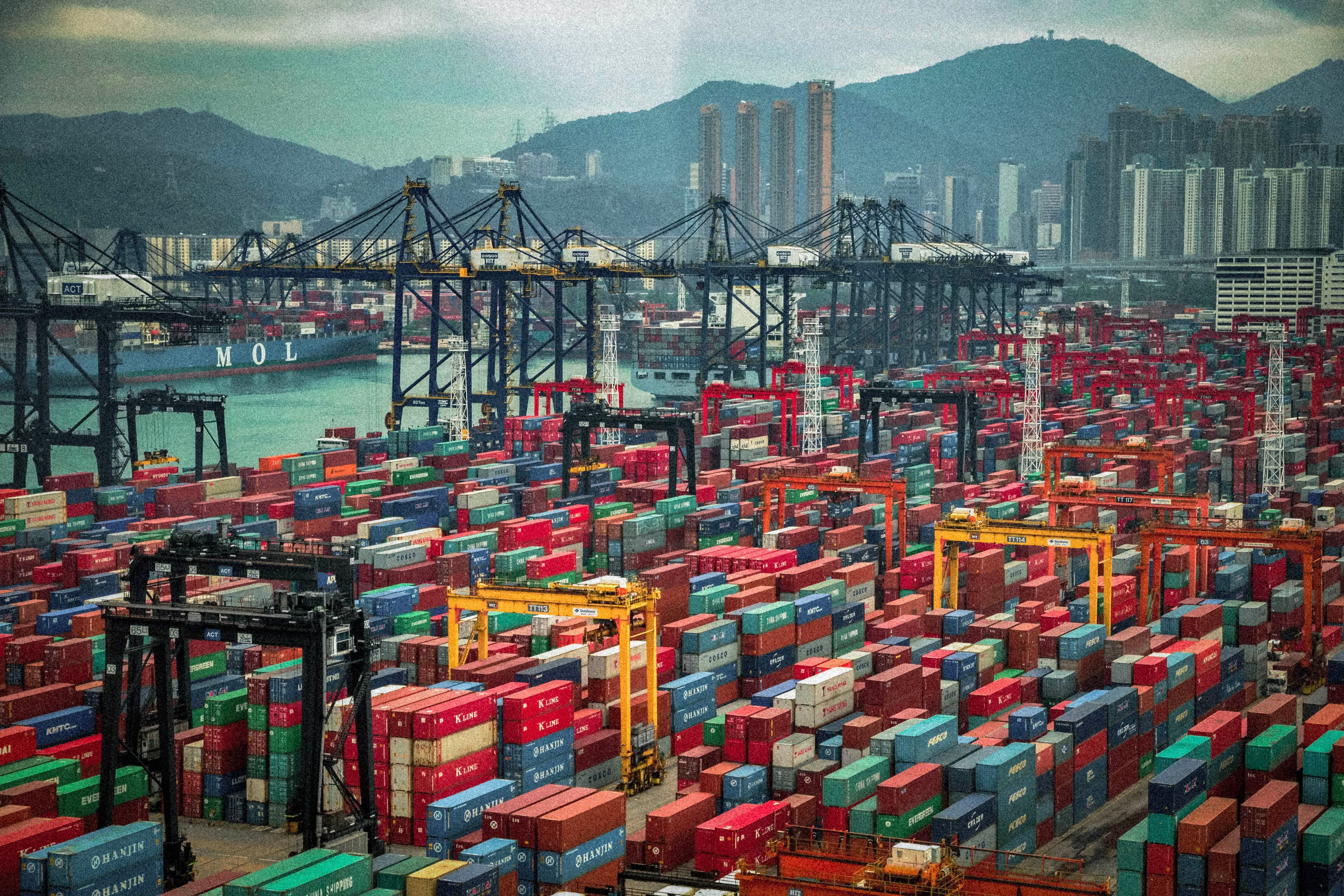
Ever since the November truce in the U.S.-China trade war, chaos has receded and a sense of equilibrium has begun to take hold in American trade policy. The White House continues to seek and sign agreements with trading partners that cap tariff increases in exchange for strategic investment guarantees and cooperation on a range of issues, including tariff circumvention and favorable treatment for U.S. exports. Business leaders have revised their tariff fears, GDP growth is forecast at a robust 3.5%, tariffs are on track to raise a remarkable $256 billion of additional annual revenue, predictions of runaway inflation and spiraling retaliation have been disproven, and green shoots of increased manufacturing activity are sprouting after a season of uncertainty.
But an increasingly conciliatory attitude toward China has created a feeling that the administration’s trade strategy is muddled. The terms of the November truce suspended high reciprocal tariffs in exchange for China permitting rare earth exports to flow, essentially resetting the U.S.-China relationship back to the status quo immediately prior to Liberation Day. The White House has even placed national security matters, such as semiconductor export controls and cyber-espionage sanctions, on the negotiating table to preserve the detente.
This has frustrated those who thought the overriding aim of Liberation Day was to decisively squeeze China and provoke decoupling. China has been able to grow its global exports despite U.S. tariffs. Commentators note that we have been treating allied countries and important fence-sitters like India more harshly than our chief adversary, “punishing our friends while courting Beijing.” The consensus among administration critics is that the November truce proves that China is winning the trade war.
Meanwhile, Trump’s trade strategy is buffeted from the other direction by political demands to signal action on affordability. The administration rolled back tariffs on what it said were grocery items not produced in the U.S., but included beef, a major American product. This implicitly ratified the logic of free traders who claim that tariffs are driving inflation—even as evidence mounts that the tariffs are, in fact, not inflationary. The administration may find it increasingly tempting to shore itself up politically in the short term by reducing tariffs, instead of confronting the true, stickier causes of unaffordability in America: housing, health care, child care, and education.
This all adds up to an anxious feeling about Trump’s trade strategy: not harsh enough on China, too harsh on allies, and running out of runway to change course due to the politics of affordability.
The China Gap
There is plenty of room to criticize the administration’s current approach on pure national security grounds. But as a trade matter, it’s a different story. The recent pessimism ignores a fundamental reality: tariffs on China are significantly higher than tariffs on the rest of the world, and as long as that remains the case, it will drive a structural realignment in the global trading system that disadvantages China.
In order to keep exports growing in the face of U.S. tariffs, China must increase sales to new markets. But those new markets tend to be exporters themselves, and don’t have the ability to painlessly replace U.S. demand. China can only access these markets by aggressively underpricing its exports—weakening the balance sheets of its manufacturers and subjecting its trading partners to China Shock dynamics of bankruptcy, unemployment, and deindustrialization. That encourages China’s replacement markets to block its exports, just as the U.S. did following the first China Shock. In essence, the measures China must take to fuel its export machine end up undermining it.
The administration should hasten this realignment by doing more diplomatically to create a united anti-China trade bloc, conditioning preferential tariffs on blocking Chinese exports and levying high tariffs on countries that remain open to them. But, crucially, realignment away from China will eventually happen regardless of this administration’s stance toward allies. It is a natural consequence of the current structure of global trade. This means that the U.S. can afford to avoid short-term disruptions to the macroeconomy—for example, from tit-for-tat semiconductor and rare earth export restrictions—so long as tariffs on China remain relatively high over the longer term.
Ultimately, one number is truly determinative for the future of the global trading system: the gap between the U.S.’s effective tariff rate on China and its effective tariff rate on the rest of the world. That gap represents the extra cost that an American purchaser would pay to source from China versus alternative countries or domestic suppliers. A high enough gap triggers “trade diversion”—the rerouting of supply chains away from China and toward new sources that have been rendered cost competitive by the higher China tariff. The Peterson Institute estimates that, as of Nov. 10, 2025, the effective U.S. tariff on Chinese exports was 47.5%, while the equivalent rate for the rest of the world was 18.5%—a substantial gap of 29%. Although the November truce suspended reciprocal tariffs, the combination of Trump’s other tariffs under Section 301, Section 232, and pre-Liberation Day fentanyl tariffs are enough to render China’s goods more expensive than others. China therefore risks losing access to the U.S. market in any product market where its cost advantage over the next-cheapest supplier is within 29%.
The mirror image of trade diversion is trade deflection. Chinese exports that were once destined for the U.S. but have lost their cost advantage need to find somewhere else to go. They could be consumed in the domestic Chinese market, or exported to new foreign markets. But this trade deflection scenario is extremely challenging for China.
First, Chinese production is far in excess of what domestic consumption can absorb. China could increase consumption, but it has been trying and failing to do so for decades. The Chinese economy depends on suppressing consumption in order to direct financial resources toward production enterprises filling demand for manufactured goods in the rest of the world. Increasing consumption would therefore reduce the global competitiveness of its exports. Bank balance sheets are full of loans to steel mills instead of credit cards for consumers, and trying to reverse those flows would cause unemployment and political churn that the Chinese Communist Party cannot stomach. As households reel from China’s property market downturn, domestic demand is at a low ebb, pushing China into ever-greater reliance on external demand to absorb its massive industrial output.
Second, China cannot seamlessly find new markets to replace all of the demand it stands to lose from the U.S. America has run such large trade deficits for so long that almost every other major economy has been built to take the surplus side of that equation and export to the U.S. The EU, Japan, South Korea, Taiwan, Canada, Mexico, and Southeast Asia all have overall trade surpluses or only small deficits supported by bilateral surpluses with the U.S. This makes up a massive share of these countries’ GDP—around 50% in the case of Mexico and Canada, 20-30% for Taiwan and Vietnam, and between 7-13% for Germany, South Korea, and Japan.
These countries are sellers, not buyers, with little to no available demand to take on new Chinese imports. The only way China can access these markets is by pricing so aggressively that Chinese goods simply replace consumption supplied by domestic sources—that is, putting its trading partners’ firms out of business and forcing its own firms to operate on razor-thin margins.
If the effective tariff gap is large enough to cause supplier shifts away from China, then trade diversion and trade deflection is what we should be seeing in the global market. And indeed, we are. That means it is China, not the U.S., that is under pressure.
China’s exports to the U.S. have cratered by 29% year-over-year as of November. The Chinese share of U.S. imports has now dropped below where it stood just prior to China’s entry to the World Trade Organization in 2001. Although a percentage of this reduction is made up through circumvention, U.S. tariffs have, so far, been high enough to create significant trade diversion away from Chinese suppliers. The Trump administration must monitor trade flows to ensure that the recent truce, which reduced China tariffs by 10%, doesn’t permit significant growth in exports. However, it is unlikely that the truce will significantly alter the trend. The current effective tariff rate of 47% is significantly above the estimated level of 35% that wipes out Chinese manufacturers’ profit margins. Following the truce, General Motors “directed several thousand of its suppliers to scrub their supply chains from parts from China.” Expect more of the same.
So far this year, China has been able to grow its manufacturing exports by 5.4%, despite U.S. tariffs, by selling to new markets. However, headline growth conceals fundamental weakness in the sector. China’s manufacturing purchasing managers’ index has been in contraction territory for months, recording that the majority of firms are experiencing drops in new orders and new exports even as overall numbers increase. Even those overall numbers may be softening—Chinese exports dropped in absolute terms in October, surprising analysts, before rebounding in November. Reuters describes Chinese factory managers as “seeking out new markets to offset lost orders from U.S. customers,” but in the words of one, “in this environment, where global consumption of our products is not enough to replace U.S. demand, our order volume and revenue have plummeted by half.”
This forces Chinese firms to survive by cutting prices, creating extreme balance sheet problems and putting net profits in freefall. Western observers often have the impression that Chinese firms aren’t subject to profit-and-loss pressure due to government subsidies. That impression is false—subsidies cause overcapacity at the sector level, but Chinese firms are subject to “cut-throat price wars at home” that “only sharpen their hunger to capture overseas markets.” With the loss of U.S. orders, this problem is now entering an acute phase characterized by producer price deflation, firm bankruptcies, and declining fixed-asset investment, endangering the future growth of the industrial sector. Chinese factories accept unprofitable orders just to retain their workforces and clear inventories. The Chinese government now has an official campaign to combat “involution,” its term for excessive price competition.
The European Front
Starved for margin and deprived of their main export market, Chinese producers are exporting at aggressively low prices into new markets that can’t accommodate them. Chinese exports to Europe are up by 14% compared to 2024 and the EU’s trade deficit with China has nearly doubled from 2017 levels. The price of imported Chinese goods in Europe has declined by 20% from 2024, with high volumes and large price drops in industrial machinery, autos, and semiconductors.
These cheap goods are not unlocking value. According to a recent Goldman Sachs report, China’s export-fueled growth has become negative-sum for the rest of the world, such that any benefits to consumers are more than offset by the damage to manufacturing sectors. Europe is especially hard hit. Core industrial employers like Volkswagen, Bosch, and Thyssenkrupp are announcing unprecedented layoffs. Europe is now actively deindustrializing, replaying the experience of American industry flooded with low-priced Chinese manufactured goods in the 2000s. In the words of the Atlantic Council:
The surge of Chinese goods is reshaping Europe’s industrial landscape, exposing the EU to the same state-driven capitalist practices from Beijing that long challenged the United States under the guise of free trade. Frustrations in Brussels run beyond inexpensive electric vehicles (EVs) and low-cost goods. In July, European Commission President Ursula von der Leyen accused China of “flooding global markets with cheap, subsidized goods,” warning of a new “China shock.” Chinese EVs, which are 20-30 percent cheaper than European EVs due in large part to government subsidies, challenge Germany’s automotive hub and its European supply chains…China’s dominance has already shuttered numerous European firms in the steel, aluminum, machinery, and batteries sectors.
These are the facts on the ground that will realign the global trading system away from China, regardless of political attitudes toward the Trump administration. To avoid deindustrialization and mass unemployment from the loss of a manufacturing sector that makes up over 20% of the European economy, the EU—and other regions facing the flood of diverted Chinese exports—will find they have no choice but to limit Chinese access to their markets. This realization is now dawning on governments around the world, which are rolling out anti-China trade and investment measures at a record pace. Just this week, Mexico announced tariffs of up to 50% on Chinese imports, drawing outrage from Beijing. Even French President Emmanuel Macron, famously dovish on China, is now threatening what he calls “protective measures” to address “unbearable imbalances.”
All countries that wish to retain their industrial capacity are converging on the same set of policies, without any central coordination or political agreement. When that convergence occurs, China will have no option to export itself out of trouble. There won’t be any large markets left to divert to.
China is explicitly betting that other countries won’t be willing to close their markets to its exports. The Financial Times reports that “policymakers in Beijing doubt Europe has the unity or the stomach to bear the consequences of erecting new barriers to cheap and high-quality Chinese goods.” But that’s exactly what happened in the U.S., and the right bet is that it will keep happening. Voters facing rapid deindustrialization have proven that they are willing to elect outsiders ready to do what ruling parties wedded to the status quo will not. If commentators think that Europe won’t tariff China because “tariffs risk slowing or reversing the green transition,” they have another thing coming.
These dynamics expose the hollowness of predictions that countries will abandon the U.S. in favor of closer trade relations with China. Absent radical and unprecedented reform of the Chinese economy, this is structurally impossible. The demand that the U.S. provides for its trade partners is irreplaceable. China has no demand, only excess supply. Its growth comes at the expense of the rest of the world, dependent on a strategy of putting everyone else out of business. As FT columnist Robin Harding put it, “there is nothing that China wants to import, nothing it does not believe it can make better and cheaper, nothing for which it wants to rely on foreigners a single day longer than it has to.” Remaining open to China while other countries close is an invitation to industrial wipeout, and no advanced economy wants to be the last one holding the bag. Taking a tariff haircut from the U.S. while retaining market access is a far more workable proposition than drinking from a firehose of unlimited Chinese exports.
Critically, this means that a U.S.-aligned trading bloc would be significantly more powerful than a China bloc. It would include those economies advanced enough to be threatened by Chinese industrial exports and care more about selling to the U.S. than importing from China. China would be left with smaller economies with little productive capacity, for whom the loss of Chinese investment would represent the greater threat. Estimates of which countries would align with the U.S. and which with China find that the U.S. bloc would constitute 68% of world GDP to China’s 26%.
The administration has at least three important tasks ahead of it. First, it must monitor the effective tariff gap closely to ensure that it remains large enough to trigger trade diversion away from China. If the gap shrinks too much—or if the administration drops the ball on anti-circumvention enforcement—the realignment will halt. Second, it should avoid doing and saying things that unnecessarily slow the trend. Realignment is coming, but bullying rhetoric will create political pressure for countries to distance from the U.S. and explore their options with China. This will leave them weaker when they later conclude that those options are unworkable, which is deadweight loss that the administration can avoid by front-loading diplomacy to create a united anti-China front. Working with allied countries to scale up a rare earths mining and processing supply chain that excludes China is an ideal venue.
Finally, the administration should do everything in its power to address the major causes of unaffordability in American life: the spiraling costs of housing, health care, child care, and higher education. These are major political challenges, but without action, pressure to scapegoat tariffs as the affordability culprit will grow, and the coalition holding them in place may break. That would close what may be a brief window to resist deindustrialization and prove the viability of a different vision of the future—one in which America masters the innovative industries of the future, builds reciprocal relationships with its trade partners, and ends its dependence on its chief adversary.

Exceptionally insightful analysis. All countries are waking to the trade threat China poses. Indeoendent actions are aligning beautifully.
Addressing affordability is straightforward if politically difficult. Remove all the work visa - H1B along with spouses, OPT and the host of other programs disadvantaging working Americans. Removing 10-50M non citizens and allowing Americans to earn will address the issues quickly.