

Larry Summers, Oren Cass, Katherine Tai, and Robert Lawrence Debate Tariffs
An excerpt from the event at Harvard Business School

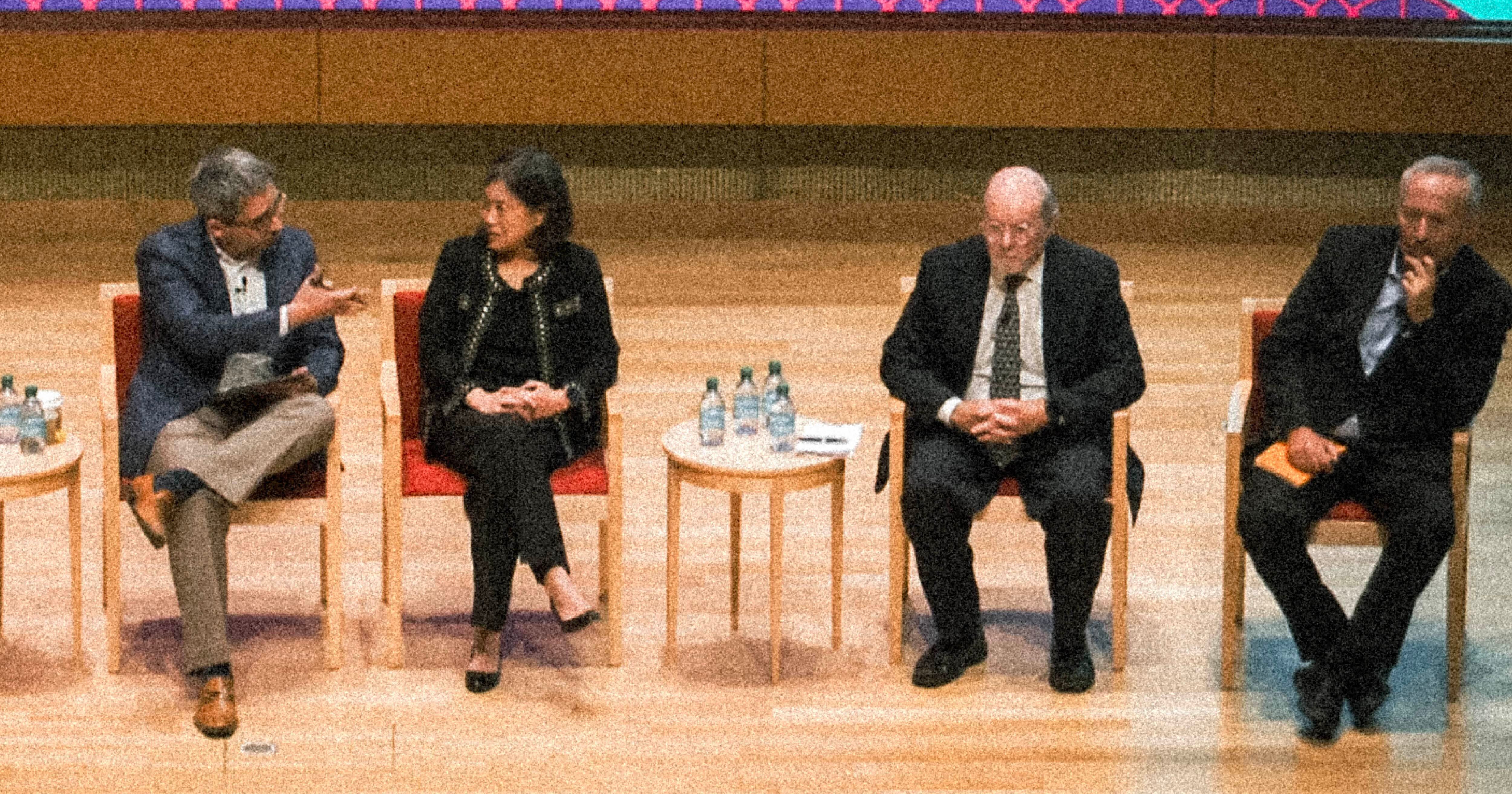
In November, Harvard Business School hosted a debate between Oren Cass and Katherine Tai on one side, and Larry Summers and Robert Lawrence on the other, over the question: Should the United States shift from the free trade approach it has supported since World War II in favor of higher tariffs?
Cass and Tai won the debate, based on polls before and after showing that the audience had shifted slightly toward their position. You can read the full transcript of the debate at American Compass. Here, we’ve excerpted a particularly interesting exchange among all four participants on China.
Oren Cass, Chief Economist, American Compass:
I just wanted to ask, going back to the Chinese auto example, do you think that we should allow cheap subsidized Chinese EVs to wipe out the U.S. auto industry? And if not, what tool would you use seeing as tariffs are second best and never appropriate?
Robert Lawrence, Professor of International Trade and Investment, Harvard University:
Well, I do think that under certain circumstances, you might resort to tariffs when they happened to be second best.
Oren Cass:
Second best to what?
Robert Lawrence:
Far better if you must insist on having such an industry or for that matter, production facilities for national defense, you should use subsidies. They are more efficient because you’re trying to increase production. If you wanted a bigger steel industry and you subsidized it, you’d increase production. If you wanted a bigger steel industry and you protect it, you actually make it more expensive to buy steel, which reduces consumption.
Oren Cass:
I’m sorry, you’ve switched the industry. So we should massively subsidize the U.S. auto industry?
Robert Lawrence:
Well, I wasn’t suggesting we do any of this.
Oren Cass:
So we should let China wipe out our auto industry?
Robert Lawrence:
Well, you said they would. Now, we do have rules and I believe in adhering to them. We have rules for unfair trade and actually that’s the traditional system which the Trump administration, and I guess you guys under Biden assisting with, undermining that old system. We have these rules and they used to be enforceable and they deal with unfair trade not as perfectly as we would like. So we should work on improving them and not undermining them by breaking the agreements that we signed historically.
And I don’t see how we’re ever going to convince foreigners to sign new trade agreements when we are the world’s biggest scofflaw when it comes to agreements. This talk about renegotiating the USMCA, which aren’t made, as a Canadian, would you have any confidence in an agreement that you signed after the way you’ve seen the United States violate its commitments? I don’t think it’s worth the paper it’s written on.
Larry Summers, former Secretary of the Treasury:
I agree with everything Robert said, but it was kind of very erudite and slightly complicated. So I’m just going to say, if they have heavily subsidized their industry, then the law is crystal clear that we are entitled to respond by, yes, putting tariffs on the specific area that they have subsidized or to retaliate. That is part of the existing system that has been in the law for 60 years that we absolutely support as part of a system.
But that is a quite different thing than the things we have heard from our opponents, which are we’ve decided it’s inconvenient. We don’t like this agreement, so we’ve got some objective that we want to achieve, so we’re going to slap a big tariff on another country and then try to renegotiate an agreement. But yes, should we live within a law that for reasons both political and economic with respect to predatory pricing provides for countervailing in the face of major subsidies?
Yes, absolutely. That is what we should do, but that is entirely consistent with the paradigm of U.S. trade policy that has existed. The difference is that we used to be able to get global support to respond when a country was subsidizing in a major way until we decided to declare trade war on the whole world and therefore reduced very substantially our leverage.
Katherine Tai, former U.S. Trade Representative:
I guess two responses. One, Professor Lawrence responding to subsidization with more subsidization or different subsidization is actually technically not in line with WTO rules. And so just one point of order there.
The second piece of it is yes, countervail was supposed to be the one tool that we had under WTO rules to counteract subsidies that are so distortive as we’ve seen in our trading relationships, especially with China. And it is actually the appellate body that ruled that a subsidy in the Chinese system has to be coming from the Chinese state or a parastatal entity acting as the state in order to be countervailable. What that means practically is that the WTO, in one of its most seminal decisions at the appellate level actually took away a really important part of the only tool that we have to counteract the kinds of subsidies that we have to compete with from China.
So I’ll just close out by saying I think everything is not okay. And at a time when everything is not okay, the answer cannot be let’s keep doing things the way we have been before, because I think that that is literally the definition of insanity that you keep doing the same thing and you expect for a different outcome. We need different outcomes in this country today. We need different outcomes around the world. What the economics of free trade has done to politics and geopolitics has taken us to a place that is tremendously dangerous. And I think that we have to respond and we have to think big. And that means also coming off of the orthodoxy of an economic order that has clearly run out of steam.
Larry Summers:
So first of all, we have laws in the United States that provide for the designation and then response to manipulation of exchange rates. Those are reasonable things to do. I think you have to be careful to understand what constitutes a manipulated exchange rate. It doesn’t just mean a market exchange rate that you wish was different. And I think we get immense advantages from having a strong currency, including the ability to borrow money at lower costs, lower mortgage rates for American families and the like. But yeah, we absolutely should respond when there are manipulated exchange rates. I kind of look at there’s a lot that could be different or could be better in this country.
But if you look at what’s happened to the middle class in Europe, if you look at what’s happened to the Japanese economy over the last 35 years, this apocalyptic talk about how terrible it all is in America, I don’t know, I’m sure glad I grew up here and got to spend my career here and maybe we could have pushed it better and no doubt there have been some mistakes that are made. But this idea that America is somehow a big failure over the last 30 years doesn’t, Katherine, correspond to my interpretation of reality.
Katherine Tai:
Larry, I guess it’s because I’m not a former Treasury Secretary, not a former president of Harvard University, and I’m not even the most ordinary of Americans. My level of economic insecurity and anxiety today is high. And I think that I’m just the tip of the iceberg for most Americans. Things are not okay. People are not experiencing the hope that the American dream can be theirs. I am glad that you were able to have your American dream.
Larry Summers:
If you think that making the cost of lumber higher from Canada, so that every house in America that gets built is more expensive is somehow going to bring back the American dream and doing ten more things like that is somehow going to bring back the American dream, we’re going to have to respectfully disagree.
Katherine Tai:
Well, that’s not what I said.
Oren Cass:
Larry’s going back and forth a lot. I want to pick up one more point because I think this is an interesting habit generally in these economic debates is that if you’ll recall when we embraced China and said free trade is wonderful and all of the factories were shutting down, economists lectured us very seriously that it’s completely unsophisticated and irrational to look narrowly at the immediate effect. We need to think broadly about the big picture, general equilibrium and what will eventually happen in the economy. There’s a very famous quote from Richard Trumka saying... somebody told him, “maybe it’ll take three to five generations, but that’s fine.”
And yet when we turn around the other way and we say, we actually think we should make some structural changes here. We should have policies that make it relatively more attractive to invest in the U.S., to rebuild industry here. That’ll create some jobs in factories, but it’ll also make it mean a lot more for the communities where these things locate.
That’s not going to happen instantly. It’s certainly not going to happen in the first nine months, but we think that’s actually a positive trajectory for a country that has been suffering under very challenging economic circumstances in a lot of ways.
Then we’re told, “oh, no, no, no. Look at what happened to soft lumber in the last two months. It doesn’t fly.” If you can say, “we like the decisions we made in 2000, that was the right trade-off, hollow out industry, cheaper stuff,” and most Americans are rightly looking at that trade-off and say, “you know what? That was the wrong one. We’re ready for something different.”
Robert Lawrence:
When we wrote an agreement with China to enter the WTO, we were aware, those who looked at that agreement were aware that there could be problems that would arise because of China’s unusual political system. And, in fact, there was a special safeguard put in that if imports from China caused disruption, just simply market disruption in the United States, we would be entitled to protect it.
And, in fact, four American industries applied, and they went to our International Trade Commission, and they actually proved that there had been this market disruption. However, the response of the Bush administration was to turn down their applications.
So the problem wasn’t that we allowed China to enter. It was that we didn’t enforce our own provisions. We have to think about adjustments and not ignore dislocation that occurs when workers are hurt.
Now, we have an imperfect trade adjustment assistance program. We had it. Actually, when Katherine Tai was the special trade representative in 2022, this program was disbanded. So do we really care about the people who are dislocated or not? How have we helped those who are hurt?
Trade does create winners and losers, and we have to have more, better programs for the losers. I’ve been writing about this since 1980. The best program is what I call wage insurance. So we do need to improve our adjustment programs in the United States for those who are hurt. Then we have to take care of those losers, otherwise we will see the political response.
But the laws we had anticipated that there would be problems. They provided provisions, and it took the election of Barack Obama before we actually invoked the safeguard to preserve tires, an industry that was then suffering severe disruption.
Oren Cass:
I agree with Robert that there were some safeguards put in principle. The problem is that we had virtually every economists saying, “don’t use them.” Like Robert Lawrence, who wrote in 2006, “China’s trade policies are broadly supportive of a rules-based multilateral trading order and its behavior at the WTO is that of a status quo power-”
Robert Lawrence:
That’s not a comment on the safeguard.
Oren Cass:
... and essentially said what China was doing was terrific and people like the Bush administration should certainly not respond because, of course, cheap stuff from China was good.
Katherine Tai:
I do need to correct for the record because this is being recorded and that is, literally, the record that I need to correct, which is TAA lapsed in 2022 because the United States Congress could not see their way to renewing it.
Why could they not see their way to renewing it? Because the Republicans in Congress are used to renewing it only, only in exchange for passing a massive liberalizing free trade agreement, which is really not in the cards anymore. And so the response from the Congress and the Republicans in particular was, “you know what? Anybody who’s displaced by trade, tough luck. Moreover, TAA in itself was never enough.”
And I’ll just go back to the classical economics training. There are going to be winners and losers from trade. We’ll make it okay because the winners and the winnings will have to be shared with the losers to compensate them for losing.
At the end of the day, when you lose your job, studies have shown that the impact of losing a job can be as significant as the emotional, social impact of losing a spouse. How do you compensate someone for that? You cannot, we did not.
And I think that is a large part of the reason why the disruption that has been wrought since NAFTA, since the WTO, since the accession of China into the WTO, which I think that I will agree with you, Professor Lawrence, that there is a lot of responsibility to go around in terms of why we are where we are today.
But that goes a long way to explaining what has happened here, such that the disruption is still ongoing 30 years since NAFTA was implemented. And the disruption is no longer limited to what is happening in the United States, but the disruption has come for everyone in the world.
Read the transcript of the full debate here.
The Free Trade people sound like a bunch of insufferable pricks.
Adam Smith knew that there is no such thing as pure economics in the real world. There was and always will be only political economy. The economists of twentieth century, especially after the fall of Soviet Union, forgot about the political part and fell for the lunacy of pure economics. It's just like open borders for the sake of universal human rights. It was utterly insane.