

What Not to Do About Gerontocracy
Samuel Moyn is right that we have a Boomer problem. He’s wrong about everything else.

For two-thirds of the last generation, the United States presidency has been held by one man or another born in the summer of 1946. Of the two who broke the pattern, the latest (four years older than the others), became so obviously senile that he was ousted by tweet in the middle of an election.
The average age in the Senate today is nearly twice that of Thomas Jefferson when he penned the Declaration of Independence. The average age of a homebuyer in America has soared to 59, around the time normal people are settling into their role as grandparents. (The average age of first-time buyers is a more modest 40, by which time only the very efficient are welcoming grandchildren.)
This state of affairs has brought many liberals around to a kind of pessimism once monopolized by conservatives, and it has tipped many conservatives into a revolutionary fervor that was once the sole province of the liberals. The result is a massive, bipartisan backlash against the decrepit oligarchs who control America and her treasures.
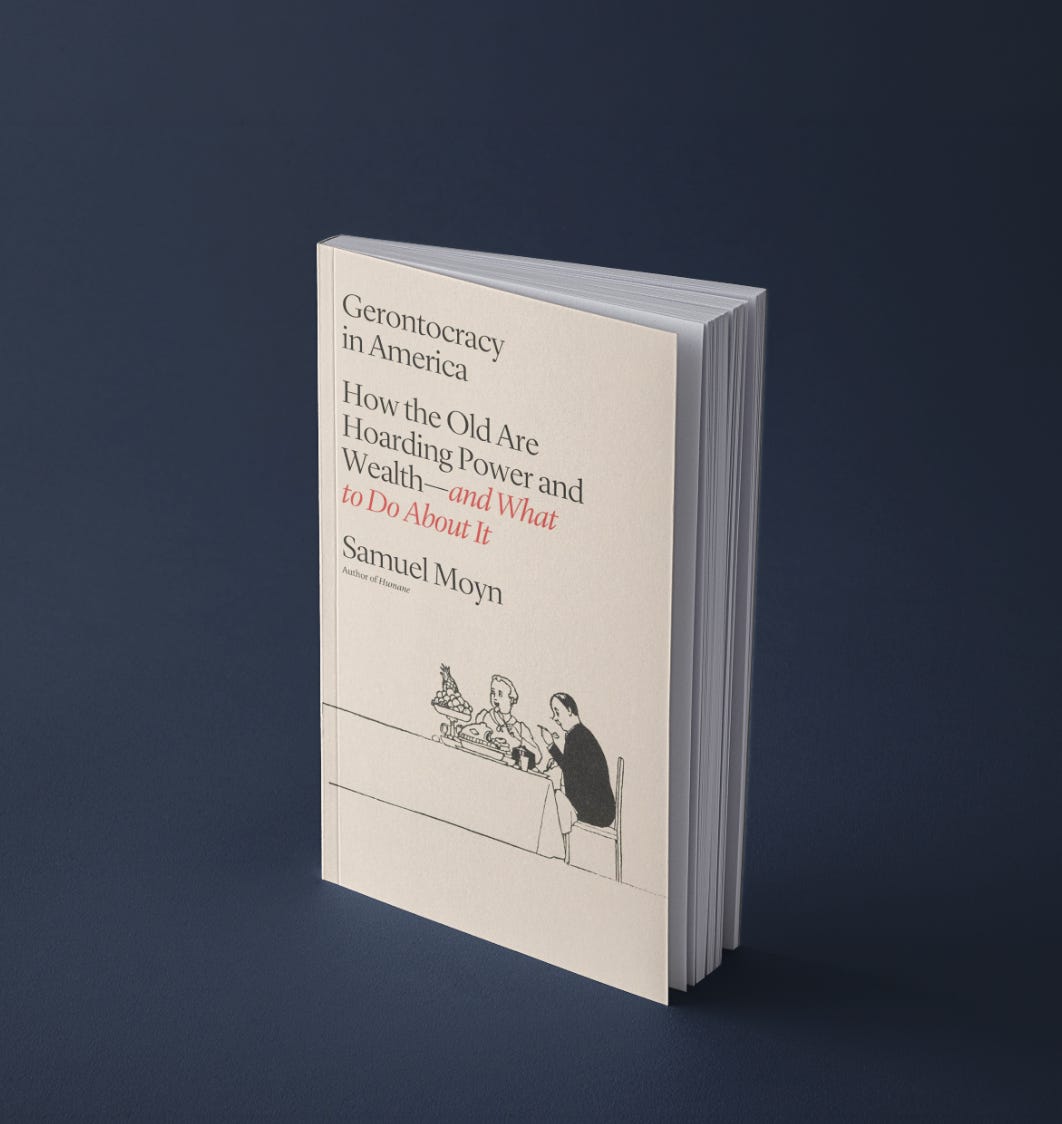
But the only thing worse than being governed by the old is being governed by the young. This is the irresistible lesson of Samuel Moyn’s Gerontocracy in America: How the Old Are Hoarding Power and Wealth—and What to Do About It. In 215 light but repetitive pages, Moyn outlines an America in which young citizens are cut off from political control, financial security, and institutional prestige by an aging elite that clings to all three for its own selfish purposes. As the only viable solution he presents a heady mixture of socialist economics, identity politics, and state-directed feel-goodism.
Besides the fact that his goals are the wrong ones, there is one major error underlying Moyn’s belief that our problems will be solved by handing over the reins to a new, revolutionary generation: We already tried that.
Moyn treats traditionalism and rule by the elderly as essentially one and the same. He refers repeatedly to “elder conservatism,” as if it is an undeniable fact of nature that the aged will be the guardians of the permanent things—or, in another view, of the dark things inherited from a world before liberation—and the young the champions of progress and reform.
He is correct, of course, that the elderly today are jealous of their political, social, and economic power. They are deeply and desperately invested in the status quo. But that is practically the only sense in which the particular generation in question, the generation with a stranglehold on American public life, could be understood as “conservative.”
Boomerdom is not a gerontocracy in any traditional sense. It is not a reactionary order invested in the preservation of centuries-old ways of living, nor a traditional system by which elders pass on the wisdom they have inherited. It is a new kind of political arrangement run by and for a generation who refuse to accept that they are old—a collective fantasy of perpetual youth rooted in the formative experience of 1960s radicalism and enabled by the singularly fortunate economic lot the Baby Boomers inherited.
This is why, for instance, the stereotypical Boomer insists that hard work and grit (along with abstention from avocado toast) will overcome any material challenges faced by the younger generations. Never mind that the number of jobs requiring only a high school diploma has been slashed by more than half since the heyday of the boomers, or that the income gap between mid-career and senior workers has grown by 61% as the portion of the workforce over 55 nearly doubled. A great many of the elderly today cannot and will not accept these facts. To admit that the world has changed, that the America into which they were born no longer exists, would be to admit that they have aged along with it.
Moyn makes one glancing reference, two-thirds of the way through the book, to “the elder propensity to deny decline and mortality,” but he has remarkably little else to say about the subject. This blind spot is made apparent by one of Moyn’s more interesting policy proposals: “a delayed housing wealth tax, levied on death and used for the purpose of building more housing; under this plan, older people would have the option of selling sooner to avoid paying the tax.” It’s a nice enough idea in the abstract, but it assumes that Baby Boomers both understand that they will die and care about what is left for their families when they do.
Moyn brushes off conservatives’ worries about the indiscriminate importation of millions of immigrants as a means to delay the economic apocalypse entailed by an inverted population pyramid. Never mind that mass migration is the most obvious cause of young Americans’ challenges in the labor market, followed closely by offshoring. Never mind that both were facilitated specifically to underwrite the permanent cruise-ship lifestyle of the Boomer generation. Never mind that a foreign invasion force competes just as much for scarce housing stock as do elderly Americans, and with far less right to do so.
Moyn slyly points to works of fiction in which the aging are ritually euthanized as a means of relieving their burden on the public—and assures us that he would stop short of this particular measure. But there is another, far more humane way to reduce the load of an overcrowded society by roughly 50 million: simply send home the people who don’t belong here.
Likewise, Moyn ignores the breakdown of the family over the course of the twentieth century, perhaps the single most important element in the Boomer story. Assigning causation is often a matter of political allegiance, but it is undeniable that the elderly’s reliance on federal welfare programs is a direct replacement for what once had been familial obligations. This is an easier solution for a generation of senior citizens who do not actually want the role assigned to elders, but it is a profoundly difficult one for the young working families left holding a heavy bag. The real story of gerontocracy in America today is the story of 30 million women terrified of being known as “grandma.”
Such troubles are not worth fussing over. Instead, Moyn fixates on the so-called “climate crisis,” the fantasy of impending apocalypse by which elderly activists relive their glory days long after every cause has been worn out. This, he assures us, is the issue of the future, and (like the huddled masses of the world) the old are the only thing holding it back.
As these snippets might suggest, Moyn is desperate to ensure that nobody mistakes him for a conservative, despite the cross-partisan appeal of his basic premise. The book is thus chock full of fantastic liberal myths that have little or nothing to do with its driving thesis: that public school teachers are underpaid, that work requirements for Medicaid are unconscionably cruel, that the process of aging discriminates against black people. When one passage could be read as lamenting the decline of once-healthy civilizations, the author hurries to add that “population growth (or shrinkage) says nothing about cultural vitality.”
The silliness of Moyn’s Ivory Tower liberalism should not distract from the extremism of his actual agenda. Politically, his opposition to elder power is shockingly absolute. Twice in the span of seven pages he denounces the U.S. Senate as a “holdover” from the dark days of antiquity, when old men held political power by virtue of experience. A few pages after that, he dismisses the very idea that elders can be valuable as resolvers of disputes and repositories of hard-earned wisdom as a “magical belief.” A chapter later still, Moyn casually admits his belief that “eventually, the abolition of the old man’s titular branch of government, the Senate, is a must.”
This is because “the aims [of the framers of the Senate] were conservative and gerontocratic, which euphemisms like deliberative and stable often masked.” Moyn makes the same point about the Supreme Court, the “nine old men” who famously stood in the way of FDR’s most radical New Deal dreams. What actually distinguishes these two bodies in the American constitutional system is not their tendency toward age but their resistance to the impulses of the mob. Words like deliberative and stable are more than euphemisms; they are the foundations of good government and indispensable safeguards against the utopian schemes of Ivy League professors.
Moyn regards such constructions as an inconvenient quirk in the American scheme of government:
In any case, after it announced the one-person, one-vote principle on Baker v. Carr (1962), the Supreme Court has never taken it to its logical conclusion. Were it to do so, it would be forced to abolish the Electoral College and the Senate, both of which notoriously overweight the votes of some Americans living in smaller states, awarding them disproportionate power. While the Supreme Court insisted on equal districts within states, it never faced the dilution of voting power inherent in giving two senators to even the smallest states, a practice that also carries over to the Electoral College, which allocates spots based on the number of senators plus the number of representatives.
Faced with such passages, it is almost impossible to believe that the author of Gerontocracy in America is professor of law and history at Yale. Surely the occupant of such a post has some knowledge of the concept of federalism. Presumably, Moyn understands and simply disagrees with the system set up by America’s founders 250 years ago. If so, he should say as much and make his case for an alternative. But to feign ignorance of the whole logic of the American constitutional system is a bizarre and ineffective choice in a book meant to persuade.
Nor should we mistake Moyn’s objection to these constitutional safeguards as some kind of democratic purism. In fact, it is quite the opposite. When Moyn attempts to explain the disaffection of younger voters, who show up on election day at far lower rates than older cohorts, he can only guess that they want representatives who look like them, and that a state mandate should be implemented toward that end.
“If giving everyone the right to vote still leads to a democracy disfavoring blocs of the population,” he asks, “why not just provide a fixed or minimum amount of representation to the blocs instead of pretending that the process will do so automatically?” Of the use cases Moyn proposes for such a quota system, the only one that is even remotely feasible in an American context is in delegations to party conventions, where the idea could be interesting. To bring such quotas into actual public office, however, would entail a revolution the republic would not survive.
Some of Moyn’s proposals veer even closer to totalitarianism, including a suggested federal age limit on political donations. He admits that such a measure “is probably a nonstarter in practice in the foreseeable future,” since the Supreme Court has already found that age limits on political donations violate the First Amendment. “In the foreseeable future” would seem to suggest that the First Amendment, like the Senate, should ultimately be consigned to the ash heap of history. Later, he takes the principle a step further by proposing the removal or dilution of seniors’ right to vote, in which context the discussion of Baker v. Carr appears.
Moyn even criticizes philanthropy on the sole grounds that its ends are chosen by private citizens, not by the federal government. To solve this imagined problem, he would strip all tax benefits from any charity whose mission is not endorsed by the state—that is, by the party in federal power at any given moment.
Indeed, it is on questions of money that Moyn is most ambitious, and most confused.
He is largely correct in his diagnosis of a tax system “set up to benefit older people preferentially and unjustly,” and a few of his proposed remedies may be fodder for bipartisan cooperation. He is correct that carveouts for senior citizens, regardless of actual need, give a handout to an established demographic at the expense of the young and struggling. Rep. Nancy Mace’s recent No Tax on Boat Loan Interest Act is a particularly egregious example.
Less absurdly, the tendency is obvious in disputes over property tax, which is locally determined and thus easily swayed by the incumbent class of owners. But (though he is ambiguous on the point) it seems like Moyn favors repealing all homestead exemptions, not just reforming them to resolve the gerontocratic tilt. That would throw out the baby with the bathwater; in fact, a stronger, more targeted homestead exemption would be a massive boon to young families in the housing market, as I have argued previously in Commonplace.
One measure Moyn will not consider is reforming Social Security. As Moyn notes, on its passage in 1935, Social Security made up just 0.29% of the federal budget. By 2025, that number had multiplied nearly a hundred times, to 22.5%. And that growing burden is being shouldered by fewer and fewer people: “where there had been 40 workers for every beneficiary in 1940, that figure dropped to 3.3 to one in 1980.” It has since dropped all the way to 2.7. Nor do benefits phase out for retirees who do not need them, so that struggling working families are left subsidizing wealthy retirees’ fourth and fifth annual cruises.
Such a setup is obviously unsustainable, and the knowledge that they are paying into a system whose rewards they will never reap is a major contributor to the outrage of younger generations at the reigning gerontocracy.
These numbers are not worth discussing, though. The real problem, Moyn informs us, is Boomer “hoarding”—a word whose variations appear no fewer than 28 times throughout Gerontocracy in America. Only in housing—where supply is sharply limited, the utility of the asset in question varies with the owner’s phase of life, and the windfalls of the last two generations have been wholly unearned—is the term really fair to use. Otherwise, it’s better known as “saving.” But even a professed socialist like Moyn would not be so foolhardy as to call for state seizure and redistribution of elderly people’s houses.
What Moyn will use the state to redistribute is jobs, and happily so. He seems to operate on a Carter-era assumption that growth has reached its natural end and that the only question left is how best the state might mete out a fixed set of economic privileges. Indeed, he treats “neoliberal” suggestions to the contrary as unworthy even of rebuttal. Thus, he devotes a great deal of energy to conceiving schemes to push Boomers into retirement, freeing up their jobs to go to younger occupants. Of these proposals, the most feasible is repealing the 1986 ban on mandatory retirement (an “ageist” practice), which may also have cross-partisan appeal.
Perhaps the most interesting, though, is “capacity testing”—that is, subjecting aging workers (or, as a pilot program, politicians) to a rigorous and standardized examination of their abilities. Moyn seems not to consider how such a change for the elderly might ripple out into other areas presently controlled by anti-discrimination law. But if the refusal of senile politicians to step down from office willingly is what leads to the reversal of Griggs v. Duke Power Co., then conservatives will rejoice at an accidental victory—even as left-wing Yale professors recoil in abject horror.
Of course, when such people are pushed into retirement, they will require financial support through their final years, a challenge made all the more daunting by the medical extension of the time between the loss of full capacity and death. The solution, Moyn cheerily informs us, is to tax everyone a whole lot more to provide for socialized elder care for all, replacing the already obscenely expensive partial welfare system.
The end result of such an arrangement should be obvious enough, and Moyn comes within half an inch of recognizing it. In the penultimate chapter he presents an image of state-controlled elder care from Michel Houellebecq’s 2022 novel Annihilation: an 80-something woman in a soiled diaper abandoned in a dark corner of a run-down public facility, ignored by the tax-paid staff as much as by her absent family. Moyn’s incredible takeaway is not that such schemes are inhumane, or unnatural, or even ill-suited to provide for people in their time of greatest need, but that “Americans don’t even have a welfare state that guarantees this much support.”
In one sense, then, Moyn’s contention is not that gerontocracy is an evil or unfair system, but that real gerontocracy has never been tried. If only young families and workers transferred more of their earnings to senior citizens, and did so at gunpoint, then everything would be hunky-dory. In a magical world where money appears ex nihilo, restricted only by the “hoarding” of this or that capitalist bogeyman (in this case, the elderly; elsewhere men, white people, U.S. citizens, heterosexuals, people with jobs and BMIs under 30), nobody would dream of describing it this way. But here in the real world, where the tax power exists downstream of lethal force and government must marshal limited resources for almost limitless needs, it is the only fair way to describe it.
A nation in crisis will not be rescued by a vibe shift. Moyn must know this, which is why he devotes so much of his attention to more radical solutions than bingo and pickleball (though attempts to make retirement more appealing are a key part of his program). But neither can he stomach the possibility that conservatives were right about anything. And so, faced with the option of a few difficult but constructive reforms (remigration, means testing Social Security and adjusting its retirement age for modern life expectancy) or a continued drive down the suicidal path of the last century, he takes the latter eagerly.
Neither Moyn (now 54) nor any of the original cheerleaders of the progressive-industrial complex will be around to see the misery or the violence this path entails. For this alone, Gerontocracy in America may be a fitting testament for Boomerdom as it nears an uncertain end.
 | A guest post by
|
Meh. Older people vote more than younger people. There’s your trouble.
The Boomers have been fighting "The Man" for so long they failed to notice when they became "The Man".