

When the Train Comes Back to Town
The revival of a local railroad is about more than the bottom line.

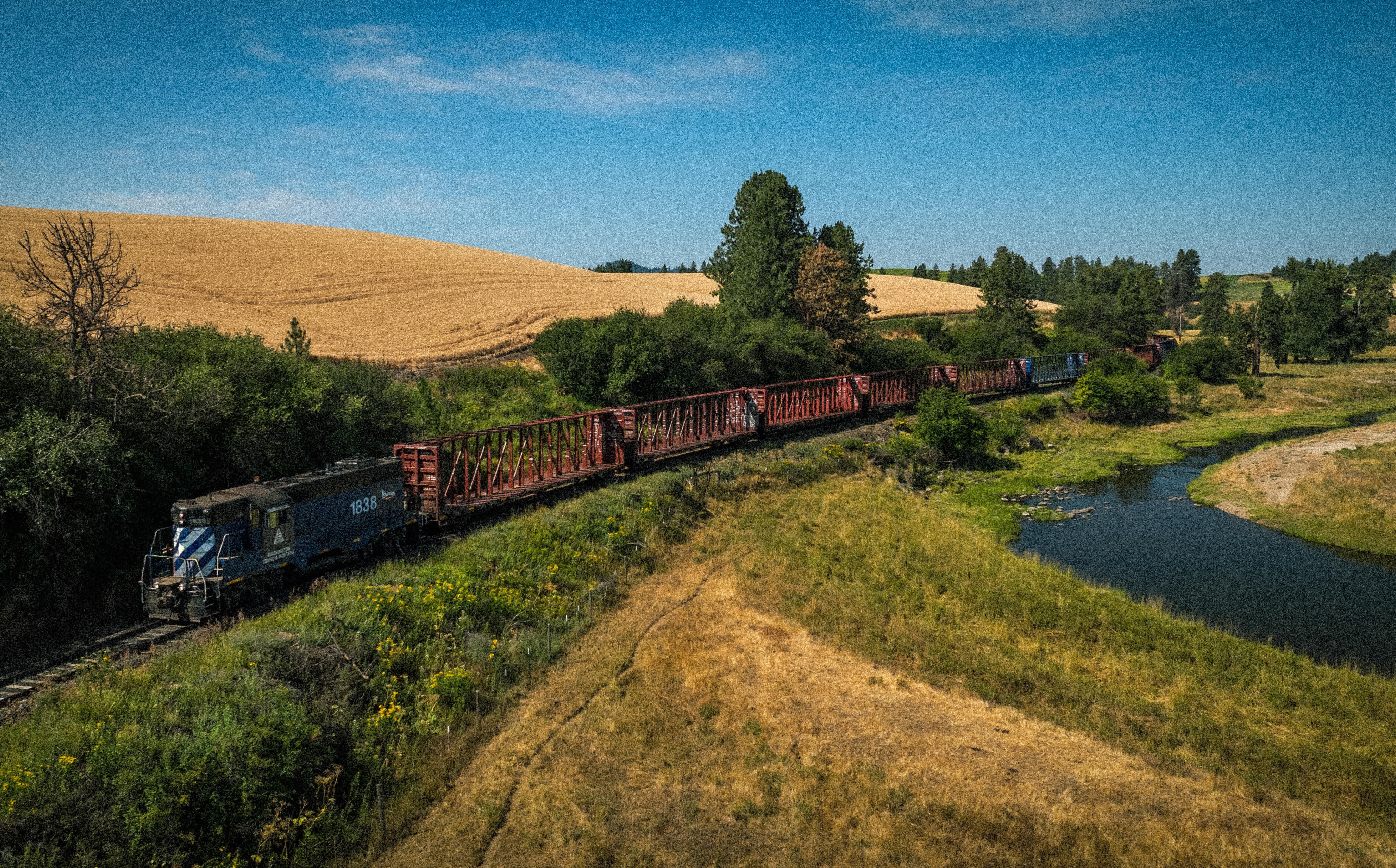
On February 7, at the Palouse Cabin Fever Brew Fest, a large crowd was imbibing regional craft beers when an old, small, blue engine rumbled down the adjacent train line. The entire crowd spontaneously broke out into applause. Even with the well-known propensity for alcohol-fueled groups to cheer for things, this scene might have looked peculiar to outsiders who don’t normally give passing trains a second glance.
But this was no ordinary train spotting. It was the revival of a line which had been shut down since 2018 and was believed never to be coming back. The site of the train represented the return of an industry thought to belong fully and exclusively to the past, and as such it touched something deep in the hearts of that stirred-up crowd.
Palouse, a town of about 1,000 in a remote part of eastern Washington, was once a stopping point for three separate train lines—an east-west line transporting the region’s famous lumber, a north-south grain line connecting to the regional hub of Spokane, and an electric “interurban” line which was part of an 80-mile-long transit system that provided easy transportation between the region’s communities for the first time.
The transit system is long-gone, both here and in almost every American community. The north-south line connecting to Spokane remains as a freight line, though it runs around rather than through Palouse. It is the east-west line, which runs right through downtown along Main Street, that has been revived, to much fanfare from locals. Here in particular, trains are a big part of local culture.
The original Washington, Idaho and Montana Railway (WI&M) was built in the early 1900s to serve the lumber industry, which led to the founding of some of the towns along its route and remains crucial to the region’s economy today. The WI&M ran from Palouse east into the forests of Idaho, trailing the Palouse River for much of its length. As the name implies, it was intended to reach all the way into Montana, though that never happened as it ultimately connected to a separate, national east-west line in the Idaho town of Bovill.
The WI&M saw its usage gradually decrease over the years, cut down by growing truck shipments and by the government-funded damming of the Columbia and Snake rivers which allowed for transport by water. In the early 1990s a company named Watco purchased the distressed regional rail lines, and later a group of farmers were able to convince the Washington State Department of Transportation to buy the lines on the Washington side in order to ship grain, though Watco remained as the operator.
According to the state DOT, “Watco could not economically rehabilitate or maintain the lines after it purchased them from major railroad companies… After attempting to develop business for a number of years, Watco finally considered abandoning the lines because they were not profitable.” The Washington side was saved by the state, but the 18-mile Idaho side was not, and it finally suffered the fate of abandonment in 2018, leaving some of the region’s logging firms without a rail link.
Losing the train hurt the economies of these small northwestern towns, disturbing a history that ran in some cases to their founding. Potlatch, Idaho, located ten miles east of Palouse, originated as a company town of the Potlatch Lumber Company, and was once home to the world’s largest white pine sawmill. Everyone in town was in one way or another employed by the company, and Potlatch white pine brought the town fame far and wide. An old man who lives in Palouse told me that he grew up working at his parents’ lumber store in Ohio, and that White Pine from Potlatch was the finest product they could stock and a top seller.
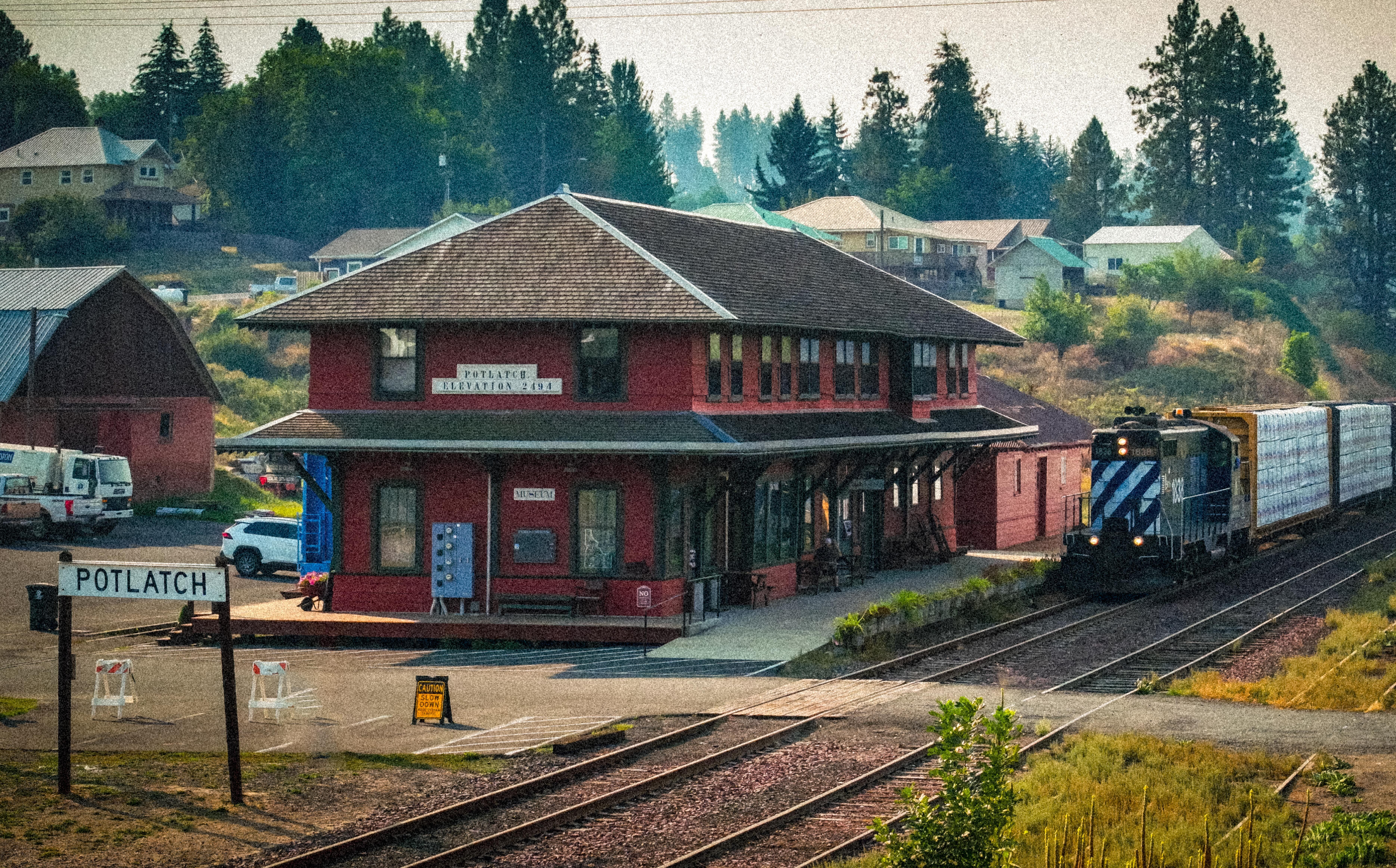
But financialization and mergers saw the town sold to its residents in the 1960s, and the mill closed completely in the 1980s, leaving Potlatch as a struggling “bedroom community” that in recent years didn’t even have a lumber train pass through—in a town where the high school mascot is the Loggers. The original train engine for the old railroad, along with its last caboose, both sit on display near the tracks.
But committed citizens on both the Washington and Idaho sides of the line were determined not to let that be the end of the story. On the Washington side was a man named Jason Hill, who moved to the area to fulfill his childhood dream of owning a railroad. He’d first learned about trains by working on a tourist ride near Mount Rainier, initially as a volunteer and then as a full-time worker, obtaining all of the skills needed to run and maintain a train line and making a host of contacts in the industry.
With the dream in mind, Hill got a small group together and began negotiations to revive the train in 2020. It was eventually determined that the only viable solution to revive the Idaho line was a sale to Bennett Lumber Products Inc., a large, family-owned business of 280 employees with a direct link to the rails. After looking over the financials, Bennett Lumber agreed, and in 2023 the company purchased the Idaho track and began spending millions of dollars restoring it. Materials expenses alone included 11,000 new railroad ties at a cost of between $70 and $100 each.
Hill and two friends then formed Washington, Idaho, & Montana Railway LLC, naming the new company after the original line, and leased it from Bennett Lumber. The next challenge was acquiring a train that could haul the lumber out of Bennett’s yard. To do so, they leased EMD GP9 engine number 1838, a lovely diesel locomotive built in 1956 that can sell for around $115,000 if purchased outright.
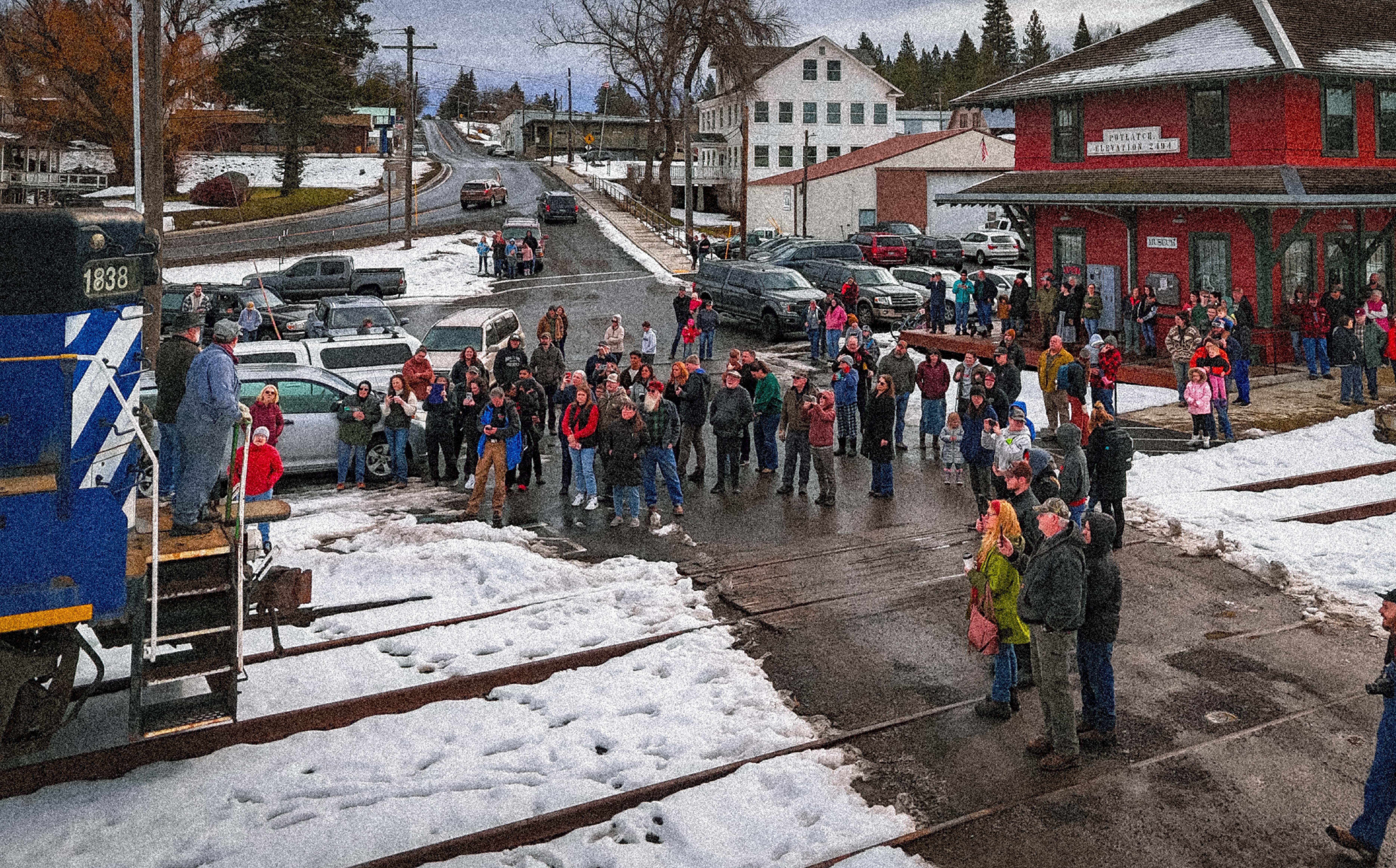
Despite its age, Hill told me the frame and car body are in great shape and could last another 100 years with good care. New train engines, by contrast, are still made in the U.S. but can cost upward of $2 million, and include so many electrical components that they are unlikely to run for nearly as long without significant upgrades. Some engines built in the 1990s are already obsolete because so many of the electrical components have been discontinued.
The train line, after being meticulously restored, began to function again as a freight route last year. It was dedicated at a ceremony in Potlatch over the winter, and brought its first run of 19 empty rail cars east to Bennett Lumber in the summer. In September, the dream was realized as the 1838 successfully hauled seven cars of Idaho white pine back west across the tracks to complete its first revenue run.
It was big news for people who live along the route. A film crew documented the event with cameras mounted on the engine and drone footage capturing the scene, while residents of the various towns gathered to greet and snap photos of the train, some riding bikes or even driving their car alongside it for short stretches.
So what’s in it for Bennett Lumber? To learn more, I spoke with Bryson Bennett, the company’s vice president and son of the current owner.
“We weren’t really looking at it as a payoff,” he told me. “The standpoint is more about giving our customers more flexibility in how they want to ship their lumber. It’s a little more economical sometimes to ship via train.” Bennett added that, particularly with current diesel rates, it’s an attractive proposition for many buyers and that the rail option could potentially bring in new business.
The company won’t undercut the market just to try and get more traffic onto the train, but it can often simply be faster and cheaper to use rail. Buyers are generally responsible for their own trucking logistics, and a single train car can carry about three semi trailers worth of lumber, meaning it can be more efficient under the right circumstances. The first run last fall included seven train cars—or 21 trucks worth—of lumber bound for customers in Colorado, New Mexico, Oklahoma, and Texas.
“I think it’s easier on the customers,” Bennett said. “They’re able to move a higher volume without having to contract several truck loads just to pick it up. They can order three cars worth, which would be nine trucks of lumber that can be shipped directly to them a lot quicker.”
What impressed me the most in my conversation with Bennett was that as a family business—albeit a large one—the company was able to take a long-term view of the project’s success, keeping customer satisfaction central to the health of the organization.
Not everything that is ever built must be maintained forever, and the decline of America’s small train lines has been just one sad part of a broader story of industrial decay. In this area, part of the issue has been the addition of river transport, but that is not true of trains generally. Rather, trains have suffered from a general lack of government and business investment, as well as the persistent notion that they somehow reflect socialism whereas automobiles reflect freedom, despite the fact that our roads are taxpayer-funded.
Hill was kind enough to take me and my kids on a ride across town while they hooked up empty cars for another load, and I must say the venerable old engine seemed to have much life left in her yet. The kids enthusiastically agreed.
But of course it’s not just kids. The reality is that humans just like trains, from my one-year-old son to my 70-something-year-old father. At a time when just about anything can become politicized, every single person I spoke to for this piece expressed their love for the train and its return to our town.
“The best part is the look of wonder on children’s faces when it goes by and blows its horn,” Kim Rundle, the owner of the Palouse Caboose Bar and Grill, located just a stone’s throw from the tracks, told me. I know what she means. My house sits on a bare bluff overlooking the train junction, and my two young children run frantically to our living room window every time it passes by.
For Hill, the WI&M is certainly a passion project, though he is confident that it can be profitable too. For now, it generally runs a load of between five and ten cars each Saturday—the day the operators are free to work on it—traveling from Bennett headquarters to Palouse before being transferred to the Spokane, Spangle & Palouse Railway, which links into the national rail network. Spokane has always been a manufacturing and trade hub, and was one of the first cities in America to get properly electrified, but grain and timber from the surrounding area have always been its chief exports.
For now, the WI&M’s operators have other jobs, doing train maintenance after hours and running it on the weekends. To boost business, Hill is also using the tracks for railbike tours, which should start this summer allowing photography tourists a unique view of the Palouse region’s famed natural beauty. The train has even become something of a local celebrity. Last Halloween the 1838 was decorated with ghosts and goblins, and at Christmas it sported multicolored lights and got a visit from Santa Clause.
Even for Bennett, which spent millions of dollars reviving the train, the community element may have been a factor. It is hard to imagine a company owned by institutional investors having the flexibility to take any view of the matter outside of the basic rate at which they need to ship board-feet of lumber to justify using capital that could have gone to some entirely unrelated venture. One gets the feeling that, like everyone else in this story, the Bennett Lumber family also just likes trains, if for more practical, logistical reasons than purely romantic ones.
In an era where an ever-widening portion of the economy seems vacuous or outright fake—artificial intelligence, sports betting, internet pornography, and the data centers which make it all possible—it is a lovely thing to see a trainload of lumber pass by and be reminded that we do still make real things in this country, and that a little boy who loves trains can still grow up to own and run his own train company.
 | A guest post by
|
So many things make me love living here. Bummed I missed cabin fever this year.
This is what is all about.