



Oren has a new essay in the New York Times today, explaining President Donald Trump’s China stance over the years as consistently oriented around what he sees as a commercial dispute, which argues that the United States cannot afford to take that approach: “The grand bargain that Mr. Trump wants, establishing a balanced economic relationship between the two nations, is not one that he can get, because the relationship is not one that can exist. The asymmetry of the two economic systems guarantees that any deal with China ends with the United States ripped off.”
But how to get from here to there? Daniel takes a look this week at key steps the administration is taking that don’t necessarily make the headlines, but do position the United States well to win the long-term competition:
President Trump arrives in Beijing next week for a much-anticipated two-day summit with Chinese President Xi Jinping. The commentary in the lead-up and aftermath of the meetings will focus on whether the détente they struck in Busan, South Korea, last October will hold, and whether they will reach an agreement on trade, investment, and other issues of importance, or lay the groundwork for one.
The summit comes at the end of a rollercoaster year for the bilateral relationship. The Trump administration’s tariff regime drove China’s share of U.S. imports down to 7.5%, erasing more than two decades of growth since China entered the WTO. At the same time, Beijing demonstrated the leverage it has amassed in the intervening decades. Trade disputes led to a series of escalation spirals, with each round of U.S. actions prompting Chinese reactions and additional U.S. actions in turn. The hostilities peaked in October, when Beijing tightened export controls on rare earths and permanent magnets, inputs that China dominates in mining and, more decisively, in processing, and that are foundational to the U.S. industrial base. The Busan summit and the ceasefire that followed began a cooling-off period that has largely held since.
To critics, the ceasefire has confirmed a charge that has dogged the administration ever since: that President Trump, for all his first-term trade hawkishness, has gone soft on China. But that charge mistakes restraint for capitulation. Tariffs and industrial policy cannot quickly reverse decades of failed policy that left the United States badly exposed. Climbing back out of the hole will take years. Even for those like us at American Compass who want to decouple sharply from China, a ceasefire that buys time for that work and minimizes the cost of transition is defensible, as long as that work is in fact proceeding as quickly as practicable.
In many areas, beneath the headline drama, it is. We have been documenting the administration’s critical minerals strategy here at Understanding America as it has unfolded, work designed to release China’s chokehold. And in “A Great Wall Around China,” I wrote about the China-containment architecture the administration has embedded in its reciprocal trade agreements to counter Beijing’s industrial overcapacity.
A third front, less remarked upon, runs through the Federal Communications Commission (FCC). The agency’s authority over electronic devices, telecommunications carriers, and corporate ownership disclosure has given it unusual leverage over China-related risks, and, over the past year, it has used that leverage.
In December, the FCC barred all foreign-made drones (overwhelmingly made in China) from receiving the equipment authorization required to enter the U.S. market, and in March, it did the same for foreign-made routers. Companies can apply for conditional approval by submitting a credible plan to anchor production in the United States. Drones and routers are sectors in which U.S. supply chains have grown deeply dependent on Chinese hardware, and in which a sudden cutoff would have functioned the way the rare-earth squeeze did last fall. Without the FCC’s action, drones and routers could have been the next rare earths. Instead, Skydio, the leading U.S. drone maker, has just announced a $3.5 billion investment to accelerate R&D and expand manufacturing.
The agency is also rebuilding the system that authorizes the sale of electronic devices in the United States in the first place. During peak globalization, the FCC had begun recognizing labs from anywhere. The predictable result was that Chinese labs, many owned or controlled by the Chinese government, came to handle around 75% of the testing for U.S. electronics, from drones to phones to baby monitors. Rules adopted last year and a proposal advanced in April will bar labs owned or controlled by foreign-adversary governments from testing and certifying U.S.-bound electronics, and labs in countries that do not extend reciprocal treatment to American testing will lose recognition. China, predictably, has not—and will not—sign a reciprocity agreement, as it prohibits any foreign-based testing. An evenhanded reciprocity does the explicit work; deconcentration from China does the rest.
The agency has also moved to bar Chinese state-owned carriers from the domestic U.S. telecom market, voting in April to issue a notice of proposed rulemaking that would prohibit them from operating data centers and points of presence in the United States and bar U.S. carriers from interconnecting with them. And in January, the agency finalized a disclosure rule requiring nearly every license and authorization holder in the U.S. tech, media, and telecom sectors to certify whether they are owned, controlled, or directed by a foreign adversary, with Chinese ownership of as little as 10% triggering disclosure. The rule builds a public map of where China’s leverage in the American technology stack actually sits.
Taken together, the FCC’s actions form a coherent program. The agency can, and likely will, use the drones-and-routers tool against any sector in which Chinese supply concentration creates the kind of leverage Beijing exercised last fall. The lab rules harden the gate through which devices enter the market in the first place. The telecom action targets legacy footholds. The disclosure rule provides transparency to identify the next pressure points.
Across critical minerals, trade agreements, and the work at the FCC, China containment is advancing on multiple fronts at once. The work is real, and the work can hold. But as Oren warns in the Times, a grand bargain would undermine all of it. — Daniel
DATA BUMP
The April jobs report released this morning delivered a surprisingly strong number, with payroll employment up 115,000 atop the 185,000 increase last month. Those are relatively healthy numbers in any environment—for instance, choosing ranges that exclude the COVID disruptions, the first three years of the Trump administration averaged 178,000 new jobs per month and the last two years of the Biden administration averaged 146,000 jobs per month.
But as Understanding America readers know better than anyone, we must calibrate job figures during the second Trump administration to the unprecedented reductions in prospective workers caused by rigorous immigration enforcement. AEI’s Stan Veuger and Brookings colleagues Wendy Edelberg and Tara Watson estimate, “in the second half of 2025, breakeven employment growth of 20,000 to 50,000 jobs each month was consistent with immigration flows. That number could dip into negative territory over 2026.” Adding 300,000 jobs in a couple of months against that backdrop is remarkable.
Kudos to Ben Casselman at the New York Times, though, for coming up with this downbeat assessment of an unemployment rate holding steady at 4.3%: “looking out a couple more decimal points, the unemployment rate edged up from 4.26 percent in March to 4.34 percent in April.”
Meanwhile, in the manufacturing sector: “Manufacturing sector labor productivity increased 3.6 percent in the first quarter of 2026, as output increased 3.3 percent and hours worked decreased 0.4 percent. In the durable manufacturing sector, productivity increased 5.3 percent, reflecting a 5.4-percent increase in output and a 0.1-percent increase in hours worked. … Unit labor costs in the total manufacturing sector increased 2.4 percent in the first quarter of 2026, reflecting a 6.1-percent increase in hourly compensation and a 3.6-percent increase in productivity.”
GOOD READS FOR YOUR WEEKEND
In the New York Times, Ross Douthat writes about Slouching Toward Kamala Harris. “The Democrats’ fundamental condition is a late-Trumpian stasis—in which the president’s stark unpopularity encourages his opponents to imagine that they can keep everything basically as it was in the Biden era, with the same broad priorities and deference to activists and interest groups, and float back to power automatically.”
The Wall Street Journal tells the story of The Secret Team Blowing Up Ford’s Assembly Line to Make a $30,000 Electric Truck. “Then they attacked Ford procedures and mandates the team deemed obsolete or even nonsensical. Field described one such rule. All Ford vehicles must be built with a slight lip above the opening to prevent rain from spilling in the window when a driver or passenger cracks it to smoke a cigarette. Nicknamed “smokers window,” it added aerodynamic drag, costing battery range. The new truck won’t have it.”
This is a long one, but if you’re interested in the Department of Justice indictment against the Southern Poverty Law Center, Bits About Money has the details on what the non-profit was doing and its, um, rather poor fit with our nation’s laws is fascinating: Notes on a Non-Profit Indicted for Bank Fraud.
Politico has a great profile of U.S. Trade Representative Jamieson Greer, “The Man Trying to Make Trump’s Tariffs Go on Forever.” It’s a story of the past year’s trade policy too. “He’s secured nine agreements on reciprocal trade so far, deals that trade lawyers say are thorough and gain significant concessions for the U.S.” And it has a great ending:
Of course, one person who loves tariffs is the president. “Almost every day I’m in the Oval Office,” Greer told a crowd at the Whirlpool factory in Clyde, Ohio. “And almost every day, President Trump says, ‘Do you think the tariffs should be higher, Jamieson?’”
“We’re working on it, sir,” he replies.
DEFICITS EVERYWHERE
Trade deficits, budget deficits, logic deficits, oh my… Michael McNair has an excellent essay, “A Surplus of Confusion About America’s Deficits,” that comprehensively rebuts Maurice Obstfeld’s recent argument, “Don’t Blame America’s Current Account Deficit on the Dollar.” Michael Pettis comments on the exchange:
Investors, business managers, workers, policymakers and even the IMF (albeit kicking and struggling) increasingly understand the adverse impacts of large, persistent trade imbalances driven by wage-and demand-suppressing policies, even if it will still be many years before mainstream economists do. The latter seem ideologically averse to any explanation of global imbalances that don’t conclude with calls for more fiscal and wage discipline in the US.
That said, fiscal discipline remains an enormous problem here in the United States, where the national debt now officially exceeds gross domestic product. Of course, that’s an entirely arbitrary marker, but it’s notable that this was the case during only two other years in American history, 1945 and 1946, which you may recall followed after some rather extraordinary one-time expenses.
Will AI help us dig out? Of course, if we suddenly see 10% annual GDP growth, debt and deficits will quickly become a thing of the past. In more likely scenarios, it will contribute some to growth, but not fundamentally change the fiscal picture. Unless, that is, AI itself becomes a significant source of government revenue.
Back in 2017, Bill Gates famously proposed a “robot tax.” Today, the talk is instead of a “compute tax.” See the Wall Street Journal: “What Is a ‘Compute Tax’ and Why Is the Idea Gaining Traction?” These taxes are generally framed and pitched as a way to slow automation or account for the negative externalities associated with rapid job displacement. In other cases, the goal is redistributive: if the AI companies are going to capture all the economic value, let’s collect some of that and mail it out to everyone as a “universal basic dividend.”
But framing automation as a bad thing outright, or telling people its benefit accrues to others and they just get a handout, is neither the right way to think about technological progress nor the right way to sell it. Rather, we should think of AI as a productive force that can help to serve the common good. If a data center cranking through gigawatts of electricity on hundreds of thousands of GPU processors can participate productively in the economy, we can choose to allocate some share of that value toward public goods: better roads, higher pay for teachers, solvent social insurance programs, even as we close our deficits, then reduce our debt, then begin lowering the tax burden on workers… if that were AI’s promise, one imagines the public might be more enthusiastic.
In the Journal, economists offer the usual complaints. “If you ask economists, most of them think this is unnecessary or too blunt,” says one. But any tax, evaluated in isolation, looks bad. If the income tax, or the corporate tax, or the payroll tax, or the sales tax didn’t exist and you proposed it, economists would presumably say the same thing. (Absurdly, organizations like the Tax Foundation actually evaluate taxes without considering how the revenue would be used or what the effect on debts and deficit would be, so all taxes automatically score as unwise and simply eliminating all taxes is predicted to deliver the strongest economy.) The reality is that we need tax revenue, indeed more tax revenue than we collect now. AI’s role as a tax base thus deserves serious consideration.
DO YOU WANT THE GOOD INDUSTRY NEWS FIRST, OR THE BAD NEWS?
The bad news? OK. “Storied Toolmaker Closes Its Last Hometown Plant—and Blames Its Tape Measures” (Wall Street Journal). While economists will continue to insist that globalization is an inevitable and productive consequence of “comparative advantage” and the relentless pursuit of efficiency gains and economic growth, looking under the hood often reveals the simple laziness of corporate executives doing things like shutting down American production because they installed a machine that prints one-sided tape measures in Connecticut and one that prints double-sided tape measures in Thailand, and people like the double-sided ones better.
But here’s some good news: “Apple Explores Using Intel and Samsung to Build Main Device Chips in the US” (Bloomberg). The economics is important here, but so is the symbolism. Apple’s move away from Intel as the latter fell behind on mobile chips in the 2000s is the inflation point in the latter’s decline. Apple considering a return is a turnaround few would have envisioned until very recently.
Speaking of which, let’s check in on Intel’s stock price since the United States purchased 433 million shares at $20.47 per share in August.
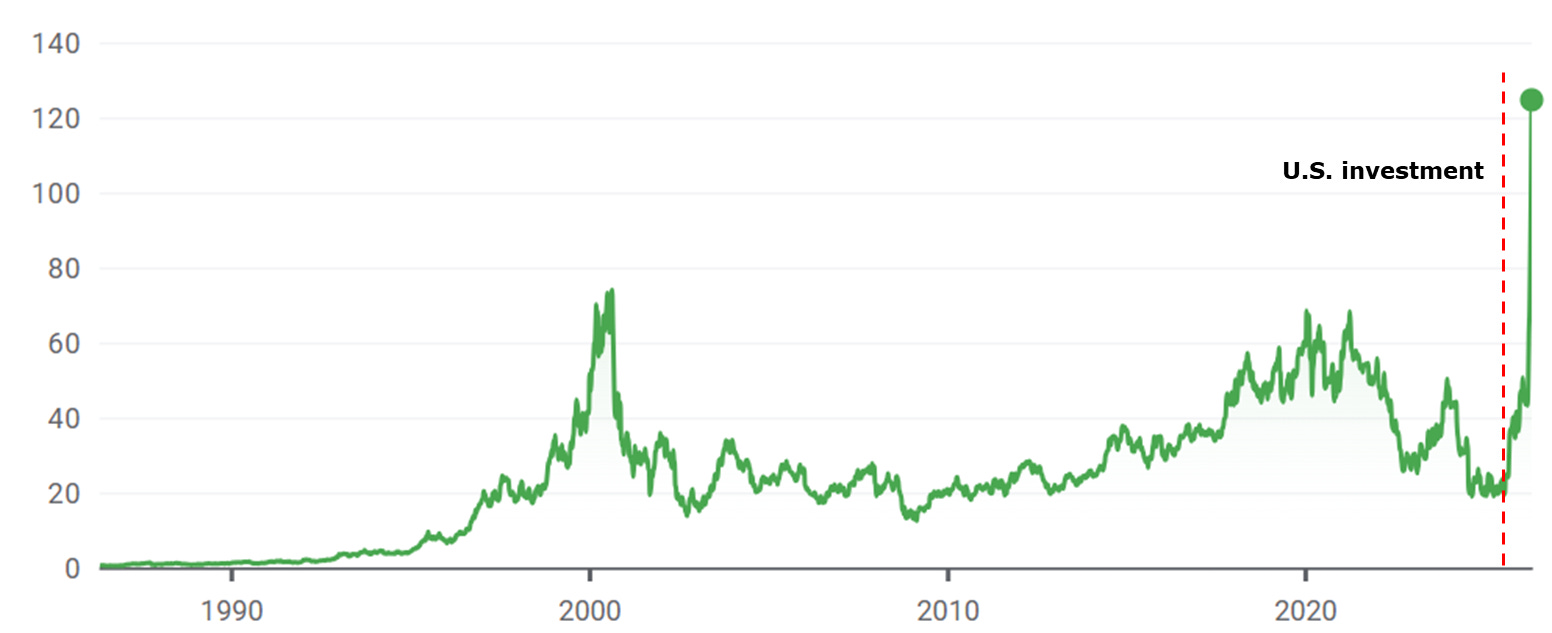
Trading above $125 as of midday Friday, the U.S. government is up about $45 billion. For reference, the entire cost of CHIPS Act support to the semiconductor industry is about $53 billion.
Now look, does this prove that equity investments like these are a good idea? Obviously not. It’s fun, though, to think about what the folks opposed to industrial policy would be saying if Intel were declaring bankruptcy today. One suspects they would consider the case study highly valuable in assessing whether such policy can work.
BACK TO THE LABOR MARKET
If you can’t get a job at Intel, “These Are the Hiring Hot Spots Where College Grads Are Landing Good Jobs” (Wall Street Journal). Birmingham, Alabama is number one. Tampa, Florida is number two. The diffusion of economic opportunity across the United State is one of the most important economic trends to watch, and one where signs continue to be positive.
Also in the Journal, an especially clear articulation of a point we make frequently at American Compass about automation. As Oren put it in Two Cheers for Automation: “A factory that automated half the steps in the production of 10,000 widgets sounds like one poised to eliminate half its jobs. But a factory that trained its workers to produce widgets twice as fast sounds like one poised to double its output to 20,000 widgets daily.” In the Journal’s reporting:
Spotify Technology co-CEO Gustav Söderström puts the choice companies face like this: They can translate productivity improvements right away into cost savings by trimming staff. Or, “the other thing you could do is to say we’re going to be roughly the same amount of people—we’re just going to do more.”
Spotify is doing the latter: “We’re keeping our head count roughly flat and just doing much more shipping, more value to consumers,” he said.
Business leaders risk missing out if their use of AI is overly focused on efficiencies, said Nickle LaMoreaux, chief human resources officer at International Business Machines.
“In your leadership discussions, are you having this idea of moving from AI to productivity to AI to growth?” she said in a recent interview. Though it is hard to predict how many people IBM will employ three years from now, “if I had a crystal ball,” LaMoreaux said, it would be “more.”
That said, the headline here is odd: “AI Is Forcing CEOs to Make a Stark Choice: Lay Off Workers or Make Them Do More.” Rising productivity does not mean “making workers do more.” It means with the same effort they can produce greater output. The actual choice is between “lay off workers or grow their companies.” That is indeed a stark choice, but it shouldn’t be an especially hard one.
In the Financial Times, Gillian Tett writes, “Humans Still Matter More Than AI in Finance.” Expect to see versions of this story a lot over the next year:
A few months ago a New York financier told me he had just experienced a “first”: his 2025 summer interns “were the first true AI natives I have seen”. This meant they had grown up not only among digital tech, but AI too.
So how did it go? He winced. While those wannabe masters of the universe initially seemed wildly impressive, when senior financiers later probed their ideas they found them alarmingly shallow.
Consequently this person’s company made fewer return offers and is now focusing less on graduates in science, technology, engineering and mathematics — and more humanities students instead.
KIDS THESE DAYS
Speaking of the humanities, this is good news: Florida Creates a More Conservative U.S. History Course to Rival A.P.,” (New York Times). Get this: it “recommends a textbook written explicitly to build patriotism.”
Congratulations to Clare Morell on winning a Christian Book Award for The Tech Exit! In “The Christian Book I Didn’t Know I Was Writing,” she reflects on how she “had worked deliberately not to write a ‘Christian book’” although it “did arise from my Christian understanding of the world, of what children are, what true freedom is, what human dignity requires, and the purpose for which human beings are ultimately made.”
And finally, read Clare’s new blockbuster report from the Ethics and Public Policy Center: The Impacts of Digital Technology on Human Relationships: How Smartphones, Social Media, Pornography, and AI Chatbots Threaten Sex, Marriage, and Fertility.
Enjoy the weekend!
“The grand bargain that Mr. Trump wants, establishing a balanced economic relationship between the two nations, is not one that he can get, because the relationship is not one that can exist. The asymmetry of the two economic systems guarantees that any deal with China ends with the United States ripped off.”
So true. They are communists, plain and simple. No way would we be compatible unless we go communist too?! Simple answer yes or no. No usual nihilist approach here with a middle of the road safe don't offend anyone answer. Can't straddle the line, those days are gone. Make a decision. If you decide communist, then as a young person go straight into politics and enter the image making BS game. That's the future for you then. If you go capitalist (hopefully with a small c) then learn to be productive, make stuff, fix stuff, be useful or you will be left behind.
So, like when in the room with someone you can't stand and can't even talk with, leave them and stay away from them. Nothing good will appear. None.
The communists are unreliable, liars, and to be completely ignored, they are bad news period.
(Read your history here)
"Across critical minerals, trade agreements, and the work at the FCC, China containment is advancing on multiple fronts at once. The work is real, and the work can hold. But as Oren warns in the Times, a grand bargain would undermine all of it. — Daniel"